The Compensation Commission established: what comes next, and what challenges Ukraine may face?
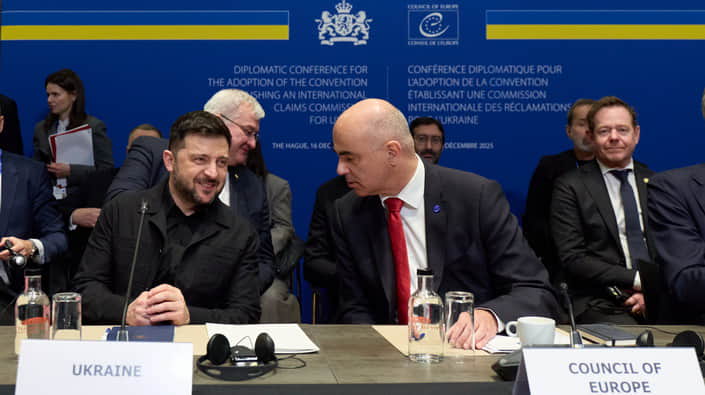
On 16 December, in The Hague, with the participation of the President of Ukraine, 34 states and the European Union signed a convention on the establishment of an International Commission to consider claims for damage caused by Russia's aggression against Ukraine, which, by analogy with its predecessors, is called the "Compensation Commission".
This important event, however, does not mean that the reparations mechanism will start working the next day.
The Convention is yet to enter into force, which requires at least 25 ratifications, technical work on the establishment of the Commission as an institution, and the search for sources from which the awarded compensation can be financed.
And it is this last issue that currently seems the most critical for the future work of the Commission.
Funding challenges
Work on the creation of an international compensation mechanism for Ukraine began in May 2022, when the President of Ukraine established a task force by decree.
Two days earlier, three members of this group – Chiara Giorgetti, Patrick Piersol, and Markiyan Klyuchkovskyi – had published a position paper outlining the future Commission.
More than three and a half years later, and indeed throughout this entire period, the central thesis of that document has remained unchanged:
"No such commission can be considered fully successful without adequate funding for the payment of compensation."
Resolving this issue was crucial to ensuring future reparations, particularly in light of earlier precedents.
Indeed, the United Nations Compensation Commission, which awarded compensation for damage resulting from Iraq’s aggression against Kuwait in 1990–1991, was funded by payments that Iraq made voluntarily over a period of nearly three decades.
In the case of Russia, however, there is clearly no prospect of a voluntary agreement to pay reparations.
There is, therefore, a risk of repeating another precedent: the Eritrea–Ethiopia Claims Commission. Established in 2000, this international institution considered mutual claims and awarded compensation; however, neither party voluntarily complied with its awards, and no separate enforcement or financing mechanism was created.
Consequently, the search for mechanisms to finance future reparations has been one of the most important processes unfolding in parallel with the establishment of the Register of Damage and the Compensation Commission for Ukraine.
No decision
"Russia’s sovereign assets in our jurisdictions will remain frozen until Russia pays for the damage it caused to Ukraine." This formula has been repeatedly used in statements by the Group of Seven and the European Union since at least the summer of 2023.
On the one hand, such language affirmed Russia’s obligation to compensate Ukraine. On the other, it fostered hopes – or perhaps illusions – that Russia might voluntarily agree to pay reparations.
Most importantly, this formula served as an argument for refraining from a decision to confiscate approximately $300 billion in Russian Central Bank reserves frozen abroad (around $200 billion of which are held in Belgium and Luxembourg).
These assets were regarded by Ukraine as the primary source of compensation for losses resulting from Russia’s aggression.
At a certain point, however, a clear dichotomy emerged: while the Ukrainian government supported both the creation of an international compensation mechanism and the confiscation of Russian assets, these two processes were not treated as mutually reinforcing or institutionally linked.
That is, in the event of confiscation, the intended purpose of these funds was envisioned as separate from the financing of reparations.
At a press conference following the signing of the convention establishing the Compensation Commission, President Volodymyr Zelenskyy, commenting on the fate of these assets, referred specifically to Ukraine’s urgent needs rather than to financing the reparations awarded by the Commission:
"We expect that we can receive €40-45 billion for 2026 and beyond, counting on a total amount of €210 billion… We need to produce drones. We lack funding. We need to produce other weapons. We need to buy air defence systems in America and Europe."
It is precisely the coverage of Ukraine’s immediate financial and military needs over the next two years that the Ukrainian government views as the primary – and almost exclusive – purpose of a potential $140 billion "reparations loan."
This position, however, is largely a forced one: earmarking confiscated assets directly for reparations did not generate enthusiasm among European officials during discussions on the fate of Russian assets frozen within the EU.
As a result, the question of how to finance reparations becomes an even more acute challenge.
Dead lock
As far as is known, since at least the summer there have been efforts to persuade stakeholders in Brussels and Kyiv to direct at least part of the frozen Russian assets or the proposed "reparations loan" toward financing priority reparations. Although the first payments are unlikely to be made before 2029, experience shows that such discussions are not premature; on the contrary, they might well have begun much earlier.
The European Commission’s draft decision on the "reparations loan" includes an option to allocate part of the funds to a Compensation Fund, to be established following the creation of the Compensation Commission. However, first, the amount envisaged would clearly cover only a small fraction of the overall need; and second, the terms and structure of the loan decision remain subject to change.
At the same time, alternative financing mechanisms are also being explored.
In a recent interview, Markiyan Klyuchkovskyi suggested, in particular, considering the model used in the case of Iraq – namely, the imposition of duties on energy exports:
"It is possible to reach a compromise under which certain sanctions are eased in exchange for 5, 10, or 15 percent of export proceeds being directed to a compensation fund."
However, this solution may prove politically difficult, and not only because of Russia’s position. In theory, such duties could be imposed on imports rather than exports.
This, however, could inadvertently stimulate the purchase of Russian energy resources, whereas efforts in recent years have focused on reducing the Russian energy sector’s export opportunities.
At the same time, there is a growing risk that certain categories of victims and types of harm will begin to be addressed separately from, or in parallel to, the compensation mechanism. For example, advocacy is already underway for the funding of "interim reparations" for victims of conflict-related sexual violence (CRSV).
In the absence of clarity on how reparations will be financed, such "fragmentation of the reparations process" is likely to intensify.
* * * * *
The establishment of the Compensation Commission, as well as the earlier creation of the Register of Damage, represents a major achievement of Ukrainian diplomacy. The pursuit of compensation for damage caused by aggression has arguably become Ukraine’s most effective effort to hold Russia accountable.
However, without a clear understanding of the conditions – and, most importantly, the practical reality – of compensation, these efforts risk being undermined, with potentially serious consequences for public trust in the state.
Resolving this issue will be possible only if it becomes a genuine priority for the Ukrainian government. At present, as far as is known, such awareness is insufficient within the Cabinet of Ministers’ economic bloc.
The formal creation of institutions alone is not enough: they must be capable of delivering tangible results and fulfilling their intended purpose. The compensation mechanism for Ukraine should aspire to become the most successful reparations precedent in history.
The necessary prerequisites for this have already been put in place.
Ivan Horodysky,
Lawyer of the Dnistrianskyi Center
This material was prepared with the support of the International Renaissance Foundation as part of the project "#Compensation4UA / Compensation for War Damages to Ukraine. Phase V: Interim Reparations for Victims of Russian Aggression against Ukraine – Exploring Approaches, Needs and Solutions."