Off track from Europe: who in Kyiv is undermining Ukraine’s European integration?
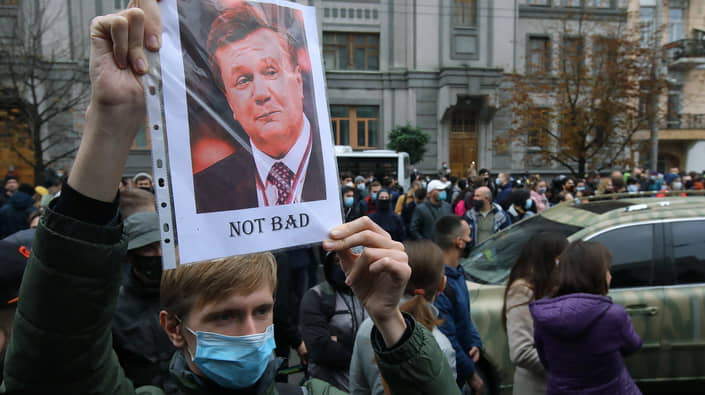
Remember 2020? Not COVID, but the real constitutional catastrophe, when the Constitutional Court of Ukraine (CCU) attempted to destroy electronic asset declarations. The motion to the Court was initiated by 48 MPs: remnants of the pro-Russian Yanukovych-era system, representatives of the Opposition Platform – For Life (OPZZh), and people linked to oligarch Ihor Kolomoiskyi. The CCU didn’t stop there – it also tried to roll back the language and land reforms.
The country was balancing on the edge of a new crisis.
Protests near the Constitutional Court showed that society would not tolerate such actions. President Zelenskyy even contemplated suspending the Court, warning that "we don’t know what kind of surprise the Constitutional Court might deliver tomorrow or the day after." The Venice Commission also sided with Ukraine, sharply criticising the CCU’s attempt to "usurp the role of the parliament."
However, dismissing the CCU by presidential decree would have been just as legally questionable. Instead, the Ukrainian government, together with European partners, decided to launch a reform of the Constitutional Court. It was a step Ukraine should have taken earlier, now made necessary by what was essentially a constitutional coup.
At the core of this reform was to be a transparent, merit-based judicial selection process.
Ukraine fulfilled its promise, albeit belatedly, and only when the reform became a condition for continuing its path toward the EU. Yet the progress did not last.
Today, one of the most significant positive developments in Ukraine’s judiciary, and a key EU requirement, has been effectively blocked.
Another critical EU condition, that of broader judicial reform, has also become deeply problematic. To this day, there is no clarity on what to do with the compromised Supreme Court.
This article explains the core obstacles Ukraine faces in this domain.
The constitutional block
The constitutional justice reform promised to the European partners was not implemented immediately by the Ukrainian government. Once the attack by the Constitutional Court on reforms had been repelled, the desire to change anything substantially disappeared.
This issue was revisited in 2022, when the competitive selection of CCU judges became the first of the seven conditions defined by the EU when granting Ukraine candidate status for accession to the European Union.
Kyiv was to determine the details of this procedure independently. The EU demanded one thing: judges could no longer be appointed in backroom deals, according to political quotas. There had to be an independent commission, competition, and transparent criteria. And most importantly, international experts who would have a decisive role in the selection.
At that stage, Ukraine fulfilled the EU’s requirements. The procedure was approved. A commission was established – it was named the Advisory Group of Experts (AGE). Competitions to fill vacancies in the CCU took place under the new procedure, and the candidates selected based on the results successfully passed integrity checks and confirmed their political independence.
Two judges, Alla Oliynyk and Serhiy Riznyk, were appointed back in 2024 by the Congress of Judges and by Parliament. This gave hope that the Constitutional Court would finally consist of independent judges, and that the constitutional provision stating that judges must have high moral character and recognised competence would finally be given real meaning.
But that was it. No new judges have been appointed.
Even though three months ago, in February, the AGE submitted lists of candidates for positions to the Parliament and the President. However, there have been no decrees, nor any decisions by Parliament. And the more time passes, the more obvious it becomes that the delay is not bureaucratic. The real reason is that these candidates are too independent. Which means – not controllable.
Meanwhile, as of January 2025, after the term of office of three CCU judges expired simultaneously, the Constitutional Court lost its quorum: it now has 11 sitting judges and seven vacant seats. Without at least 12 filled seats, the Court has no right to issue any decisions. So both the judges and the entire staff of the CCU are merely receiving salaries without being able to work.
But the issue is not just about money.
Is it even necessary to explain how dangerous it is not to have a functioning Constitutional Court at a time when dubious decisions may arise concerning martial law, elections, or potential international agreements that could cause heated societal debate, as was the case with the "subsoil dealt"?
In 2020, Zelensky demanded the immediate cleansing of the Constitutional Court. But in 2025, he is ignoring the results of the selection procedure that he himself supported. And if the European Union does not react firmly and clearly now, this may become a signal to cancel the competition entirely. This has already happened before: in 2022–2023, the president did not appoint two candidates to the High Council of Justice under his quota, and the competition was cancelled. This traps us in a loop: international experts recommend "too independent" candidates, they are not appointed, the competition is cancelled, the quorum is lost, and the cycle repeats.
The "solution" is obvious – remove international experts, appoint "our people", and return to the Tupitskyi era. But if that happens, this will not only be a constitutional crisis, but a direct threat to European integration, because let’s emphasise again – this reform is the first of the seven, for which we have already been granted significant progress and a large credit of trust. And trust, as you know, is very easy to lose.
Judicial reform: second condition – second backslide
Second on the list of the seven EU conditions was the reform of the High Council of Justice (HCJ) and the High Qualification Commission of Judges (HQCJ). These two institutions are key in the judicial system: the HQCJ is responsible for selecting judges, and the HCJ – for their appointment, dismissal, and disciplinary accountability.
At the time, Ukraine presented the implementation of this condition as a victory – and it had grounds to do so.
Even before receiving the EU’s "candidate checklist," since 2021, these institutions began undergoing cleansing. International experts were involved in the Ethics Council, which did the selection of HCJ members, and in the Selection Commission for HQCJ – they had a prevailing vote. It was this that enabled the judicial system to move forward from its deadlock.
The HQCJ was formed in its new composition and began work.
Since November 2023, the HQCJ has submitted for dismissal 50 judges, including "Maidan judge" Andriy Klyuchnyk, the scandalous Inna Otrosh, and the District Administrative Court of Kyiv judge Petro Kovzel, etc.
The Commission is now moving closer to assessing judges of the Pechersk District Court and the liquidated odious District Administrative Court of Kyiv (DACK). By suspicious coincidence, at this exact time, the State Bureau of Investigation (SBI) began initiating multiple criminal cases and conducting searches connected to the activities of HQCJ members.
At the same time, in June this year, the tenure of international experts in the HQCJ Selection Commission is coming to an end. If the SBI manages to pressure one or two more HQCJ members into resignation – a new selection process for this body will be announced. And the new members will be chosen not by independent experts, but by the odious Council of Judges, as well as the Council of Prosecutors and the Bar Council.
The head of the Council of Judges is Bohdan Monich – a protégé of judge Pavlo Vovk, while the Bar Council is led by Lidiya Izovitova – a long-time ally of Medvedchuk.
We can only imagine what kind of people would enter such an important body, and how they would select 550 appellate judges and 1,800 first-instance judges.
And what about the High Council of Justice?
Here, the authorities are attacking not people, but the mechanism. MPs led by Denys Maslov, head of the Verkhovna Rada Committee on Legal Policy, have initiated a draft law that effectively eliminates disciplinary liability for judges.
If it becomes law, the dismissal of judges caught drunk driving, taking bribes, traitor judges, and many others will become practically impossible.
Under such circumstances, abandoning independent international experts in selection commissions would be a fatal mistake.
The authorities understand this, yet do not change course. For example, the EU Rule of Law Roadmap includes a transition to selecting candidates "with an emphasis on the capacity of judicial self-governance bodies" – without a single mention of international involvement. And not sometime later, but already in the near future (implementation deadline – mid-2026). "Judicial self-governance" refers to the aforementioned Council of Judges, which systematically delegates individuals with a "negative" reputation to commissions.
Of course, international experts are not to remain in Ukraine’s decision-making system forever. But now is certainly not the time to remove them. On the contrary, their involvement must be strengthened and expanded until the EU itself confirms that our system is no worse than theirs.
Otherwise, we may soon find ourselves at a point where two of the seven conditions for which Ukraine received candidate status and opened EU accession talks will collapse. And then, there will definitely be more than one country opposing our accession.
The Supreme Court – a problem everyone sees, except the authorities
When discussing backsliding in judicial matters, it’s impossible not to mention the notorious Supreme Court.
Russian passports held by judges, corruption scandals, rulings that sabotage reform – these are what come to mind when speaking of the country’s highest judicial institution. Over the past two years, the European Commission has twice emphasised in its reports the need to reform the Supreme Court. This is also mentioned in the aforementioned Roadmap, but the wording is extremely vague, with no mention of international expert involvement in the selection of judges.
This gives the authorities room to propose cosmetic changes instead of a genuine reform.
For example, on May 27, the Verkhovna Rada’s Committee on Legal Policy supported draft law No. 13165-2, which effectively introduces a fake integrity check for Supreme Court judges. MPs managed to produce an even worse version than the previous drafts. According to this version of the draft law, judges of the highest court won’t be subject to real checks – it’s enough to simply review their asset declarations for the past year. Everything before that is officially "forgotten."
Unfortunately, this has become yet another example of how the authorities use vague EU requirements to imitate judicial cleansing.
It has been said many times that our international partners must spell out requirements as clearly as possible to reduce space for manipulation.
However, the EU’s willingness to offer Ukraine more flexibility does not mean readiness to approve fake reforms. So if this law is adopted, it will be yet another reason not to give Ukraine the green light for accession, even among those EU states most supportive of reforms.
What could still save the process?
Ukraine’s authorities should not count on these backslides going unnoticed by international partners.
Under no scenario does the European Union want to welcome into its ranks a country that, by its actions, shows an intention to return its judicial system to the Yanukovych era. And this is not metaphorical – until 2013, judges were selected by representatives of judicial self-governance, the bar, and prosecutors. The quality of such selections was evident.
But it is now time for international partners to formulate very concrete demands for Ukraine, including:
International experts must remain in the selection procedures until Ukrainian institutions are reformed. The Venice Commission has already stated this in its opinion.
Judges of the CCU selected through the new competition must be appointed immediately by the Congress of Judges, the Parliament, and the President.
The law on the Supreme Court must provide for a thorough integrity check and transparent selection of a new composition.
Any ambiguity in the Roadmap or other documents guiding our path toward the EU can be interpreted in favour of imitation and backsliding, not genuine reform. That’s why all further requirements and conditions for our accession must be clearly outlined in all documents.
Ukraine has already passed an extraordinarily difficult road. Including in reform, and in fighting for its identity and European belonging. But today we have reached a point where this path can be derailed not only by external enemies, but by internal saboteurs.
There is still time to get the process back on track – but that will require a more serious approach. Interim benchmarks from the EU can illuminate the path, but walking it is a task only the Ukrainian government can fulfil. And time is running out.
Mykhailo Zhernakov, Executive Director of the DEJURE Foundation
Kateryna Shevchuk, Communications Manager at the DEJURE Foundation