NATO declaration on Ukraine and defence spending: full text with explanations
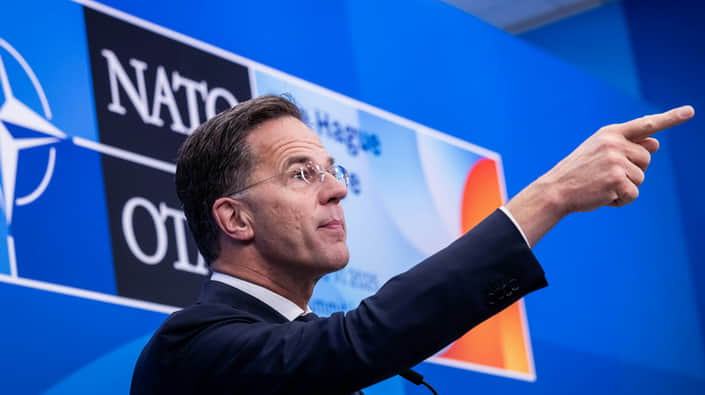
The NATO leaders’ meeting in The Hague has concluded.
This was the first summit since Donald Trump’s victory in the 2024 elections. Given the unpredictability of the current US president and his long-standing scepticism about international meetings, many people had concerns about this gathering.
On his way to the summit, Trump added fuel to the fire by stressing that he would only announce his stance on collective defence, namely NATO Article 5, in The Hague.
One cause for concern was the lack of clarity up until the very last moment about whether the Alliance would reach a consensus on increasing defence spending to 5%, as demanded by the United States (more details in this article: A million euros a minute: inside NATO’s Hague summit, where success and setbacks meet).
However, the final document puts those doubts to rest. As expected, the declaration is relatively brief, but clearly positive for Kyiv.
Only two non-member states are mentioned in the declaration: Russia, which is uniquely identified as a "long-term threat" (even China was not mentioned), and Ukraine, whose defence is recognised as a priority for the Alliance.
European Pravda is publishing the full text from The Hague, with key provisions highlighted and explained in blue italics.
* * * *
1.
We, the Heads of State and Government of the North Atlantic Alliance, have gathered in The Hague to reaffirm our commitment to NATO, the strongest Alliance in history, and to the transatlantic bond. We reaffirm our ironclad commitment to collective defence as enshrined in Article 5 of the Washington Treaty – that an attack on one is an attack on all.
This may sound like a formality, but it holds special weight for NATO countries. At the very first summit since Trump’s election victory, the United States has supported this unequivocal wording and has not attempted to soften it.
We remain united and steadfast in our resolve to protect our one billion citizens, defend the Alliance, and safeguard our freedom and democracy.
2.
United in the face of profound security threats and challenges, in particular the long-term threat posed by Russia to Euro-Atlantic security and the persistent threat of terrorism, Allies commit to invest 5% of GDP annually on core defence requirements as well as defence– and security-related spending by 2035 to ensure our individual and collective obligations, in accordance with Article 3 of the Washington Treaty.
The United States has agreed to language that is fully aligned with the European and Ukrainian vision.
Russia is defined as a joint threat to the entire transatlantic space, and thus to the US itself, and is specifically described as a long-term threat. This means the issue cannot be resolved through short-term tactical agreements such as US-Russia talks.
The threat posed by Russia is cited as the key reason why NATO has agreed that all members without exception must raise defence spending to 5%, just as Trump wanted.
Our investments will ensure we have the forces, capabilities, resources, infrastructure, warfighting readiness, and resilience needed to deter and defend in line with our three core tasks of deterrence and defence, crisis prevention and management, and cooperative security.
3.
Allies agree that this 5% commitment will comprise two essential categories of defence investment. Allies will allocate at least 3.5% of GDP annually based on the agreed definition of NATO defence expenditure by 2035 to resource core defence requirements, and to meet the NATO Capability Targets. Allies agree to submit annual plans showing a credible, incremental path to reach this goal. And Allies will account for up to 1.5% of GDP annually to inter alia protect our critical infrastructure, defend our networks, ensure our civil preparedness and resilience, unleash innovation, and strengthen our defence industrial base.
These arrangements have been known since spring (European Pravda has covered them in detail). The 5% GDP target comprises two parts: 3.5% and 1.5%. The larger portion is "hard security" – funding for the armed forces. The smaller portion covers security-related infrastructure projects (such as building transport routes and financing the defence industry).
The trajectory and balance of spending under this plan will be reviewed in 2029, in light of the strategic environment and updated Capability Targets.
Allies reaffirm their enduring sovereign commitments to provide support to Ukraine, whose security contributes to ours, and, to this end, will include direct contributions towards Ukraine’s defence and its defence industry when calculating Allies’ defence spending.
This is a crucial element for Ukraine. All NATO members declare their unwavering commitment to continue financing the Ukrainian Armed Forces and state that Ukraine’s defence is part of ensuring the Alliance’s own security.
NATO Secretary General Mark Rutte has stated (with US approval) that this provision serves as a "bridge to membership" for Ukraine, as agreed at last year’s Washington summit. He has also emphasised that the wording about "Ukraine’s irreversible path to NATO" introduced under Biden remains in force. Acceptance of this by the Trump administration is a key achievement.
Notably, although this provision directly contradicts Hungarian government policy, Orbán did not veto it, once again confirming he is willing not to block Ukraine-related decisions if they have US backing.
4.
We reaffirm our shared commitment to rapidly expand transatlantic defence industrial cooperation and to harness emerging technology and the spirit of innovation to advance our collective security. We will work to eliminate defence trade barriers among Allies and will leverage our partnerships to promote defence industrial cooperation.
This point is broadly worded, but the general goal of eliminating barriers to the arms trade among NATO members is positive. It gives Ukraine greater confidence in the possibility of purchasing US arms for its military. However, there is no firm obligation here, nor can there be. For example, Türkiye faces difficulties purchasing high-tech US military equipment due to its ties with the Kremlin. Hungary may face similar restrictions because of its cooperation with China.
5.
We express our appreciation for the generous hospitality extended to us by the Kingdom of the Netherlands. We look forward to our next meeting in Türkiye in 2026 followed by a meeting in Albania.
An interesting detail: the next two summits will be held in Muslim-majority NATO countries. It is currently unclear whether this is a signal (perhaps from the US) or simply a coincidence.
The Hague, Netherlands
25 June 2025