No promises, just funding: NATO Hague summit to approve new ways to support Ukraine in fight
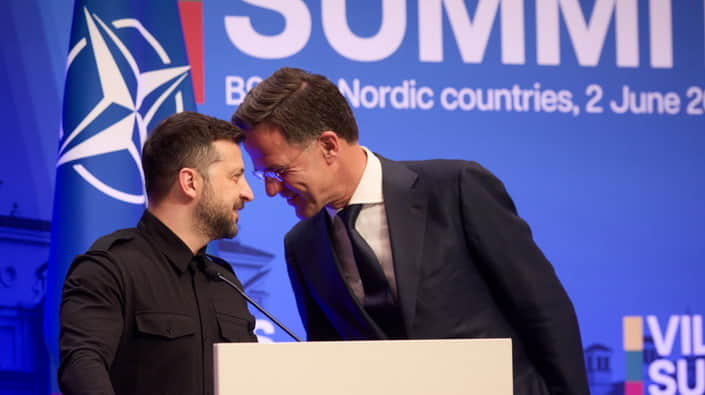
The Summit is less than three weeks away.
Unlike the chaotic and last-minute decisions seen during the Trump administration, this year’s summit appears to be more organised. The Alliance already has a clear vision of how the summit in The Hague will unfold, what role Ukraine will play, and the general outline of the decisions expected following the meeting of leaders.
The United States and the pro-Ukrainian members of NATO – which includes the host country, the Netherlands – have come to a compromise: Ukrainian President Volodymyr Zelenskyy will be officially invited to The Hague. He will participate in one of the summit’s formal events, although no official meeting of the NATO-Ukraine Council is planned.
Two issues are at the heart of NATO’s relationship with Ukraine – and both will take centre stage at the summit: first, Ukraine’s path to NATO membership; second, the continuation of military aid and securing the funding for it.
The NATO summit is not expected to bring bad news for Ukraine for either point.
The Alliance has agreed on a compromise that maintains its current policy of Ukraine’s irreversible path toward membership. Although Trump and his team have repeatedly signaled a willingness to make concessions to the Russians, this has so far been avoided. The decisions expected to be adopted in The Hague are likely to be safe for Ukraine
However, there is an ongoing debate over how the summit’s conclusions will address Russia. This remains uncertain and could result in either favourable or less favourable outcomes.
Still, the prospects for military aid to the Ukrainian Armed Forces are more than promising. NATO is leaning toward a scheme that will simplify the funding of weapons supplies to Ukraine, especially on supporting equipment produced by Ukraine’s own defence industry.
A summit for the rearmament of Europe
First, a topic that does not directly concern Ukraine but is crucial for the Alliance – and will ultimately affect Ukraine as well.
"A new defence investment plan will be at the heart of the summit in The Hague," NATO Secretary General Mark Rutte said in Brussels on 4 June. His words deserve a closer examination.
Even before taking office, Donald Trump warned that he would demand a sharp increase in defence spending from NATO partners.
However, the level of US demands, which the White House presented in early spring, shocked many. The proposal called for NATO’s defence spending benchmark to rise sharply – from 2% to 5% of GDP.
Over two months ago, Secretary of State Marco Rubio attended a ministerial meeting in Brussels with a clear message: the 5% demand was not a joke.
As participants later revealed off the record, Rubio warned the partners: either they accept the US demand, or Trump would reduce the American military presence in Europe.
However, as European Pravda had anticipated, the 5% demand turned out to be flexible in practice. Washington agreed to a compromise. Real defence spending in European countries is expected to rise to 3–3.5% of GDP, while the remaining 1.5–2% would be covered by projects not directly related to the military – initiatives that were not previously classified as "defence spending."
Examples include road construction (which could be used by tanks if needed), communications infrastructure, or funding for cybersecurity projects, and so on.
This gives Trump the opportunity to claim that his 5% demand has been met, while keeping defence spending at a level that most European countries can realistically meet.
In any case, this implies hundreds of billions of dollars in weapons procurement.
In 2024, European NATO members together spent nearly $500 billion on defence, or 2% of their combined GDP. An increase to 3% would mean an additional $250 billion annually. Up to half of that could go directly towards weapons and ammunition.
These are unprecedented sums for the European defence industry.
And the key point: it’s not just about money.
Twice as many troops
While media coverage often focuses on defence spending in terms of billions or percentages, NATO is in fact focusing on a different metric. The Alliance has prepared a classified document on "capability targets", which outlines the number of brigades and key weapon systems each NATO member must possess for effective collective defence.
On 5 June, defence ministers are expected to officially approve these targets, which will serve as the basis for summit decisions on increased defence spending.
As Secretary General Mark Rutte explained, the document outlines the requirements for core defence capacities, including the scale of air and missile defence systems, the number of long-range weapons held by allies, ground brigades and key logistics parameters.
A radical expansion of European armed forces is now underway.
Currently, NATO operates under capability targets approved in 2021, prior to Russia’s full-scale invasion of Ukraine.
Back then, most NATO politicians underestimated the risk of a direct Russian attack on the Alliance, even as military officials insisted on significantly building up the armed forces. Media reports indicate that the 2021 approved targets required NATO’s European members to maintain 80 brigades
Four years later, those targets remain unmet. For instance, Germany currently has 20% fewer brigades than its 2021 requirement.
The new document presented to ministers now proposes a much larger increase in European armies. According to Reuters, the target may rise to 130 brigades.
Given the existing shortfall of approximately 20%, this would mean European NATO armies would need to nearly double in size.
No clear timeline, but up to 10 years for expansion
The timeline for troop increases has not been disclosed. However, based on statements to journalists by NATO representatives, the full expansion is unlikely to take more than ten years. This schedule is to be synchronised with the planned increases in defence budgets to 3–3.5% of GDP. Army growth will also be inevitable, given that allied militaries are expected to significantly expand their arsenals and trained personnel will be needed to operate and maintain the new equipment.
NATO emphasises that capability targets are the top priority – more important than the overall amount of military spending.
"What matters to us is that they fulfil what they committed to… If a country fails to meet the targets, it puts other partners at risk," explained a senior NATO official during a media briefing in Brussels this week.
The US has also underlined the importance of following through, warning that they won’t allow a repeat of past failures. For example, at the 2014 Wales Summit, all NATO members pledged to raise defence spending to 2% of GDP, but only a few seriously intended to meet that goal. By 2021, only six members had reached the benchmark.
"There is not unlimited time. We cannot have another Wales Pledge style," declared US Ambassador to NATO Matthew Whitaker on Wednesday.
Money for Ukraine
This sharp increase in NATO defence spending, soon to be formally pledged to Trump by alliance leaders at the summit in The Hague, is expected to benefit Ukraine.
While NATO has avoided detailed public statements on this topic for now, the Secretary General has publicly assured that Ukraine will at the very least not be affected by the changes.
"It would be strange and not wise if NATO would take decisions on spending more in such a way that it would somehow work against Ukraine, getting what it needs going forward to stay in the fight and be in the best possible position in the peace talks. We will design the new investment plan in such a way that it will not impact the way our Allies are working with Ukraine to make sure that you have what you need to stay in the fight," said Secretary General Rutte, responding to a question from European Pravda ahead of the ministerial meeting.
He did not comment on questions about the specific funding scheme for Ukraine’s Armed Forces, which is also expected to be finalised in The Hague. US Ambassador Whitaker likewise declined to elaborate, telling EP that member states are "in the middle of negotiating."
As mentioned earlier, the planned 5% defence spending is to be split into two categories:
- 3.5% for hard security (e.g., weapons procurement, military salaries, etc.)
- 1.5% for security-related spending, (e.g., infrastructure projects)
Ukraine is expected to be eligible for funding support under both.
As of now, NATO members already count some of their military aid to Ukraine – such as purchasing new equipment – as part of their official defence spending. That practice is expected to continue.
"Military support to Ukraine is already part of the 'hard security' category and will remain so," confirmed one Alliance representative, speaking anonymously due to the political sensitivity of discussions ahead of the summit approval.
A new opportunity is also being considered: The Hague summit may allow Ukraine-related aid to be counted under the 1.5% security-related category as well. Secretary General Rutte reportedly outlined this option in a confidential letter to member governments.
However, this letter caused some confusion among allies. Some interpreted it as suggesting all Ukraine-related aid should be shifted from the "hard" to the "soft" category. According to one EP source, Ukraine has since urged Allies and the Secretary General to reconsider this approach, as the 3.5% "hard" category is expected to include a larger share of available funds than the "soft" one.
European Pravda could not confirm whether Mark Rutte intended such a shift in accounting. For now, the prevailing view within NATO is that Ukraine will receive aid through both budget lines.
"We want to give allies maximum flexibility in deciding which component to use for Ukraine-related aid," explained a high-ranked official involved in shaping NATO’s new capability targets during a press briefing in Brussels.
According to the official, this allocation will depend on the type of assistance:
"Not everything we give to Ukraine can be counted as military support," the official said, citing logistics or infrastructure aid as examples – while declining to share further details due to ongoing talks.
It remains unclear whether NATO is considering classifying resilience and reconstruction aid to Ukraine under the "soft security" spending. If adopted, that would indeed mark a breakthrough decision.
Lifeline aid for Ukraine
The increase in NATO’s defence budget targets – combined with the permission to include aid to Ukraine within those categories – is expected to significantly benefit Ukraine’s Armed Forces (AFU).
There is, however, every reason to believe that NATO states will struggle to spend the sums now required by the US.
German Defence Minister Boris Pistorius acknowledged this on Wednesday. The difficulties in meeting even the far more modest 2021 goals – such as increasing personnel in European armies – are already well known. Another major challenge is the limited capacity of Europe’s defence industry, which, despite entering the fourth year of full-scale war on its borders, still hasn’t scaled up enough to meet demand from European defence ministries.
Canada is expected to face even greater difficulties in meeting Trump’s demands. As a country that shares its only land border with the United States and has not, until recently, faced a direct military threat, remains far below the 2% defence spending benchmark. In 2024, the Canadian government allocated just 1.37% of GDP to defence – the fifth-lowest level among NATO members.
"Even with sufficient funding, Ottawa still faces a major challenge in actually getting those dollars out the door. Auditors found last month they failed to meet the procurement strategy's rules across a dozen contracts," writes Globe and Mail, concluding that the 3.5% target is unrealistic for the country.
Another example is Luxembourg, which currently spends 1.29% of GDP on defence, the third-lowest level in the alliance. This small yet wealthy nation simply lacks the capacity to raise its military spending to the levels NATO demands.
Thus, many NATO states may seek to "compensate" for their own shortfalls by increasing their Ukraine-related spending.
This could include leveraging Ukraine’s growing defence industry, growing much faster than many NATO countries. A new proposal to create an "industrial Ramstein," – a coordinated initiative for weapons production – may offer European leaders another way to demonstrate progress in fulfilling defence promises made to the US.
Additionally, discussions are underway about adjusting the 3.5% / 1.5% spending split for certain countries, such as Luxembourg, allowing a greater share to be allocated to "soft security," – which includes non-lethal support to Ukraine.
Of course, support for the Ukrainian Armed Forces cannot fully substitute for Europe's own rearmament.
"It’s not a matter of choosing between helping Ukraine and building our own military capabilities. We need to do both!" explained a senior NATO official.
Across the board, sources emphasised that The Hague summit is expected to result in a consensus on raising both defence and security-related spending.
Membership question: no breakthroughs, but no betrayals either
We’ve focused so much attention on defence spending for one simple reason: it will be the only topic that NATO leaders will discuss in depth and adopt decisions on at the summit.
It is already known that allies have agreed to keep the final summit communiqué very short. Some predict it will contain up to five key points.
For comparison, the Washington summit’s final declaration – including its section on Ukraine – had over 40 points. The Vilnius declaration had 90.
Oddly enough, this brevity works in Ukraine’s favour.
The reality is that, under the current phase of Donald Trump’s presidency, it is impossible to achieve the kind of ambitious language on Ukraine that was included in the Washington Declaration. That declaration, as a reminder, stated that Ukraine is on an "irreversible path to NATO membership."
"This decision remains in force," NATO Secretary General Mark Rutte reiterated this week in Brussels.
Trump, as is well known, has publicly declared that he is prepared to block Ukraine’s NATO accession in response to Kremlin demands. Therefore, any attempt to reach a compromise acceptable to the White House would almost certainly result in a legally codified step back from NATO’s ambitions regarding Ukraine.
By contrast, the current approach, where NATO deliberately avoids any topic other than defence financing, is the only way to preserve Ukraine’s current status in its relationship with the Alliance.
Does this mean Ukraine will be completely excluded from the summit communiqué? Not necessarily.
A reference to Ukraine aid funding could very well be included.
After all, it would be difficult to avoid mentioning Russia. What else, if not Russia’s war, could justify the sharp rise in defence spending and the revision of NATO’s capability goals?
This is where perhaps the biggest intrigue of The Hague summit lies:
Will other allies succeed in convincing the US to accept stronger language on Russia?
That remains unresolved – and will likely stay open until the final days before the summit.
Another unanswered question is what exactly President Zelenskyy will do in The Hague.
Ukraine, like other NATO partners (such as Japan and South Korea), has been invited only to the first day of the summit – to the official leaders’ dinner. There will be no plenary sessions involving partners.
But will there be a meeting with Trump? And if so, in what format?
Those negotiations are still ongoing.
Sergiy Sydorenko,
Editor, European Pravda, from Brussels