Fascism at the doorstep: how Poland has changed and what threatens its democracy
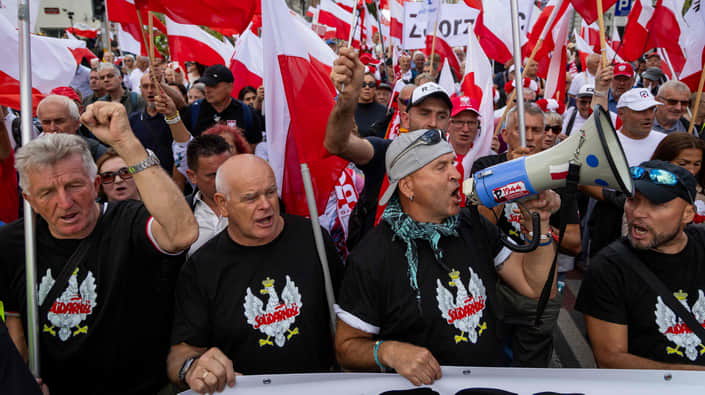
On August 6, Karol Nawrocki was sworn in as Poland’s new president.
As a little-known candidate with a shady past, his victory over the clear favorite, Warsaw Mayor Rafał Trzaskowski, has severely weakened Prime Minister Donald Tusk’s liberal ruling coalition.
A reporter for Krytyka Polityczna notes that left-wing and centrist voters are now behaving as if someone had died.
"A strong leader who can break the rules"
Unlike the previous president, Andrzej Duda, Nawrocki will not serve as a mere passive executor of Law and Justice (PiS) party leader Jarosław Kaczyński’s will. On the contrary, though he was endorsed by PiS, he may well be a new exponent of the far right and one of the forces shifting Poland’s political landscape.
There are already signs that Sławomir Mentzen’s Confederation could replace PiS as the main political force on the right.
If so, the Tusk-Kaczyński duopoly that has ruled Poland since 2005 could give way to a new duopoly comprising the far right (Confederation) and the far left (represented by Adrian Zandberg’s Together).
Such is the conclusion of a recent sociological study that I conducted with Przemysław Sadura of the University of Warsaw (which sparked much heated debate in Poland).
Nawrocki’s victory reflects a massive consolidation of the right around a common candidate. Key to his success was the transfer of support from the Confederation: as much as 34% of the votes cast for Nawrocki in the second round came from those who had voted for Mentzen (who received 14% in the first round) or Grzegorz Braun (6%), an openly anti-Semitic ex-Confederation politician, in the first round.
Polish society has become much more radical overall.
According to one measure, voters for all right-wing candidates scored above a four on a five-point radicalization scale, and those supporting Trzaskowski and other left-wing candidates also scored high.
The public’s acceptance of "radical politicians" and dissatisfaction with a lack of "authentic" leaders has become widespread.
But the right has managed to channel these sentiments much more effectively than the center and the left.
A willingness to accept authoritarianism has also increased across the electorate. All voter groups now voice support for a "strong leader who can bend the rules." Even Trzaskowski’s supporters scored 3.28 (above the neutral level) on this scale.
As Poles’ appreciation for democracy has declined, anti-system attitudes have become almost universal. Regardless of political orientation, a majority agrees that "the current political system is so dysfunctional that it cannot be repaired." Voters’ preferred solutions vary, but the intensity of their discontent does not.
This helps to explain how Nawrocki weathered so many scandals during the campaign, including allegations that he had extorted an apartment from an elderly man and participated in football hooliganism.
The liberal media’s coverage of these issues paradoxically strengthened his position as an "authentic" anti-establishment candidate. In the end, he became a symbol of the popular opposition to elites.
Commentators and surrogates for Trzaskowski displayed open contempt for Nawrocki and his supporters, and this classist dynamic further galvanized voters who can never hope to identify with "salon Poland."
While liberals framed the election as pitting Poles against idiots, the right framed it as a struggle between patriots and traitors.
We now know which was more effective.
A new face of a right Poland
The original source of the country’s political polarization dates back centuries, to the unresolved post-feudal division between urban elites and rural dwellers.
Any liberal government that fails to restore the latter group’s trust in elites through far-reaching social reforms will fall sooner or later.
That is why Polish politics has swung between Tusk’s liberalism and Kaczyński’s nationalist populism for the past 20 years.
But Poland’s new right is primarily led by young, educated men from the cities.
Some 47% of Mentzen’s voters are between the ages of 18 and 34, 64% are men, 29% have a college education, and 23% live in large metropolitan areas.
These are hardly subalterns from the periphery. One would have expected them to form the core of the liberal-democratic center, but they have opted instead for radical right-wing populism.
The new right is internally divided into three factions. There are libertarians (45%) motivated by a vision of radical economic transformation; nationalists (35%) who emphasize identity issues and sovereignty; and radical anti-establishmentarians (20%). Each group has different motivations, but they are united by their disappointment with the status quo.
This heterogeneity could be both a strength and a weakness.
The Confederation will not necessarily want to form a coalition with PiS after the 2027 general election (current polls give right-wing parties a clear victory). While 81% of PiS supporters are in favor of a coalition with the Confederation, 63% of those who support Tusk’s Civic Platform would be willing to accept an alliance with the Confederation as a means of keeping PiS out of power.
Among Confederation voters, 35% support a coalition with PiS, 17% with Civic Platform, and 48% would rather shake things up and force an early election.
These preferences point to a possible reconfiguration of the Polish political scene.
With a clear advantage in potential coalition arrangements, the new right could well come to dominate Polish politics for decades.
Short of pulling off some miracle, it is difficult to see how Tusk can reverse the current trend.
Until recently, he had assumed that Trzaskowski would win the presidency, allowing his government finally to repair the damage done to the judiciary and public media under the previous PiS government.
It wasn’t to be. Nawrocki has already announced his intention to bring down "the worst government in Polish history." The future of Polish democracy is now very much in doubt.
Sławomir Sierakowski,
founder of the Krytyka Polityczna movement, is a Mercator senior fellow
This article originally appeared on Project Syndicate and is republished with permission from the copyright holder