A gift for Putin: how Fico handed Slovakia's key national holiday to Russian propaganda
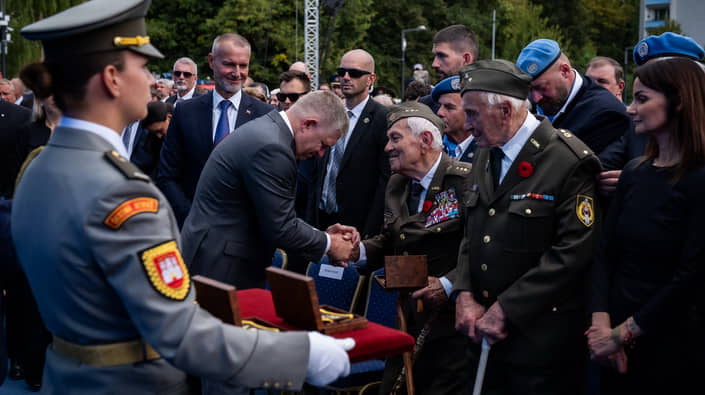
Every nation finds dark and bright moments in its history. Naturally, all nations focus on those bright moments and make holidays out of their anniversaries. A few days ago, Slovakia celebrated the anniversary of the Slovak National Uprising (SNP) of 1944.
The SNP is clearly one of the three main bright events in modern Slovak history, the other two being the declaration of Czechoslovak independence in 1918 and the Velvet Revolution in 1989.
It is, however, fundamentally important to remember also the dark moments of the history. Namely 1 September 1939, the day Slovakia shamefully joined Hitler in invasion to (Catholic and Slavic) Poland, June 1941, when Slovakia joined Hitler in invasion to (Slavic) Ukraine/USSR, and deportations of Slovak Jews in cattle cars to concentration and extermination camps in occupied Poland started in March 1942 .
These tragic and shameful events are only silently mentioned in Slovakia, but it is necessary to remember them, because they are a warning. The Slovak governments have a dark tradition of associating itself with the greatest evil, and the journey "from Tiso to Fico" can be dangerously short.
An uprising replaced by a myth
History of all nations is often the subject of various misinterpretations and manipulations. An extreme example is the "history of Russia" – a completely fabricated conglomerate of carefully selected facts, suppressed tragedies and fantasised events.
Their brief summary is "from victory to victory" (ot pobedy k pobede), presented to a brainwashed nation of slaves who "do not know of any other country where a person can breathe so freely" (drugoi takoi strany neznayu, kde tak volne dyshet chelovek).
The SNP was also the subject of manipulation and distortion of facts from the very beginning. It would have been so even without the communist rule and the Russian occupation, for completely internal reasons.
The reason is clear: the SNP plays a fundamental role in the history of Slovakia, because it is the story of national redemption, which turned a nation of hitherto loyal collaborators with Nazi Germany into a nation which joined the right side of history and gained a place in the anti-fascist coalition.
During the years of communist rule and Russian occupation, the SNP was presented to the public as a project of the communist party and Soviet partisans parachuted to Slovak mountains.
This was indeed in sharp contrast to reality. While communists were part of the SNP, they were not in charge of Uprising´s preparations, nor its execution. Would they be, Slovakia could become part of the Soviet Union after the end of the war, as was desired by Slovak communists.
Consequences of such development for Slovaks would be entirely devastating.
Fortunately, preparations for the Uprising were in the hands of domestic resistance and Czechoslovakia's exile government in London, which initiated preparations among officers of the Slovak army secretly loyal to the exile government.
The process started in 1943, as the moods among Slovaks started to change. It was becoming increasingly likely, that Germany will be defeated, the outreach of London-based Czechoslovak exile government in Slovakia was growing, economic situation started to worsen, and growing number of Slovaks were dissatisfied with arrogance of ruling clerical-fascist regime led by Catholic priest Jozef Tiso, including the treatment of the Slovak Jews.
At the same time Slovak soldiers returning from the fronts were bringing information about mass murders of Jews and other civilians by Nazi's in Ukraine and Kuban. These undermined any remains of German moral authority among Slovaks.
Under the guidance of the Czechoslovak exile government, the illegal military command center of the future uprising was formed in Slovakia in late 1943 and early 1944. In a parallel process, the domestic civil resistance united with the communists, signing a Christmas Agreement at the end of 1943.
They jointly established the Slovak National Council with the Council’s main goal to prepare a nationwide uprising and to restore a democratic Czechoslovakia.
By signing Christmas treaty, Slovak communists gave up their dream about pushing Slovakia under direct control of Moscow – a nightmare scenario for Slovaks. They would not give up their red dream, would they control the process.
The second aspect of the SNP overplayed by the communist and Russian propaganda was the role of partisans in Uprising.
While up to 18 000 partisans operated in Slovakia, they represented less than quarter of Uprising´s fighters and their military impact was rather mixed. While some groups were relatively efficient, many were rather dubious.
Overall partisans probably made more harm, than service to the Uprising, especially by triggering too early eruption of the Uprising in the time, when the preparations were not yet completed.
Broader context in which the SNP broke out were success of Normandy invasion resulting in liberation of Paris (19-25 August 1944), the Warsaw Uprising (1 August – 2 October 1944) in neighbouring Poland, Romania’s switch of her allegiance from the Axis powers to the Allies on 27 August and advance of the German-Soviet front from the east.
SNP's main military objective was to enable a rapid breakthrough of the Soviet troops advancing from Ukraine through the Carpathians deep to the west without the need to fight through well-defended Slovak mountains. This was to be achieved by Slovak army divisions located in Eastern Slovakia.
Unfortunately at the end of August when Uprising had to be declared due to partisan wild actions, the leadership of the East Slovak divisions was not prepared and allowed disarmament of these crucial forces by Germans. As a result, the liberated territory of Slovakia was large (see the map), but isolated, and too remote from the front to enable intended large break-through to the west.
SNP preparation time was significantly cut by the activities of partisans in summer 1944. In particular, on 27 August 1944, partisans attacked groups of German soldiers and officers traveling through Slovakia by trains in towns Martin and Ruzomberok and executed dozens of their members.
The victims of partisan killings inspired by Soviet „instructors" were not only German soldiers, but also Slovak civilians of German ethnicity: dozens of them were for instance executed during August 1944 in village Sklabina.
Until the end of August 1944 Slovakia was not occupied by German army. However, partisan attacks forced Tiso's government in Bratislava to invite German army to help to suppress partisan activities. German advance then forced Slovak officers preparing the Uprising to declare it on 29 August, when military preparations were only 70% complete.
Consequently, uprisers failed to fulfill their main objective of opening the Carpathian passes to the Soviet army. Quick disarmament of two divisions in the East Slovakia also meant loss of some of the best trained and equipped units. In the beginning, the uprising’s army consisted of 18,000 soldiers.
That number grew after the first mobilisation to 60,000 by the end of September. Unfortunately failure to get under control some of the most important military arsenals due to the premature eruption of Uprising meant serious lack of heavy armaments, anti-tank weaponry and ammunition. For instance, the army had weapons only for roughly 75 percent of its fighters.
Despite these military failures, Central Slovakia sustained its freedom for almost two months, until 27 October 1944 when Banska Bystrica, headquarters of Slovak National Council and SNP's military command fell.
Nevertheless the guerilla war against German occupants continued in the Slovak mountains throughout the cold winter 1944/45 till spring 1945, when Germans were pushed from Slovakia by units of Soviet, Romanian and Czechoslovak armies and Czechoslovak Republic was reestablished.
Jozef Tiso, Catholic priest who, as a president of Slovakia, led Slovaks to he war against Poland and Soviet Union, signed laws deporting Slovak Jews to concentration and extermination camps, and after the defeat of the Upraising decorated German soldiers on the square of Banska Bystrica, was sentenced to death and hang in April 1947.
Opportunities for Russian propaganda
For almost three years Czechoslovakia remained a free democratic country, until February 1948, when democratically elected communists overtook power after a deep government crisis.
Almost immediately communists started to push their narrative of the SNP interpreted as a communist´s and Moscow-led revolution. Many real leaders of the SNP were suppressed: some killed, some silenced by imprisonment or fear of it. State-controlled „Slovak Union of Antifascist Fighters" (SUAF) was filled with loyalists committed to spreading communist interpretation of the Uprising for the next 40 years.
In 2025 practically all participants of the SNP are dead and most of the SUAF members are old people who fought against the fascism only on the paper during the years of Russian occupation, when
they embraced communists's and Russian narratives.
For younger generations events from more than 80 years ago are what for my generations were stories about fights on Piava river during the WWI: domain of legends.
This lack of interest of young generation of Slovaks in the history open doors for occasional "parachutists" from various political parties into the SUAF, trying to use it as a publicity stand for their own political goals.
Paradoxically, even Slovak neo-Nazi politicians occasionally do that. Such efforts occasionally for a brief moment steer media interest and quickly dissipate.
Much more stable and politically influential is position of part of ultraconservative Slovak Catholics, to whom SNP was a military coup against a legitimate Slovak government orchestrated by Czechs, evangelicals, Jews and other anti-Slovak elements.
This group is not very numerous, but by systematically weakening western-type of Christian democracy in Slovakia and fueling neo-Nazi sentiments, it undermines fragile Slovak democracy.
To make cognitive dissonance among part of Slovaks perfect, they also push for formal recognition of sentenced war criminal Jozef Tiso as a martyr and canonise him as a saint by Catholic Church.
Juraj Mesík,
Slovak Foreign Policy Association