Orbán fights for a veto: will he succeed in blocking Ukraine's financing scheme
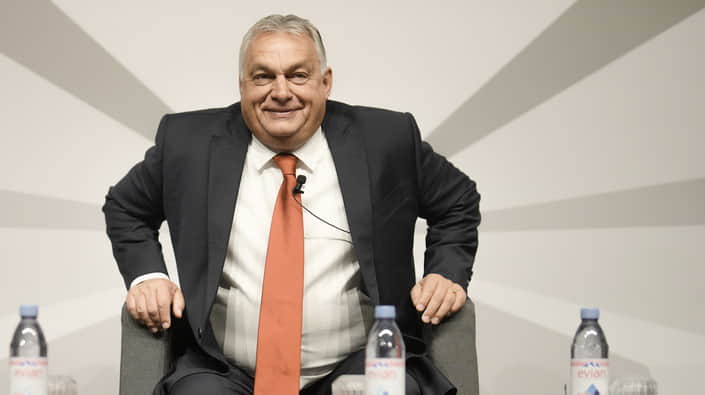
In 2025, the issue of frozen Russian assets once again came into the spotlight in the EU. Against the backdrop of weakening US support, the discussions were further intensified by internal disputes – particularly due to Hungary’s "special" position.
Budapest, widely regarded as the most Kremlin-friendly government within the EU, has been obstructing Brussels’ efforts to support Ukraine since the beginning of Russia’s full-scale invasion. It has blocked several aid packages, resisted sanctions against Moscow and slowed down Kyiv’s EU accession negotiations.
This time, however, Viktor Orbán’s government has concentrated its efforts on the fate of Russian assets.
The matter concerns reserves of the Russian Central Bank – worth more than $200 billion – frozen in European depositories, which generate $3–5 billion in annual income. In 2024, EU leaders decided to channel 99.7% of this revenue to the European Peace Facility (EPF) to support Ukraine.
Budapest is now challenging the legitimacy of this approach. The Hungarian government has filed a lawsuit with the Court of Justice of the European Union against both the European Peace Facility and the Council of the EU over the decision regarding Russian assets.
Rights without obligations?
Hungary’s demands, though concise, concern two decisions at once.
First, Budapest is contesting the decision of the European Peace Facility’s (EPF) steering committee of 26 February 2025. That decision directed almost the entire second tranche of income derived from the management of the frozen assets of the Central Bank of the Russian Federation to support Ukraine, particularly military assistance.
A procedural peculiarity was included: Hungary was deemed not to qualify as a "Contributing Member State."
As a result,
Orbán’s representatives could neither take part in the vote nor exercise a veto.
The rationale was that, since Hungary had not contributed financially to this tranche, it could not participate in decisions on its use.
This approach is consistent with both the Fund’s internal rules and the broader logic of the EU’s Common Foreign and Security Policy (CFSP), which provides that decisions on financing specific measures are taken by the states that actually fund them. In other words, a country that does not contribute financially to a measure cannot block it.
Hungary’s counterargument is that membership in the Council of the EU and participation in CFSP mechanisms automatically entitle it to a say in voting, regardless of whether it has made a financial contribution to a particular tranche.
Budapest therefore claims it was deprived of its voting rights without sufficient legal grounds. In its view, this violates basic institutional guarantees and undermines the balance of decision-making in EU security policy.
More importantly, however, this lawsuit could destabilise the mechanism established to channel income from frozen Russian assets toward Ukraine. That mechanism was introduced under EU Regulation No. 2024/1469, adopted in May 2024.
By adopting this Regulation, the Council confirmed that income generated from the immobilised reserves of the Russian Central Bank is not considered sovereign assets, is not protected by sovereign immunities, and cannot be returned to the Russian Central Bank. Instead, it must be directed to support Ukraine.
A precedent that could destroy everything
Formally, Hungary’s lawsuit challenges only the decision of the EPF Committee of 26 February. In reality, however, it has the potential to undermine the entire framework for using the proceeds of frozen Russian assets to support Ukraine, which was established by the 2024 Regulation.
The position of the Court of Justice of the European Union will therefore be decisive. The possible outcomes of Hungary’s claim can be divided into several scenarios – each carrying both legal and political consequences.
If the lawsuit is rejected, the Court will confirm the EPF Committee’s reliance on the "Contributing Member State" criterion, thereby granting it greater legal certainty.
Politically, such a ruling would strengthen the practice of allocating funds without the participation of states that do not contribute financially to a given measure and would confirm the delegated powers of the EPF Committee. This outcome would also limit the effectiveness of veto powers within such structures, while sending a signal to other member states about the boundaries of procedural objections as a tool for blocking decisions.
However, if the lawsuit is upheld, a series of problematic issues will immediately arise.
The worst-case scenario would be if the Court annulled the EPF Committee’s decision of 26 February ex tunc – that is, retroactively, from the moment of its adoption.
Legally, this would mean that all actions taken on the basis of that decision – including the disbursement of funds for Ukraine’s military support – were carried out in violation of procedural rules, since Hungary was unlawfully excluded from voting. It remains unclear how such funds could be clawed back into the EU budget.
The Court could, at the same time, preserve the legal effects of the decision on a temporary basis through so-called interim measures, in order to avoid the collapse of disbursed funds and executed contracts. Formally, however, the decision would still be considered invalid.
As for the Council Decision of 21 May 2024 (CFSP 2024/1471), upholding Hungary’s claim would not annul it directly. Yet it would render its implementation – particularly through the EPF Committee – legally defective.
This would create the need to design an entirely new mechanism for channeling income from Russian assets to Ukraine. The greatest challenge in that scenario would not be legal but political: whether member states would have the will to return to the negotiating table for a "second round" on the already complex and contentious issue of using Russian funds to support Ukraine.
* * * * *
Hungary’s lawsuit is more than a legal dispute. It strikes at the very principles of member state "sovereignty" within the framework of the Common Foreign and Security Policy (CFSP).
If the Court of Justice of the European Union rejects the claim, the European Peace Facility will gain additional legitimacy, and the practice of channeling proceeds from frozen Russian assets will be firmly established.
If, however, the lawsuit is upheld, the consequences will be far-reaching:
not only would a precedent be set, but the very procedures for financing support for Ukraine would need to be reconsidered and restructured.
This will be a critical test of European unity, balancing the imperative of providing strategic assistance from the aggressor’s resources with the need to preserve trust, legality and democratic principles among member states.
At the same time, the case risks undermining broader efforts by Ukraine and its allies to advance the seizure and use of Russian assets worldwide.
Sofia Kosarevych,
Analyst at the Dnistrianskyi Center
This material was prepared with the support of the International Renaissance Foundation as part of the project "#Compensation4UA / Compensation for War Damages to Ukraine. Phase V: Interim Reparations for Victims of Russian Aggression against Ukraine – Exploring Approaches, Needs and Solutions."