Macron between bad and worse: how France's turmoil affects Ukraine and Europe
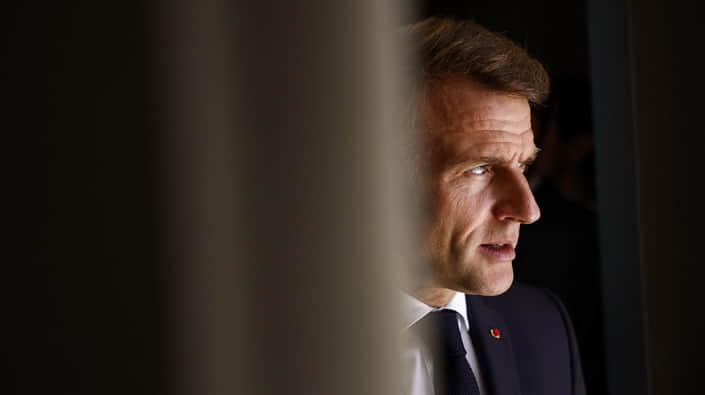
France is no longer just navigating a political crisis, it’s exporting one.
Since May 2022, France has seen five prime ministers. In 2024 alone, four different heads of government tried, and failed, to stabilise the country. Even Michel Barnier, the former EU Brexit negotiator, lasted only 91 days in the Prime Minister’s office before resigning in December.
The French Parliament, meanwhile, has been in a state of permanent deadlock since the snap legislative elections of 2024. With no party or alliance holding a majority, successive governments have been unable to pass basic reform.
The use of Article 49.3 of the Constitution, which allows bills to be passed without a vote, has become standard procedure, further eroding French people trust in their government.
Veteran observers now speak of a "permacrisis", a chronic state of dysfunction where Matignon, the office of the Prime Minister, has lost its traditional shielding function.
Rather than absorbing political tension, each successive government collapsed under it.
This disintegration at the top has real consequences across Europe. A politically paralysed France is no longer a reliable engine for the EU’s agenda. As one French analyst put it: "We are watching the institutional corrosion of the Republic in real time."
The country is now navigating a budget deficit of 5.8% of GDP, far above the EU's 3% threshold. National debt stands at 114% of GDP, and in the past year alone, France’s credit rating has been downgraded twice.
In November 2024, Fitch cut France’s rating from AA to AA-, citing structural fiscal imbalances and the government’s inability to implement spending cuts. Moody’s followed in March 2025 with a similar downgrade.
The deeper issue is that trust in institutions has collapsed. A recent IFOP poll shows that only 23% of citizens trust the National Assembly, and barely 30% approve of President Macron’s handling of the crisis.
In the absence of stable leadership, political extremes gained more and more credibility. According to recent polling Rassemblement National and its allies are now leading nationally with 34–36% support; La France Insoumise, on the far left, is polling at 17–20%; traditional governing parties, Les Républicains, or the Socialists, remain fragmented, each under 10%.
With no stable coalition in sight, this results in a political system that neither functions nor reflects the electorate.
Macron’s gamble and its consequences
Macron came to power promising reform and modernisation. But his presidency has increasingly relied on risky assumptions.
The 2018–2019 Yellow Vest protests, sparked by a fuel tax, broke his reform momentum. He responded by loosening fiscal discipline and injecting €17 billion into spending, a pattern that would soon become routine.
The snap elections of June 2024 were another gamble. Intended to restore control, they shattered political order.
A year later, in August 2025, Macron appointe Sébastien Lecornu as Prime Minister. Just 192 hours later, the Lecornu I government fell in a confidence vote; a historic first in the Fifth Republic and the shortest-lived government since 1958.
The response to the crisis has become a method. Macron’s government has repeatedly turned to public spending as a way of delaying deeper reforms.
During COVID, France covered wages, rent and utility bills, financed by soaring public debt. That approach now shows its limits.
The budgetary situation is not just precarious, it paralyses investment, including in defence and Ukraine support. France has already struggled to match the level of aid provided by the UK, Germany, or Poland.
With institutional tools exhausted, Macron faces three choices, all risky.
The first is a centre-left coalition. That would demand U-turns on pensions, spending, and labour reform, and for Macron’s allies to remain resistant.
The second is a constitutional reform to introduce proportional representation. This could unblock the Parliament but risks further fragmentation, discontent or delivering power to the far right.
The last is inertia. Decrees, caretaker ministers, emergency budgets, and a France drifting until the next presidential elections, in 2027.
Each path narrows France’s influence in Europe.
The country once central to EU integration, defence, and Ukraine strategy is now absorbed by internal firestorms. With Kyiv entering another winter of war, Paris is counting prime ministers.
Europe without France?
In late August 2025, the Franco-German Council of Ministers met in Toulon with high ambitions. Emmanuel Macron and German Chancellor Friedrich Merz had agreed to relaunch Franco-German cooperation with a set of joint initiatives on defence, energy, industrial policy, and EU enlargement.
But within weeks, Paris was back in political turmoil. Sébastien Lecornu’s government collapsed after only ten days in office, leaving Berlin without a reliable partner. Strategic defence initiatives like the Future Combat Air System (FCAS) and the Main Ground Combat System (MGCS), critical Franco-German industrial projects, have since lost momentum.
Traditionally, Franco-German summits have traditionally set the tone for European policy, but according to analysts at IFRI and DGAP, Berlin is already exploring alternative options, including trilateral coordination with Warsaw and Rome.
In July 2023, Macron announced a sharp rise in military spending: €6.7 billion earmarked for 2026, part of an ambitious €413 billion defence law running through 2030. The increase was meant to modernise France’s forces, such as drone capability, ammunition stock, and electronic warfare tools.
But none of this is guaranteed. With Parliament put on hold and no sustainable budget passed since 2023, France has relied on emergency budget rollovers. The Ministry of Armed Forces has already warned that without a full finance bill, planned increases would be suspended.
Nonetheless, France remains the EU’s only nuclear power and its sole permanent member of the UN Security Council.
But today, those symbolic assets are dismissed by political uncertainty.
In Washington, Berlin, Warsaw and Rome, Paris is increasingly seen as "unpartnerable," according to senior analysts at the German Marshall Fund and the Centre for European Reform. Rome’s Giorgia Meloni is stepping in to lead the EU’s southern flank, particularly on migration and enlargement.
In the East, Poland and the Baltics are shaping defence planning around Ukraine with or without Paris. Even within the "Coalition of the Willing", the Franco-British-led group backing Ukraine, France’s voice is fading due to its limited material contributions and political paralysis.
As one senior French diplomat anonymously told Carnegie Europe, "We used to set the tempo. Now we’re playing catch-up; if we’re lucky enough to be in the room."
Implications for Ukraine
France has struggled to match the level of support offered by other European allies. Meanwhile, Germany has pledged over €22 billion, while France total allocations remain under €8 billion, a gap that cannot be explained by economic capacity alone.
While part of this insufficiency is rooted in France’s immediate fiscal constraints and instability, the deeper concern in Brussels is political continuity.
With Macron weakened and no clear successor within the centrist camp, if the far-right Rassemblement National (RN) wins the 2027 presidential election, it could trigger a strategic rupture in EU policy.
Marine Le Pen has already refused to define Russia as an aggressor state, and her party has regularly opposed France’s arms deliveries to Ukraine.
The Kremlin is watching Paris closely.
Russian analysts and officials routinely frame France’s crisis as proof of Western decay and elite failure. RT and Sputnik have amplified narratives of French chaos, presenting Macron as a "failed emperor" and promoting the RN as "a party of peace."
Internally, French populist parties have used the war in Ukraine to attack government spending, calling aid "irresponsible" in the context of France’s 114% debt-to-GDP ratio.
For Moscow, a France consumed by infighting and constrained by debt is a strategic gift. It weakens the EU’s eastern posture, discourages smaller states, and potentially opens a breach in the front of European deterrence.
If France retreats from the geopolitical frontline, Russia faces fewer constraints and more opportunities, in Ukraine, and beyond.
* * * * *
France’s crisis is now a European problem. Paris can no longer set the pace in Brussels. That matters for Ukraine. Ukraine needs shells, money, diplomatic support and training. By the end of 2025, the EU aims to send 2 million shells to Ukraine. This year, money should start flowing from a loan backed by profits on frozen Russian assets.
The EU training mission (EUMAM) is expanding, a joint EU–Ukraine drone programme is starting, and BraveTech EU will fund testing of front-line innovations by 2026.
If France, the EU’s only nuclear power and the bloc’s permanent voice on the UN Security Council, keeps its commitments, these targets are achievable. If it doesn’t, deadlines will slip, coordination will suffer, and Russia will gain an opening.
This absence of leadership left room for others to take the lead.
Berlin on industry and funding, Warsaw and the Baltics on deterrence, Rome on migration and enlargement.
If Paris keeps looking inward, Europe’s centre of gravity will keep shifting east and south.
Charlotte GUILLOU-CLERC,
Journalist, France