Frontloading: EU’s alternative path to break Hungary’s veto on Ukraine's accession talks
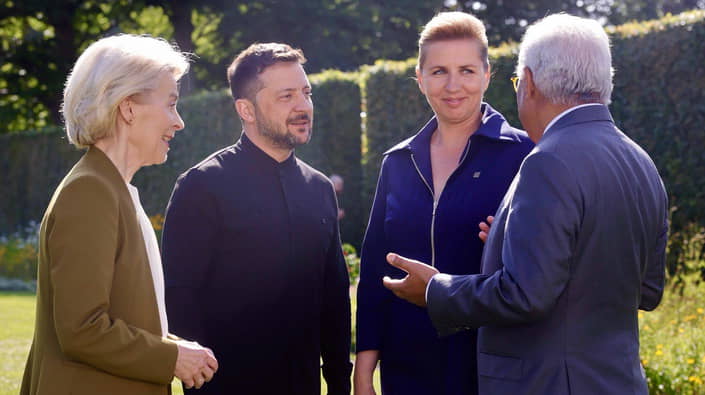
There is less than two months to go before European institutions close down for Christmas, and this is the short window of time Denmark has in its current presidency of the EU Council to push through substantive decisions on Ukraine and its accession to the European Union. After that, Cyprus, not the most pro-Ukrainian of EU members, will take over the presidency for six months. The Cypriot government has announced that during its term, it will shift focus away from Ukraine to other issues.
Danish Prime Minister Mette Frederiksen does still have time to break through the wall of Hungary’s veto and launch substantive EU accession negotiations with Ukraine.
When, back in early summer, Frederiksen promised President Zelenskyy to find a way to open the first cluster of negotiations (and then all the rest), both Copenhagen and Brussels were confident it could be done within weeks. In fact, it has turned out to be much more complicated.
With the deadline approaching, Ukraine’s allies within the EU are forced to look for alternative solutions.
One proposal put forward publicly comes from António Costa. The President of the European Council is now urging all member states to reform the decision-making system and abandon the unanimity requirement for technicalities such as opening negotiation clusters and chapters. Meanwhile another suggestion is that Ukraine could be offered EU membership with limited rights. Its proponents believe that if Kyiv were to agree to joining without having the same power of veto as the other members, this would soften the position of some opponents.
But none of these ideas stand much chance of being approved, numerous European Pravda sources in Brussels say.
Insiders' assessments range from the flat "Costa’s plan is already dead" to the more moderate yet equally bleak "there is no consensus, and it’s unlikely to appear anytime soon."
However, there is an alternative plan whose chances of being approved are very high.
This plan is being promoted in the EU Council, supported by the European Commission, and has received Ukraine’s backing as well.
Although the details are not yet finalised, the plan already has a name – "Frontloading".
Not waiting for Orbán’s "demise"
There is a prevailing belief within the EU that Orbán’s current veto is only temporary. The reasoning goes that elections are set to be held in Hungary in April, at which point Hungary's blocking tactics will pause. This view was voiced, in particular, by MEP Michael Gahler, who expressed the opinion that no negotiation clusters for Ukraine would be opened before April.
"It will open in April one way or another. Either Mr Orbán will be over, or he will have got some other hints that he had better not block the decision", the MEP said.
Yet even if one assumes that the Hungarian elections will automatically remove the veto, simply sitting and waiting for a change of power in Budapest hardly seems wise.
Elections in Hungary are scheduled for 12 April 2026. It will take another month for the new parliament to convene following the elections. Then the new parliament and government will deal with the most urgent domestic issues, and negotiations with Ukraine will certainly not be among them.
In practice, the lifting of the veto and the start of talks with Ukraine could only happen around June, just as Cyprus’s EU presidency is coming to an end.
That is eight months away. Losing that much time just waiting for the start of negotiations would be an unacceptable luxury for Ukraine.
The following year will be favourable for bold decisions. Ireland, a country more active in promoting Ukraine's accession, will take over the chairing of the EU Council from Cyprus on 1 July 2026. And then after Ireland, Lithuania – one of Ukraine’s key advocates.
Kyiv expects that during this period, Ukraine will be ready for the next steps and capable of completing some of the negotiation chapters.
But the groundwork for this must be laid now.
It is at this point that the outlooks of Kyiv and the European capitals diverge.
"You can carry out reforms even without starting formal negotiations. Just take EU legislation and adopt it", they say in Brussels, and in a formal sense, they are absolutely right.
Ukraine’s political reality is somewhat different. It’s no secret that the "monomajority" in Ukrainian parliament exists only on paper. Many MPs have lost interest in parliamentary work. Holding new elections to renew the legislature is impossible until martial law is lifted. Those MPs who continue to work often distrust bills labeled by the government as "EU integration" initiatives, and this distrust is not always unfounded.
As a result, gathering enough votes even for those bills genuinely necessary for EU accession has become a difficult exercise.
For that reason, for reforms to succeed, it is highly desirable to have European backing for key legislative projects, as well as a formal list of EU requirements, up front, rather than only following the start of accession negotiations, as normally happens.
How all the "Plan Bs" failed
Since the spring of 2025, when the Hungarian government began openly declaring its intention to block Ukraine’s progress toward EU membership, EU member states and institutions have repeatedly tried to find ways to bypass Hungary’s influence.
One such attempt took place in the summer, when Denmark and Ukraine negotiated with other countries about a bold, albeit legally dubious, scheme that would have allowed them to "outmanoeuvre" Hungary’s authoritarian leader.
That initiative collapsed in July, coinciding with a Ukrainian government reshuffle and attacks from the President’s Office on anti-corruption bodies and activists who protested the move.
But should all the problems in overcoming the veto be blamed solely on "anti-corruption issues"? Not entirely. The situation is more complex.
The attack on NABU (National Anti-Corruption Bureau of Ukraine) and SAPO (Specialized Anti-Corruption Prosecutor's Office) strengthened the position of those within the EU who opposed creating a special procedure to assist Ukraine's accession. Yet such opponents existed even before Kyiv’s July decisions. For a number of European capitals, maintaining their veto power within the EU is politically important.
The Ukrainian government’s actions in July immediately became – and remain – a convenient argument for those who would have sought to block such concessions anyway.
So when European Council President António Costa tried once again to persuade his colleagues to make concessions and agree that technical, preparatory procedures, such as the opening of negotiation clusters, could be launched by a qualified majority vote, the initiative met with strong resistance from several capitals.
Suddenly the key country resisting the proposal became the Netherlands.
This country has consistently supported Ukraine, but for several Dutch political parties, the distribution of powers between Brussels and the member states is a deeply sensitive political issue. And now, with the Netherlands in the midst of an election campaign, such questions carry particular political weight.
Therefore, during a parliamentary session in The Hague on 30 September, Prime Minister Dick Schoof was forced to make a political commitment that the Dutch government, under any circumstances, would not agree to abandon unanimity on issues concerning Ukraine. This not only buried Costa’s initiative but also made any broader departure from unanimity politically impossible.
After all, one can debate the idea of "outmanoeuvering" Hungary, which has irritated many within the EU, but the Netherlands is in a completely different political league.
"Frontloading": an alternative to bypassing Orbán
All of this forced compromises, both from Ukraine’s allies within the EU and from Ukraine itself. As a result, Brussels devised another scheme that formally doesn’t cross red lines for member states, yet allows Ukraine not to remain stuck in a deadlock.
This initiative is named "Frontloading" – the idea being to resolve most of the issues at the initial stage.
Discussions about frontloading had been held behind closed doors until now. But on Wednesday, a representative of the Ukrainian government made the initiative public during a panel at the Accession Exchange Forum in Kyiv – and endorsed it.
"There have been various creative solutions before [on how to open clusters despite Hungary’s veto]. Now we have a new term – "frontloading". And it might work," said Oleksandr Ilkov, head of the Government Office for European and Euro-Atlantic Integration.
Numerous European Pravda sources in Brussels say that "frontloading" is now viewed as the only realistic option to break the deadlock created by Orbán’s ongoing veto.
The initiative enjoys the backing of the Danish EU presidency, as well as the relevant departments of the European Commission and the Council of the EU.
The irony, however, is that despite such broad support, the details of the initiative have not yet been agreed upon.
There is only a general understanding of how it would work, but in this case, the details truly matter.
Essentially, the idea is for the EU presidency, the European Commission and key member states to agree on moving toward informal accession talks without the official opening of a negotiation cluster.
"There will be regular meetings and everything that normally happens during formal negotiations", explained one European Pravda source. Even ministerial-level meetings, like intergovernmental conferences, are possible". Another insider said "we see this as a temporary format, lasting until Hungary’s veto is lifted. In practice, that will likely be until the end of Cyprus’s presidency."
The idea is to carry out as many steps and reforms as possible during this period. Then, once Hungary lifts its veto – perhaps after an electoral defeat of Orbán – and the clusters are officially opened, Ukraine will already be at an advanced stage of negotiations.
A number of details of this plan, however, remain undefined.
For example, Kyiv hopes that under the framework of frontloading, Brussels will officially hand over to Ukraine a draft of its "negotiation position" for several clusters.
The negotiation position outlines, among other things, the key areas of reform in a candidate country that the EU prioritises for assessment. Receiving this document would allow Ukraine to focus on the most critical reforms. Normally, a candidate country obtains this document only after the official launch of accession talks.
Ukraine was sceptical about pursuing such an unofficial track until recently. That has now changed. Several European Pravda sources say that Kyiv’s officials have expressed in-principle support for the initiative.
The government has realised that Orbán will not lift his veto, and that the more conventional "Plan B" options, which envisaged opening negotiation clusters, have been blocked. They've therefore concluded that it’s better to move forward with something rather than wait idly.
There is one condition on which Kyiv will not compromise: if Ukraine embarks on the frontloading path, it must do so together with Moldova in order to avoid being separated on their shared path towards EU membership.
Chișinău is aware of the initiative and is broadly supportive of it.
"Frontloading is a new and creative idea", says Iulian Groza, Executive Director of the Chișinău-based think tank IPRE, which focuses on European integration. It may well work. But it should be understood that this is not a way to bypass Hungary’s veto. In the end, there still has to be a unanimous vote to open the clusters."
Sergiy Sydorenko,
Editor, European Pravda,
Brussels – Kyiv