Ukraine warned but not punished: EU report assesses reforms and failures, setting the bar for Kyiv
"We are all waiting for the EU report, though we understand there won’t be much good news in it." European Pravda heard this and similar statements very often over the past month from Ukrainian diplomats and officials working on the country’s accession to the EU. This scepticism was not unfounded.
Indeed, the pace of reforms over the past year has not accelerated. Parliament increasingly struggles to gather votes for pro-European changes. Most importantly, the attempt to undermine the independence of the anti-corruption system in July, further accusations of attacks on the NABU [The National Anti-Corruption Bureau of Ukraine] and problems in the judiciary added to scepticism about the EU’s assessment.
In this context, the European Commission delivered a surprisingly positive verdict.
The report rated Ukraine’s actions better than in any of the past three years since it joined the enlargement package. For the first time, European bureaucrats did not identify a single negotiation chapter where Ukraine had failed to make progress in meeting the accession requirements. The number of areas in which Ukraine shows "good progress" is higher than ever before.
Essentially, Brussels positioned Ukraine as one of the frontrunners in aligning with the EU.
And, probably in response to Kyiv’s persuasion and reassurances, the EU decided to avoid harsh public criticism or any mention of a "backsliding." This aligned with the expectations of both the authorities and independent analysts (even the "shadow report," despite its critical tone, did not speak of backsliding).
Still, it would be a mistake to believe the EU issued no critiques or expectations.
On the contrary, the report sets rather clear and ambitious benchmarks for Ukraine’s further reforms, in particular, regarding the role of independent (including foreign) experts in appointment procedures within the judicial system. The EU also noted the ongoing pressure on NABU and sent a signal to the authorities about this issue.
Moreover, Kyiv also understands that progress in 2025 remains insufficient and that it was achieved partly thanks to this year’s "screenings," which boosted Ukraine’s indicators, but will no longer happen next year.
Therefore, to remain among the leaders, Ukraine must accelerate reforms and approach the next annual report with solid results.
Ukraine’s EU integration ranking
Every year, usually in November, Brussels holds the "event of the year" for countries aspiring to join the European Union: the European Commission publishes its Enlargement Report. It provides a detailed analysis of how candidate countries are meeting accession requirements and how close they are to joining the EU.
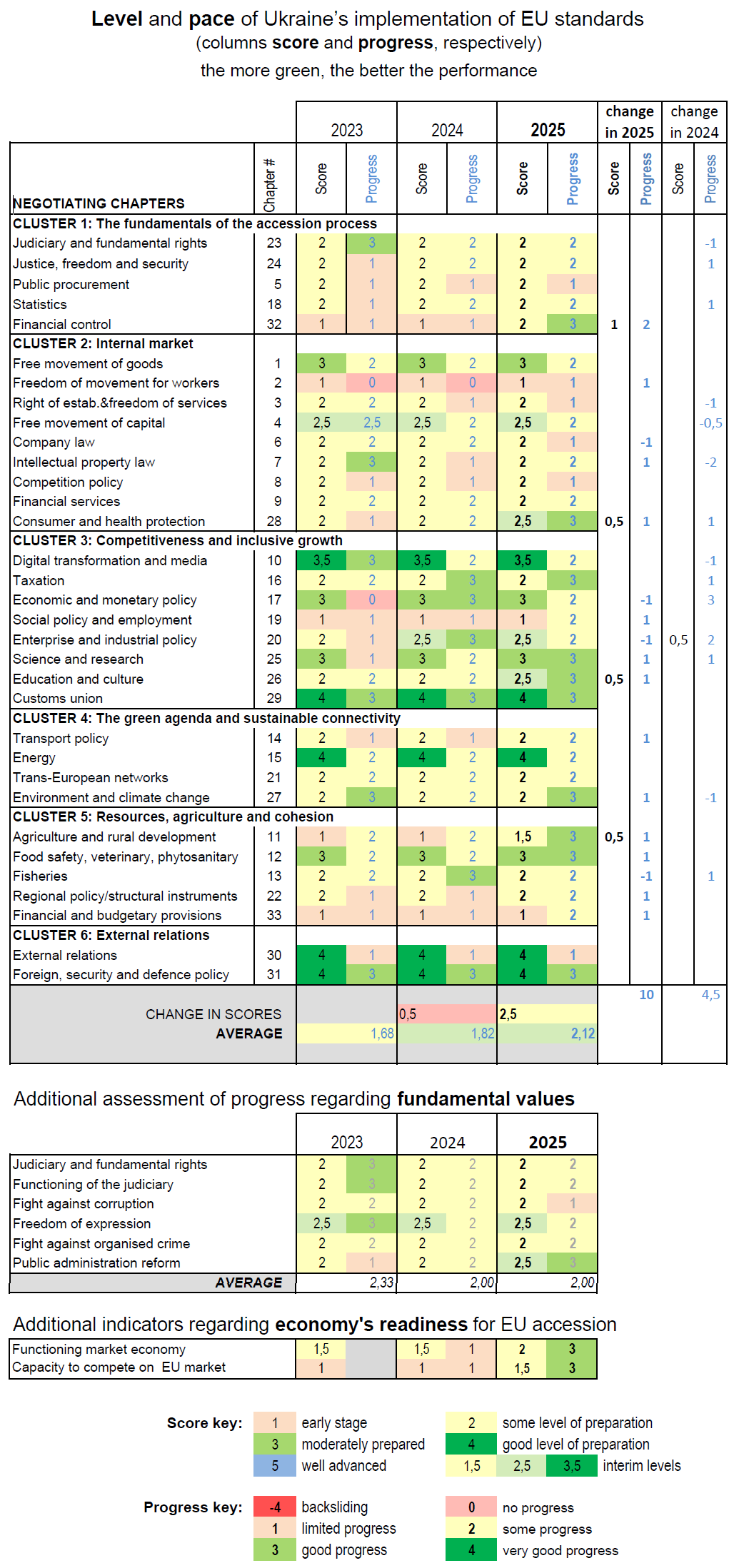
European Pravda builds a "matrix" based on this report each time, showing what has happened on Ukraine’s path toward accession and where progress has been made.
The Enlargement Report is more of a bureaucratic than a political document.
The European Commission’s administrative body prepares this report independently of national governments, so no country can be credited for an unfinished reform simply for geopolitical reasons.
Therefore, it serves as a kind of check-up for candidates, including Ukraine, which all EU actors will use as a reference throughout the following year.
It is also important that the European Commission prepare the report using a single methodology for all candidate countries. This makes it possible to compare progress among different nations and to assess how quickly Ukraine is moving toward accession year by year.
Ukraine achieved a personal best this year.
First, a very brief note about the evaluation system shown in the table.
For each chapter of the accession negotiations, Ukraine and other candidate countries receive two ratings. The first reflects the overall progress achieved throughout the entire accession process. There are five categories: early stage, some level of preparation, moderately prepared, good level of preparation and well advanced. Each of these levels has been assigned a score from 1 to 5.
In theory, to join the EU a country must score between 4 and 5 across all chapters. As we can see, Ukraine is still quite far from that level. Therefore, another indicator is even more important – the speed of change, which has six categories. The lowest is a "backsliding" in a particular area, an exceptional situation that serves as a kind of public punishment of a candidate country by Brussels. Next come "no progress," "limited progress," "some progress," "good progress," and "very good progress." The latter five levels are rated from 0 to 4 points.
A score of 2 for the speed of change is considered the median. Ukraine surpassed it for the first time this year, receiving an average score of 2.12 for its 2025 performance. If we also pay attention to the economic criterion and public administration reform (which are not separate negotiation chapters but are of great importance to the EU), Ukraine received a "good progress in reforms" rating in 13 areas – about one-third of all indicators assessed by the EU for a candidate country.
It was also the first time in three years that the European Commission did not assign a score of 0 ("no reforms") in any category. In short, President Zelenskyy’s and Deputy Prime Minister Taras Kachka’s statements about Ukraine’s success are justified, though there are some nuances.
Pressure on NABU: The EU sees and notes everything
As mentioned above, one possible evaluation of a candidate’s actions is a "backsliding."
Early in the report’s drafting, a few EU member states reportedly suggested assigning Ukraine the lowest rating for its anti-corruption and judicial reforms, though such opinions were far from the majority.
A finding of reform backsliding is essentially a black mark, signalling that the European Commission sees the country as a hopeless partner (this year, for instance, Georgia received the most negative assessment). Ukraine is certainly not in that category. Moreover, there were positive developments in the field of justice in early autumn, such as the appointment of Constitutional Court judges, so Ukraine received 2 points for judicial reform and 1 point for anti-corruption efforts.
"But you have to know how to read between the lines," one EU official told European Pravda.
In reality, the report acknowledges that Brussels sees both Ukraine’s progress in fighting corruption and the fact that
there are still actors within the country trying to undermine these efforts.
And this does not concern only the well-known events of July, although the report emphasises that the EU took note of all developments, even those that were not publicly highlighted.
For instance, when listing the elements of attacks on Ukraine’s anti-corruption infrastructure, the EU report mentioned the parliamentary temporary investigative commission on corruption offenses, established in June 2025 and headed by Serhii Vlasenko and Maksym Buzhanskyi. "It is important that parliamentary oversight does not erode public trust in anti-corruption institutions through unwarranted public statements nor overstep the limitations stemming from the separation of powers," the European Commission’s document stated, a rather transparent criticism of this parliamentary body’s activities.
The report also referred to criminal proceedings initiated against NABU officers by the Security Service of Ukraine (SBU) and the State Bureau of Investigation (SBI) actions that, in the EU’s view, have become systemic enough to warrant inclusion in the report. The Commission added that it does not consider this issue closed even after the repeal of the controversial July laws.
"Undue pressure on anti-corruption agencies remains a matter of concern," the report reads.
So how did it happen that, despite this criticism, Ukraine still received a better assessment than many expected?
The answer lies in the fact that, beyond the pressure on NABU, numerous other positive developments occurred over the year, which outweighed the negatives. Moreover, the report repeatedly emphasises that "the independence of NABU and the Specialised Anti-Corruption Prosecutor's Office (SAPO) was swiftly restored following internal protests and serious concern from international partners." This "swift" decision by the president to withdraw the law impressed European officials who, based on experience with other partners, know that such corrections often take much longer.
Additionally, the EU values the fact that NABU and SAPO investigations frequently produce tangible results, demonstrating that the fight against corruption continues and not merely on paper.
National joint 24/7 newscast and reform requirements
Among other politically significant aspects of the report is the section dealing with the media sphere.
Last year’s Enlargement Report caused a political stir when the European Commission, for the first time, stated that the Ukrainian authorities must end the "Joint Newscast," describing its format as outdated and undemocratic in practice (as discussed in last year’s article From "corruption" to newscast).
Brussels’ criticism lacked specificity back then, but the 2025 report added concrete details. The European Commission set a deadline for how long the newscast may continue in its current form:
"The reassessment of the publicly funded Telethon should take place at the latest by the time of the eventual suspension of martial law," the report stated, reminding the authorities that surveys already show declining public trust in the joint newscast.
Notably, this criticism of the "Joint Newscast" format does not undermine the overall fairly positive assessment of media pluralism in Ukraine.
The authorities, in particular, gained points because in 2025 the Ukrainian public broadcaster Suspilne received almost the entire budget it had requested. The EU also praised the resumption of live broadcasts of Ukrainian parliament sessions – a step European partners had long been urging Ukraine’s leadership to take.
However, there are also many other requirements that Brussels expects Kyiv to fulfil and indeed, there are quite a few of them.
The term "requirement" is fully appropriate here. In the report, the European Commission’s recommendations are phrased as directives "Ukraine should…" and the list of reforms outlined in the Enlargement Report is subsequently treated by EU institutions as binding expectations.
Ultimately, Ukraine’s decision to join the EU is a sovereign choice, and meeting the necessary criteria is part of that commitment. Ignoring these conditions and hoping that the requirements will eventually disappear would be a serious mistake.
In this context, particular attention should be paid to the judicial reform requirements.
Brussels has effectively ended the debate over whether "international experts" are needed in selection commissions.
The answer is yes, they are essential, as this is an explicit requirement in the Enlargement Report, at least concerning two commissions within the justice block (which holds exceptional importance for the EU).
First, Ukraine must urgently extend the provision allowing the "temporary involvement of independent experts nominated by international partners in the selection of members of the High Qualification Commission of Judges."
Second, the procedure for selecting judges to the Supreme Court and other higher courts, as well as for verifying their integrity declarations, must change. The EU expects a system with the substantial participation of independent experts appointed by international partners.
Additionally, in this same section, the European Commission reiterated its demand to repeal the "Lozovyi amendments", to fill the remaining vacancies in the Constitutional Court, and, notably, introduced a new requirement: to establish a competitive selection procedure for the position of Prosecutor General.
Overall, the prosecution system and the requirements for its reform receive so much attention in the report that this topic deserves a separate, detailed analysis.
It is also worth noting what gives the EU confidence that such ambitious changes will, in fact, be implemented. The reason lies in Brussels’ belief that Ukraine genuinely strives for EU membership not merely at the level of political slogans.
"There remains an overall consensus, which includes the parliamentary opposition, that EU integration is a priority," the European Commission states.
Ukrainian politicians continue to reassure their European counterparts that this commitment is real. And in the eyes of EU officials, where there is genuine political will, the means to achieve reform will always be found.
Sergiy Sydorenko,
Editor, European Pravda