EU candidate ranking 2025: leaders, laggers and Ukraine’s critical crossroads
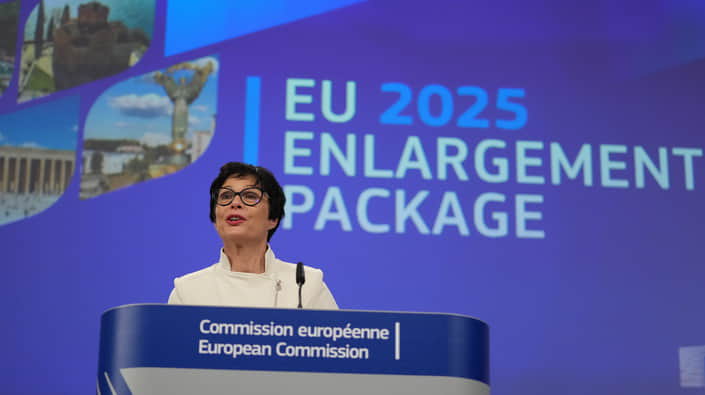
The EU Enlargement Report for 2025, which was unexpectedly favourable towards Ukraine, has been enthusiastically received by Ukrainian politicians and officials. And indeed, it does give us some reasons to be cheerful. In particular, the report makes no mention of "backsliding on reforms". The European Commission has concluded that the situation in Ukraine is not critical enough to warrant that label.
The report has also turned out to be Ukraine’s most successful since joining the EU enlargement process three years ago. For the first time, Ukraine’s average score across all negotiating chapters exceeded the median level of 2 points ("Some progress").
"This is the best assessment to date – proof that even as we defend against Russia's full-scale aggression, Ukraine continues to reform and transform according to European standards," President Volodymyr Zelenskyy said on X.
But Kyiv’s jubilation is misplaced.
In fact, the report should have been seen as a wake-up call for Ukraine.
You only have to compare Ukraine’s score with those of other key candidates.
EU Enlargement Commissioner Marta Kos said on Tuesday that Ukraine is one of the four leading enlargement states – and that’s true. Those leaders are Montenegro, Albania, Moldova and Ukraine. But out of these four, Ukraine is trailing in last place.
The report officially placed Moldova "top", as it has shown remarkable progress over the past year, overtaking Ukraine. The leader, however, is Montenegro, which may soon declare its readiness for accession.
It’s important to stress that this doesn’t mean Ukraine has lost its chance of rapidly joining the EU. But unless Kyiv speeds up the pace of reform immediately, it risks dropping out of the group of leaders entirely. That process has already begun.
European integration ranking 2025: how we measure it
The EU Enlargement Report from the European Commission is the key document of the year for candidate countries, a sort of "check-up" on how the accession process is going.
The report is prepared using the same methodology for all candidate countries so that comparisons can be made. It shows who is moving faster towards accession, who is plodding along more slowly, and who has chosen a different path from the European one.
Every year European Pravda analyses the report and produces a table with indicators for all the enlargement countries (see past publications: European integration ranking 2024, European integration ranking 2023).
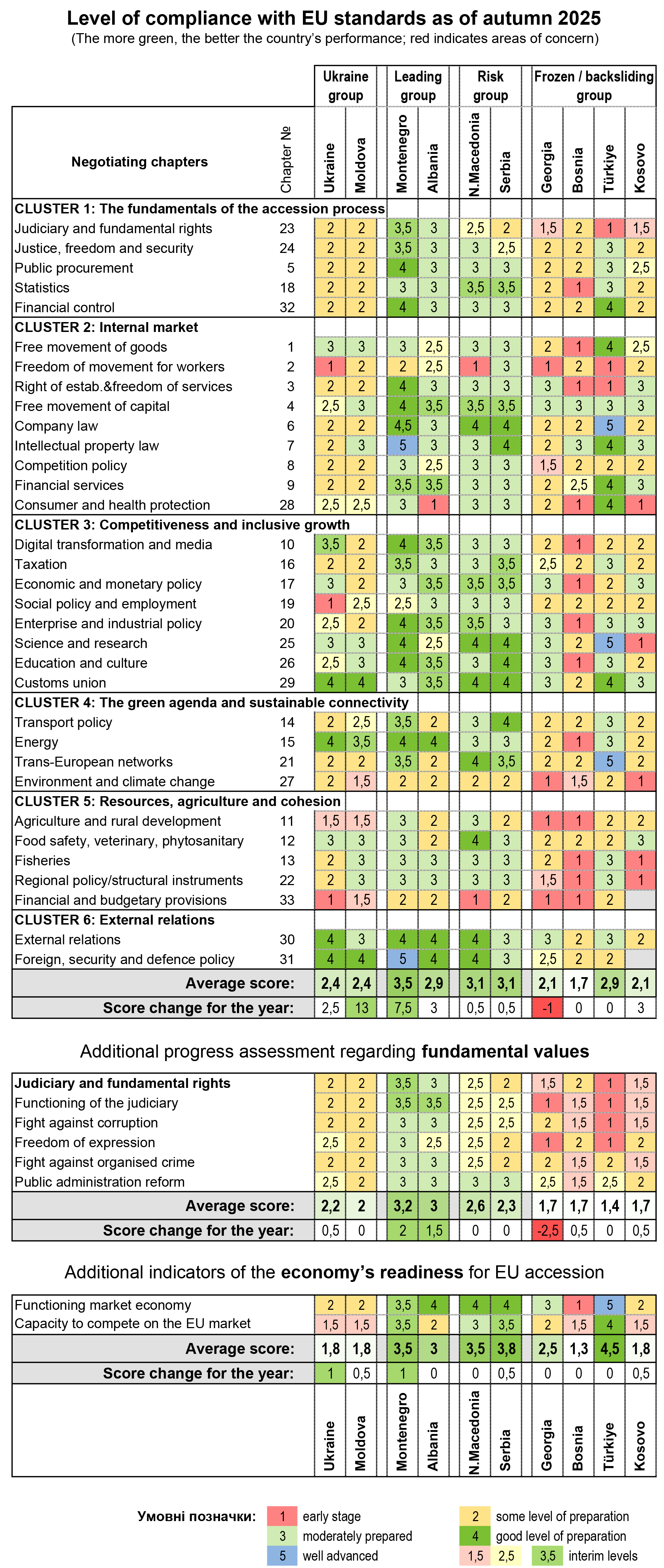
Brussels gives each country two assessments for each area: the level of compliance with EU rules, which we quantify on a scale from 1 to 5, and progress, which evaluates changes over the past year and can be negative, zero or positive, scored from 1 to 4.
This table includes only the first rating. It shows the current state of the candidate countries, their level of readiness for accession, regardless of how long the country has been implementing reforms.
Later in this article, there is a table showing the pace over the past year, which illustrates which candidates are genuinely approaching EU membership.
In addition to the 33 negotiating chapters, we also analyse the report’s assessments of the areas that matter most to the EU. These deserve special attention.
First, there are two key elements from the first cluster, Fundamentals, such as the state of the judiciary, anti-corruption, and combating organised crime. For each one, the EU prepares its own assessment in addition to evaluating the negotiating chapters.
These carry so much weight for the EU that unless progress is made in these areas, negotiations on the "economic" chapters are halted. This is legally codified in the enlargement rules. That is why we highlight them separately in the table. Ukraine showed no progress here last year, but it also avoided setbacks.
Another separate value is the economic criterion – an assessment of the market orientation of a country’s economy and its ability to compete if that country joins the EU. Ukraine is finally showing growth here.
There are two main surprises in this year’s report.
One of them concerns the outlier applicants.
Leaders and laggards in the EU accession candidate ranking
Last year’s EU report identified four countries that were still in the enlargement package but had no real chance of accession in the foreseeable future.
They were: Türkiye, the "eternal candidate", which has received negative assessments in recent years due to backsliding on reforms and the unlikelihood of accession given Ankara’s current policies; Bosnia and Herzegovina, which faces systemic governance challenges and, despite efforts by its supporters, languishes at the bottom of the ranking; Kosovo, which is not being assessed on all the criteria since not all EU members recognise its independence.
Georgia joined the outliers in 2024 when its authorities finally chose a pro-Russian and anti-democratic path of development.
Georgia came in for the most criticism in the 2025 report, with more marks for "reform backsliding" than all the other candidates combined, effectively halting Tbilisi’s journey towards EU membership.
One big surprise this year is that the circle of outliers has expanded.
The European Commission has added Serbia and North Macedonia to the list. Neither country’s authorities are willing to continue with democratic reforms. The EU noted the start of backsliding on reforms in Serbia. When that’s the case, high economic indicators (Serbia was actually a leader in enlargement until recently) no longer matter to the EU.
As a result, the EU has publicly stated that there are now only four countries in the group of leaders, including Ukraine.
Reform progress in Ukraine: "Historic" but insufficient
As the examples of Türkiye and Serbia show, it’s not just the current state of play that matters (both countries have indicators significantly higher than Ukraine’s), but also the pace of change. In theory, to complete accession negotiations, candidate countries need scores of 4 or 5 across all chapters.
This part of the table is more complex, but it is the one that truly shows whether a country is moving towards EU accession.
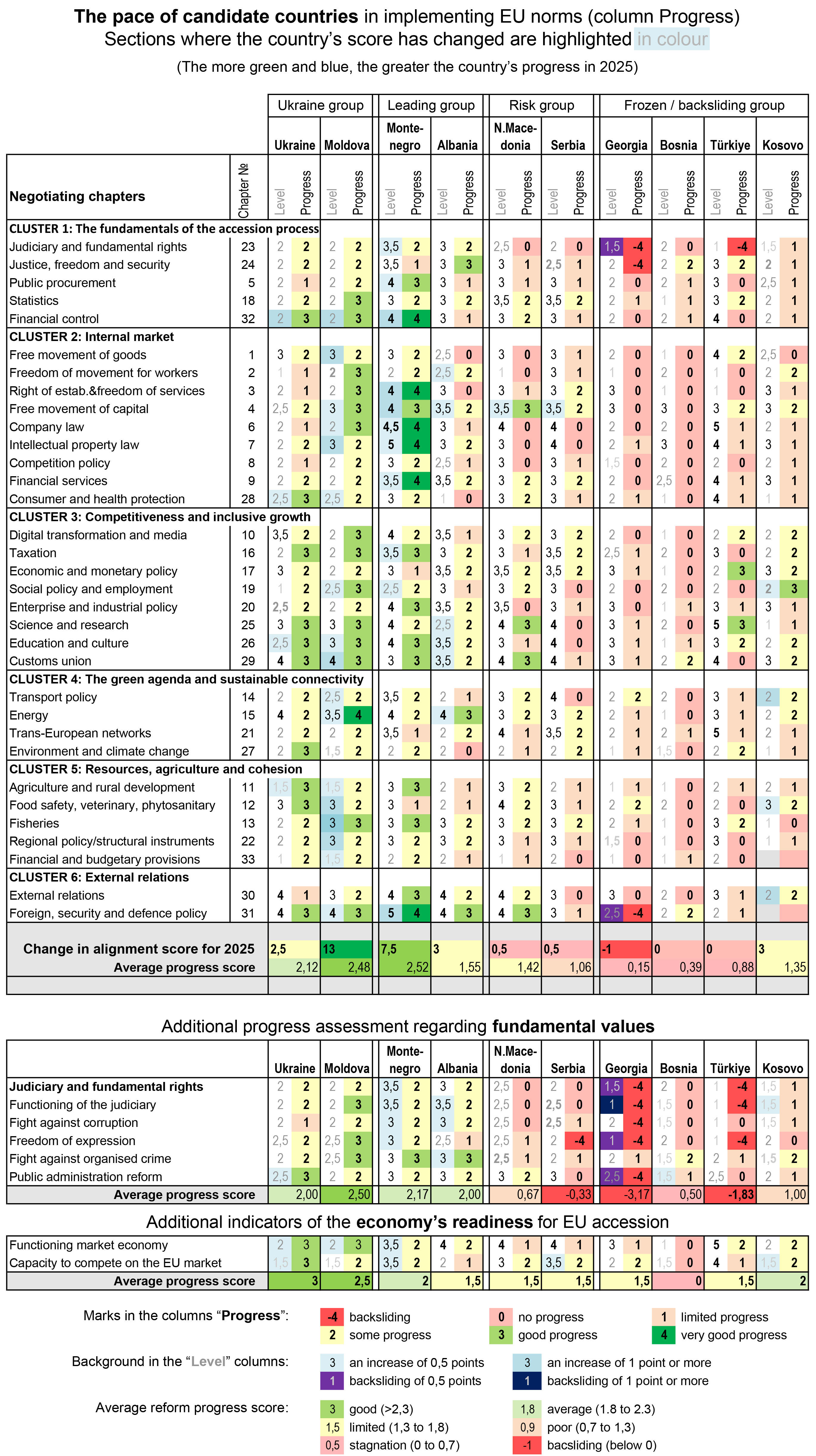
The more green and blue elements there are in a country’s column, the more actively it is implementing EU requirements.
Red (especially dark red) elements indicate problems.
There is a summary at the bottom of the tables, with the most important column, "Change over the year", showing the number of additional points the country earned from the EU in one year.
The situation doesn’t look good for Ukraine. Officials are celebrating the report as a "success", yet Ukraine has gained only 2.5 additional points across all 33 negotiating chapters. Ukraine still needs 54 points to reach a minimum of 4 points in all areas.
That will take another 22 years at this rate!
Of course this is a rough estimate, but clearly that is not the pace Kyiv is hoping for.
Is faster progress possible? The EU report says it is, and Moldova has demonstrated this in what was the second big surprise in the report. Chișinău has progressed more than five times faster than Ukraine: Moldova has earned 13 additional points in one year.
When it comes to enlargement, the EU often evaluates Ukraine in comparison with Moldova. For nearly a decade Kyiv was considered the leader in this pair, with Chișinău trailing behind.
It’s not any more. According to the 2025 assessment, Moldova has overtaken Ukraine, with an average negotiating chapter score of 2.44 (Ukraine’s is 2.36). The secret of Moldova’s success is the pace of reform, which is genuinely faster than Ukraine’s.
Special attention should also go to Montenegro. While it has gained fewer additional points than Moldova this year, it is already at an advanced level, with an average score of nearly 3.5 across negotiating chapters. Out of the 40 indicators of EU readiness, almost all of Montenegro’s are in the green zone. It only has three 2s (2 being the most common score for Ukraine and Moldova).
At the current rate, it would only take Montenegro two and a half years to bring all its chapters up to at least a 4. There are solid grounds to expect that it will soon be ready to join the EU.
Conclusions for Ukraine
Observers in Brussels have primarily focused on Montenegro’s rapid progress, while Moldova’s sensational success has been somewhat overshadowed.
The reason is that Montenegro is genuinely on the verge of accession, and that is not surprising. European Pravda reported a year ago that Brussels had chosen a strategy of rapidly preparing Montenegro for EU membership. Montenegro is indeed the best prepared of all the candidate countries to take that step.
The question now is who will join the accession package alongside it.
In recent months, Brussels has been increasingly mentioning a potential new trio – Montenegro, Albania and Moldova. No Ukraine. This has upset Kyiv and its allies, but Kyiv’s only effective argument remains reforms. The logic is simple: no reforms – no accession.
We must not allow ourselves to be misled by encouraging assurances from EU officials who say they are "impressed by how Ukraine is implementing reforms while it’s at war". The real assessment of the pace of reforms in the European Commission report is a genuine wake-up call.
But back to Moldova.
A new parliament has just been elected there, with the pro-European Party of Action and Solidarity (PAS) retaining its majority. A new government has been appointed, creating favourable conditions for accelerating reforms. In addition, it is no secret in Brussels that Commissioner Marta Kos is supportive of Chișinău.
All of this means that next year’s enlargement report could once again show extraordinary progress by Moldova. If Ukraine continues at its current pace, much more slowly than its neighbour, it risks falling hopelessly behind, and the Ukraine-Moldova coupling may naturally break apart.
The only chance for Ukraine to avoid this, and ideally join the next wave of enlargement, lies in a real renewal of reform.
This must be a priority for President Zelenskyy, the government, and above all Parliament, where all the political groupings claim to support EU accession.
It’s time we realised that Ukraine is approaching a historic crossroads that will determine its future and that the EU is fully aware of all the challenges, even when it does not state them explicitly. The 2025 EU Enlargement Report clearly confirms both these points.
Sergiy Sydorenko
Editor, European Pravda