Moldova’s president backs unification with Romania. Why is this happening and where could it lead?
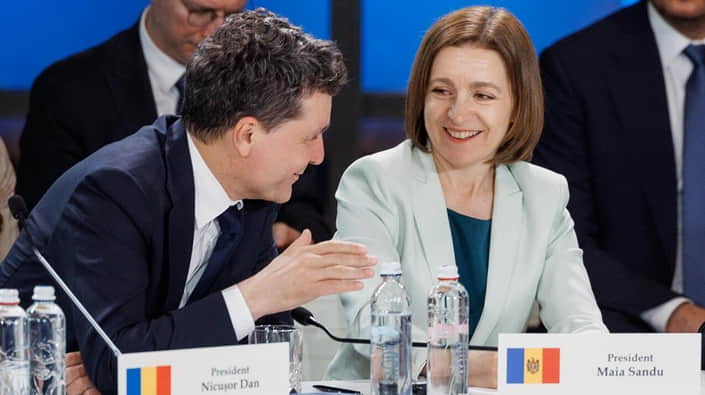
On Monday, a political earthquake struck Moldova. The country’s president, Maia Sandu, in an interview with the British podcast The Rest Is Politics, unexpectedly and candidly spoke in favour of her state joining Romania. She stated that if a referendum were held, she would vote "yes" and explained why.
This stirred up many politicians and experts in her country. The opposition is now demanding the president’s resignation. The story has sharpened existing lines of division for ordinary voters. Both supporters and opponents of the head of state have had their opinions on her strengthened.
At first glance, Maia Sandu’s statement may seem strange and even weird. At a time when other states and nations are making great efforts to gain and preserve their independence, she, while holding the office of head of state, declares her desire to give up Moldova’s independence.
But Moldova’s history explains why this isn't as strange as it might seem.
In Moldova, the idea of unification with Romania is a fully legitimate political movement. Some parties publicly declare support for Unirea (the creation of a single state) in every election. No one disputes its legality, even though in practice it would mean the end of the period of Moldovan statehood.
It is even more important to understand what Sandu’s statement about unification with Romania actually means.
Can we say that Moldova is officially moving towards such unification?
Is this possible in practice?
Do the societies of Moldova and Romania support it?
Why is dismantling the country’s independence not considered a crime?
European Pravda answers these questions.
What is "Unirea" and why is Sandu not defending independence?
There was no ambiguity in Maia Sandu’s statement in the interview. She said that she supports the accession of the Republic of Moldova to Romania and, if given the opportunity, would cast her vote in favour. "If we have a referendum, I will vote for unification with Romania", the president stated.
After the interview ended and Sandu left the room, the podcast hosts discussed this and did not hide their surprise at her words. "[Before the interview] literally everybody told us that she would not address the Romanian unification. And she went straight in there", noted Alastair Campbell, journalist and former director of communications and strategy under ex-British prime minister Tony Blair.
"Which is so remarkable, isn’t it?" agreed the other host Rory Stewart, journalist and former government minister. "Because if you are a head of an independent state, even from a position of your ego, you would never want to vote in a referendum to merge with a neighbour!"
Indeed, Sandu has supported a scenario that would result in Moldova losing its independence.
In many countries, politicians’ actions aimed at dismantling statehood would be illegal.
But not in Moldova. The explanation lies in the history of this state.
Almost all of the territory of today’s Republic of Moldova was part of Romania before World War II. In 1940, under the Molotov-Ribbentrop Pact, a secret agreement between the Soviet Union and Nazi Germany, Moscow occupied these lands. After the end of World War II, Moscow created the Moldavian Soviet Socialist Republic on this territory.
Even the very name "Moldova" is Romanian. It is a historical region, most of which remains part of Romania today. A number of villages and towns were split by the creation of this Soviet republic, with one part remaining in Romania and the other now part in the Soviet Union. To this day, on both banks of the Prut River there are now towns on both sides with the same names that were single entities 100 years ago – such as Ungheni, to take just one example.
After the occupation, the Soviet authorities did everything possible to destroy Romanian identity in Moldova. They even artificially created a "Moldovan language" (by changing the alphabet used for the Romanian language).
A reverse process is now underway. In 2023, Moldova’s parliament removed all references to the "Moldovan language" from the country’s constitution, replacing them with "Romanian".
Historical processes in this part of Europe are, of course, more complex, but this simplified description is sufficient to explain why in Moldova Unirea is not seen as the dismantling of independence, but as a return to one’s own statehood and the restoration of historical justice.
Maia Sandu is one of those who share this view.
Soft support for the unification of Moldova and Romania
The president’s statement has predictably provoked angry reactions from the Moldovan opposition.
The pro-Russian Socialist Party of Moldova issued an official demand for Sandu’s resignation, arguing that her remaining in office is a "threat to the existence of Moldova" as it concerns the "dismantling of the Republic of Moldova." The leader of the Socialists, former pro-Russian president Igor Dodon, expressed confidence that Sandu dreams of leading a united Romania. The president of Moldova also holds Romanian citizenship. This is legal in Moldova and does not provoke public protests.
However, the opposition’s outrage will have no real impact. They lack the authority and influence to initiate impeachment.
Moreover, Sandu’s statement was not a real scandal. In Moldova, few people doubted that she supports Unirea. She had simply refrained from saying so publicly until now.
Back in 2016, Sandu had said the same thing she says today: that she would be ready to support Unirea in a referendum.
This occurred during the presidential election in which Sandu ran and lost. Pro-Russian forces seized on her statement to launch media attacks against her back then. Sandu learned from that experience. She has avoided publicly endorsing Unirea, though she has not concealed the fact that she also considers herself Romanian. That proved sufficient for the electorate. Voters who support unification with Romania now form the core base of support for Sandu and her Party of Action and Solidarity (PAS).
So why did Maia Sandu decide to change tactics and publicly speak out on a topic that irritates many?
There are two likely reasons.
First, the Sword of Damocles of new elections no longer hangs over Sandu.
She is serving her second term and can no longer be elected president of Moldova. Her party has just won parliamentary elections. Ahead lie several years of an inter-electoral period, when a country’s leader has the best opportunity to work on their legacy, which, in her vision, should include returning the debate on Unirea to the public sphere.
Second, the political landscape in Moldova (and in Romania as well) has changed sharply over the past year to year-and-a-half. After finishing her term as president, Sandu clearly plans to remain in politics and retain influence over the state.
There are many unionist politicians in Moldova (those who publicly support Unirea), but none of them has real chances of entering the "top league" of Moldovan politics. Many carry a toxic, often corrupt, reputation. Some lack the charisma essential for a successful politician. Because of the absence of other strong leaders, Maia Sandu and PAS were for a long time an almost uncontested choice for unionist voters.
But that era is now in the past.
Against the backdrop of the rise of populist far-right parties in Romania (often with Russian links or funding), similar processes have begun in Moldova. The sensation of the 2025 parliamentary elections was the unionist party Democrația Acasă (Democracy at Home), whose leader, Vasile Costiuc, was previously known for his contacts with the Russian FSB. However, Costiuc turned out to be a fairly effective speaker, a populist and a TikToker, and he is now siphoning off some of Sandu’s traditional electorate. In the most recent elections, his party won 5.6% of the vote.
Sandu can no longer rely on those who voted for her and PAS in the past to be loyal. She must now compete with new far-right forces, and that cannot be done in silence.
Is Moldova preparing to unify with Romania?
In her interview with The Rest Is Politics podcast, Sandu mentioned that the first discussions about returning to Romania took place in Moldova "in the late 1980s, when the [Soviet] regime was not as strong as before."
However, no referendum was held at that time. It can be stated with confidence that it would not have had any chance of success.
During the years of Soviet occupation, Moldovan society changed profoundly. Fifty years of harsh Russification and large-scale population replacement created a significant cultural, ethnic and linguistic divide between the Soviet and Romanian parts of Moldova. For example, the Russian language became dominant in Chișinău, Moldova’s capital.
In addition, Soviet propaganda for many years shaped a hostile image of Romanians in Moldova.
Finally, at that time Romania, having only just overthrown the Ceaușescu dictatorship, was a depressing place, and union with it was not particularly attractive.
The situation has fundamentally changed.
Romania is now an EU member state. Living standards there are significantly higher than in Moldova.
The linguistic and ethnic landscape in Moldova is completely different from what it was in 1991. The era of Russification is in the past. Today, Romanian, not Russian, holds the dominant position in Chișinău.
Despite this, the majority of Moldovans still do not support unification with Romania.
Maia Sandu acknowledged this in the interview: "As president of Moldova, I do understand, looking at polls, there is no majority of the people today who would support the unification of Moldova and Romania."
Public support for Unirea in Moldova has grown in recent years, but it does not exceed 40%.
This is a high percentage, nevertheless. The authorities could consider how to persuade people and reach 50%. But there is an even more important problem: support for Unirea is very uneven across the country. It is high in the centre and west of the country, but low in the south and north, where in some cities more than 90% of people would vote against it. These are regions where Russian propaganda remains strong and anti-Romanian sentiments are artificially fuelled.
There is also a threat to Moldova’s territorial integrity. Moldova includes the autonomous region of Gagauzia. Legislation provides the Gagauz people with the right to self-determination in the event that Moldova loses its independence (this provision was written in the early 1990s precisely with the possibility of Unirea in mind). Another separate issue is Transnistria, which is still occupied by Russia. It is likely that this region might agree to reintegrate into Moldova but not into Romania.
All of this makes the idea of a referendum on Unirea highly uncertain, especially one that would not lead to deep problems in Moldova’s already divided society.
The "backup option" of Moldova’s European integration
Maia Sandu emphasised in the interview that her goal is not "Unirea at any cost."
The goal is to preserve Moldova’s stability in the face of a constant Russian threat.
Unification with Romania is one of the ways to achieve this.
"Look at what is happening around Moldova today. Look at what is happening in the world. It is getting more and more difficult for such a small country as Moldova to survive as a democracy, as a sovereign country and to resist Russia", she explained.
She added that while unification with Romania does not enjoy sufficient support, there is another model that society does support. "There is a majority of people who support EU integration, and that is what we are pursuing, because it is a more realistic objective and it does also help us again survive as a democracy", she said.
Sandu explains that there are two paths: either Moldova moves towards the EU, or towards Romania.
The fact that she constructs this dichotomy helps explain the motives behind Sandu’s unusually candid interview.
At present, Moldova has publicly set the goal of completing EU accession negotiations by 2028 (the final year of Sandu’s presidency). However, there are several obstacles on this path, stemming from Russia’s war against Ukraine.
In Moldova, many hope for a swift end to the war, a Russian withdrawal from Transnistria and the joint accession of Kyiv and Chișinău to the EU.
But a less attractive scenario is also possible. Russia could continue its aggression year after year, while Hungary’s veto, directed against Ukraine, could go on blocking Moldova’s progress toward the EU. In that case, Sandu warns, Moldova has a Plan B: simultaneous integration into the EU and NATO through unification with Romania.
This plan is complex. It is uncertain. It carries risks, including destabilisation. But if the EU is not ready for the "simple" path of integration, this may become the only alternative.
And it fits entirely into Maia Sandu’s logic of building her political legacy – one that will become an important chapter in the history of Moldova. Or Romania.
Sergiy Sydorenko,
Editor, European Pravda