Strength over law: how the US operation in Venezuela empowered Moscow and exposed its own weakness
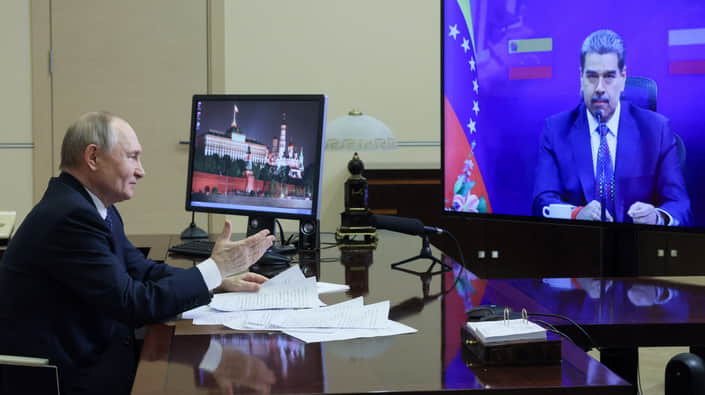
The US military attack on Venezuela on 3 January, and the abduction of the country’s authoritarian, pro-Russian leader Nicolás Maduro, demonstrated that under the new administration, the "right of the strong" has decisively prevailed over the constraints traditionally regarded as binding under international law.
Although this is far from the first such case for the United States.
At one point, Washington even tried to legalise its right to use force to intervene in the affairs of other states, recalls Hanna Shelest, Director of Security Programmes at the Foreign Policy Council, "Ukrainian Prism".
However, the "right of the strong" is not merely about the ability to change power in another country. It also includes responsibility for what happens next. The events in Venezuela, as well as the mistakes made by the Americans, give reason to doubt that such a multi-step plan actually exists.
What are these mistakes?
What do these changes mean for the global order?
Will Russia’s actions change as a result? (Spoiler: yes, definitely.) Will China perceive this as a "Trump permission slip" to attack Taiwan? (Spoiler: most likely not.)
European Pravda discusses all this with Hanna Shelest, one of Ukraine’s leading non-governmental experts on international security.
Did the US have the right to launch a military operation in Venezuela?
What happened on 3 January triggered a sense of déjà vu from 1999 and the years that followed, when the concepts of the Responsibility to Protect (R2P) and its derivative, humanitarian intervention were actively debated worldwide. The two most prominent precedents for its application were Kosovo (1999, when NATO intervened to prevent genocide) and Libya (2011). The United States also insisted on applying this definition to Iraq, both the operation following Iraq’s attack on Kuwait in 1991 and even the regime change of Saddam Hussein in 2003.
At one time, this approach was strongly promoted by the Americans. It was discussed at the UN level. In 1999, NATO incorporated this principle into its Strategic Concept (albeit without using the term R2P).
The core idea is that if human rights are gravely violated in a particular country, then once a certain threshold is crossed, other states may intervene to forcibly stop those violations. But from the very beginning, questions arose: in what situation does the right to intervene militarily in the affairs of another state in order to protect its people actually apply? Who determines where that threshold lies and when it has been crossed?
Clearly, this is not about minor issues but about serious human rights violations. But how serious must they be? For example, the suppression of Ukraine’s Maidan protests [of 2013-14] and the events in Syria are fundamentally different situations. Yet in both cases there were human rights violations. So who decides whether the threshold has been crossed?
The second question is this: even if there is agreement within the international community that the threshold has been crossed, who exactly has the right to intervene? Is a UN decision required in such cases? After all, the responsibility to protect peoples is supposed to rest with the entire world. In the early 2000s, there were even proposals to recognise that the state capable of intervening should do so.
There were vast political and expert debates on this issue back then, and attempts were made to justify this approach through the UN Charter. In 2005, a relevant UN report even appeared. However, the idea remained underdeveloped and vague and was effectively shelved. For many years, few people referred to it. Nevertheless, there was a general consensus that "humanitarian intervention" becomes possible under two conditions: when the UN is incapable of acting, and when truly serious human rights violations, gross violations, are taking place.
And if one examines the situation closely, both of these conditions were indeed present in Venezuela.
Another issue is that international law does not contain a direct norm that enshrines the concept of the Responsibility to Protect. As a result, the question of violating a state’s sovereignty will inevitably arise.
On the other hand, if there is political will, it is possible to construct a legal basis to justify US military intervention, starting with the fact that many countries around the world (including Ukraine, incidentally) did not recognise the most recent elections in Venezuela and did not consider Maduro the legitimate head of state; that the country has been subjected to sanctions for human rights violations, and so on.
In reality, however, the Americans themselves have in recent days destroyed the possibility of relying on these arguments.
A US attack without acknowledgment of the real cause
The biggest problem with the Americans’ actions is that Maduro was captured and is now being prepared for trial for reasons entirely unrelated to his regime’s brutal human rights violations.
Instead, the focus is on a drug cartel or "narco-terrorism," as Trump called it. In the publicly known charges, there is no mention whatsoever of the systemic human rights violations committed by Maduro’s regime over many years.
There is also a second point. The Americans may now fall into the same trap they fell into with Saddam Hussein. When Saddam was captured in December 2003, this enjoyed overwhelming support. When he was put on trial, the United States began to face reputational problems. And when he was sentenced to death and executed, on a religious holiday, the first day of Eid al-Adha, the Americans lost this battle entirely.
The United States wanted Saddam Hussein to remain, in the eyes of Iraqis, a criminal tyrant and a convicted offender. Instead, he effectively became a "martyr."
There is no certainty that the same will not happen with Maduro.
After all, the United States has made two major mistakes in the Maduro case.
Firstly, had they overthrown Maduro as a dictator and tried him for the crimes of his regime in Venezuela, I believe the Americans would have received far greater support, including from other Latin American countries, where Maduro was also widely disliked. Instead, accusations of "narco-terrorism" may provoke a backlash in the region.
And there is already a negative reaction in the region to US actions.
Secondly, Trump is further turning other countries against his actions. We have heard statements in which he hinted that Mexico could be next. Even though it has a democratically elected president and a democratically elected government.
As a parallel, I would recall Slobodan Milošević, who was tried by an international criminal court precisely for his actions while in power. In the end, Milošević died quietly in The Hague and did not turn into a national hero. Saddam Hussein, by contrast, acquired a completely different image.
Will this be repeated in Venezuela with Nicolás Maduro?
On the threats to other foreign leaders
The very act of seizing the leader of another state on the grounds that the United States considers him illegitimate has become a precedent in the 21st century. And given Trump’s other actions, this has serious consequences.
It was assumed that any Western leader of foreign minister could fly to New York every September for the UN General Assembly knowing that the United States guaranteed immunity even to hostile leaders at the worst of times. Gaddafi, Iranian ayatollahs and Soviet leaders traveled to the General Assembly during crises without any problems.
At most, the United States might play games by denying visas to parts of a delegation, but the personal security of a leader was never in question.
Now, however, the question arises: if the Americans act this way on the territory of another state and Trump immediately hints that he "might do it again", where is the certainty that they would not do something similar on their own territory? Given the unpredictability of the current US administration, governments in many capitals are now asking: alright, who is next on Trump’s priority list? Where does he want to change power next?
So this has indeed opened a Pandora’s box.
Is the US becoming the "world’s policeman" again?
It looks like Trump would like to play such a role, and this is an interesting detail because it brings together two of his contradictory impulses.
On the one hand, he advocates American isolationism rather than the role of global policeman. On the other hand, he likes to demonstrate strength and to achieve visible results.
Trump has to seek a compromise between these impulses. It seems for now that the United States may arrive at a policy resembling the Monroe Doctrine (1823), under which the US acted in the second half of the 19th century and the early 20th.
At that time, too, there was American isolationism, but it did not mean that the US focused only on itself. Rather, it meant: this is our hemisphere. We are responsible for the entire American continent. We are in charge here, but we do not interfere in Europe.
The US may now move toward a similar policy.
They would see themselves as a "continental policeman" for North, Central and South America, but would not assume such a role with regard to China, Taiwan, the Philippines or Europe.
And here, in Europe, there will be less and less of America.
Consequences for Russia
The United States has always believed that it has the right to do more than other countries. From Washington’s perspective, therefore, the operation in Venezuela did not expand the permissible framework for others.
This also changes little for China. Beijing considers Taiwan its territory and has never concealed that it might use force to retake the island. They have never tried to disguise this position, so they do not need the Venezuela precedent to justify their actions if, at some point, they decide that the time has come for a military operation.
Another issue is signals coming from the US may indicate that it is gradually giving up on Taiwan – something that fits neatly into the logic of a return to the Monroe Doctrine. But this is a development entirely unrelated to the operation in Caracas.
Russia, however, will be seriously affected by what happened in Venezuela.
History shows that Russia consistently seeks to copy past US actions and invokes them in international forums.
For many years, there was not a single conference at which one would not hear a Russian representative, expert, diplomat, or politician say: "Why is it allowed for the Americans but not for us?" Even when they seized Crimea, they constantly justified it by arguing that if the Americans entered Kosovo in 1999, why could they not do the same? Or why was it allowed in Iraq but not in Georgia?
For this reason, Trump’s actions will undoubtedly become a green light for the Russians.
They will use the events in Caracas to justify their future actions.
Moreover, Maduro’s detention was a painful blow for Moscow – one that it will have to come to terms with.
Russia had been a security guarantor for Maduro. It supplied Venezuela with Russian air-defence systems, which turned out to be ineffective. In addition, Maduro had been protected for several years by Russian guards, former Wagner fighters, who proved unable to help in any way. [Venezuelan authorities claim that most of the dictator’s guards were killed during the raid by the US Delta Force special unit. – EP]
Now, all Russia can do is issue statements calling on Trump to release Maduro. There is nothing more they can do.
This is a serious blow for the Kremlin.
This is already the second time in a year that Russia has failed in its role as a guarantor. First there was Syria, where Assad lost power and the Russians simply washed their hands of the situation. At least Assad’s life and freedom were preserved. He was evacuated to Moscow, although he had expected more, since the Russians had promised him everything. Things turned out even worse for Maduro.
Against this backdrop, other dictators who rely on friendship with Russia are now facing a serious question: will they actually receive its protection?
This does not mean that everyone will turn away from Russia tomorrow, but they will no longer entrust it with their personal security. And in negotiations with the Russian authorities, partners of this kind, from Africa, Iran, Latin America and elsewhere, will now make very different demands of Moscow. Russia has lost important leverage in its relations with states in its sphere of influence – the guarantee of regime security and the safety of their leaders.
On the possibility of similar operations against democratic countries
Europe’s reaction to Trump’s actions is vague and restrained for now, which is a pragmatic choice. First, everyone is waiting to see how events unfold. Second, no one wants to provoke Trump unnecessarily, especially now, when talks related to Ukraine have intensified.
Many European leaders are currently facing a difficult moral choice. Even if they would like to condemn US actions, they understand that speaking out too sharply against Trump could cost them the contact they have built with him in recent months, which could negatively affect the Ukrainian track.
Ukraine matters more than Venezuela for them.
As for the destruction of the world order… let’s be honest: the world order has long been broken. In fact, it no longer exists. The old rules and principles no longer work.
Yes, one can analyse the threat of similar actions by Trump toward other countries, including NATO partners, but for now this does not seem likely.
After all, such operations are not Trump’s decision alone.
Such actions require the involvement of many actors and months of planning and preparation. This means that they must be approved not only by Trump, but also by a significant number of relevant professionals. Ultimately, even the decision to begin preparing such operations is not made by Trump alone.
Second, even after Venezuela, Trump will face a certain degree of criticism within Congress, and the administration will be forced to take this into account next time.
Therefore, if we are talking about actions against a NATO country, such as Greenland, I cannot imagine such an operation being approved even under this administration.
Even in the case of Mexico, which has a legitimately elected president, taking such a step would be extremely difficult. After all, there is a powerful Mexican lobby in the United States.
Finally, it is important to understand that the operation in Venezuela has a very strong domestic dimension and is largely aimed at the US midterm elections.
One of the most sensitive and decisive issues in the United States today is drugs and the fight against drug trafficking. This is precisely the issue around which Trump is building his domestic messaging. And it is exactly this that became the basis for the charges and the pretext for the forcible capture of Maduro. He will therefore "sell" this special operation during the elections as proof that he has protected American citizens from the spread of drugs.
An attack on a NATO country would not produce a similar effect. On the contrary, it could turn voters against him. Venezuela, however, could very well become the story on which Trump will build his party’s campaign in the 2026 congressional elections.
Sergiy Sydorenko
Editor, European Pravda