Bringing Ukraine into the EU by 2027: exploring the idea of "membership-lite" as part of a peace deal
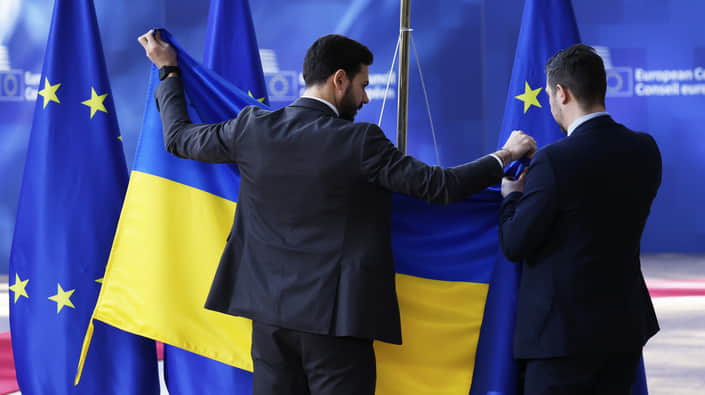
Ukraine is apparently due to join the European Union in 2027 according to the draft "peace plan" agreed upon by Ukraine, the United States and some European leaders. We say "apparently" because the full text of the plan has not been published and the wording of its provisions remains subject to negotiation.
Media leaks in early December suggested that the peace agreement envisaged Ukraine joining the EU as early as 1 January 2027, but this date is no longer under consideration. Now, even the most ardently pro-Ukrainian leaders don’t see it as a serious suggestion.
However, no one has abandoned the idea of a rapid "geopolitical accession" for Ukraine.
Although this is impossible under current EU rules, Brussels has made no objections. Moreover, EU institutions have begun discussing how to implement this idea. This is what is meant by the concept – recently reported on by the Financial Times – of "membership-lite" for Ukraine.
That said, a final decision is still a long way off.
Not all EU member states are ready to back the idea.
And the scheme depends on two of the most unpredictable players in global politics – Vladimir Putin and Donald Trump.
EU accession as a condition for ending the war
Ukraine’s leadership has been talking about the need for rapid EU accession for quite some time. But the idea gained real momentum on 18 August, when President Volodymyr Zelenskyy and European leaders made a joint visit to the White House.
Trump was informed that European and Ukrainian leaders agree that Ukraine’s accession to the EU is a mandatory condition for a sustainable peace. Trump then made a phone call to Hungarian leader Viktor Orbán demanding an explanation as to why he is blocking Ukraine’s progress towards EU membership.
And in the autumn, when the United States returned to peace-making efforts, any lingering doubts about whether the White House understood the importance of this issue vanished.
EU membership for Ukraine acquired the status of a "key security guarantee".
Trump’s team included it in their peace plan – first in the expanded 28-point version, and later in the 20-point plan, in an even more favourable wording for Kyiv. Thus Ukraine’s accession to the EU became one of the key conditions for peace.
This also completely changed the paradigm of how Ukraine’s EU integration is perceived by European politicians and opened up new opportunities for Ukraine.
EU accession for Ukraine in 2027? Not necessarily
At first, few in Europe took the idea of timelines for Ukraine’s EU accession seriously. One of the main reasons was that the plan included a date that was clearly unrealistic – 1 January 2027. This would have meant that less than a year remained until accession.
It is clear now that this is impossible.
German Chancellor Friedrich Merz has publicly spoken out against this. "[The] accession [of Ukraine to the EU] on 1 January 2027 is out of the question. It's not possible," he said last week.
Ukrainian officials have also dropped all talk of 1 January 2027, a date that would require all the preparatory work to be completed and all the legal formalities to be fulfilled by the end of 2026. For example, last week President Zelenskyy said in response to a question from European Pravda that Ukraine intends to be technically ready "in 2027". Given that technical readiness must be followed by legal and political decisions, this rules out the possibility of a status change as early as 1 January.
Kyiv also acknowledges that the accession date may change as a result of the negotiations.
If 2028 is stated in the documents, Ukraine will support that.
Zelenskyy is already leaving wiggle room as regards the date. In an interview with the Czech media outlet Rozhlas, he acknowledged that 2027 is desirable but not mandatory. "We would like it to happen in 2027. Ukraine will be technically ready. But it depends on the consent of our partners, and I cannot speak for them," he said.
Earlier, Deputy Prime Minister for European Integration Taras Kachka predicted in an interview with European Pravda that Ukraine would be technically ready to join the EU in 2028.
And Foreign Minister Andrii Sybiha, commenting on the idea of 2027, noted in an interview with European Pravda that there are risks attached to declaring an overly ambitious date, as it may ultimately lead to public disappointment.
EU accession despite the rules
Where did the idea of 1 January 2027 come from? According to European Pravda, it was proposed because 2027 will be a year of change in Europe. In April, France will elect a new president. Parliamentary elections are set to be held at the end of the year in some countries, including Italy and Poland. Kyiv wanted to complete the procedures while these countries are still led by their current leaders.
On the other hand, it is harder for politicians to make bold decisions during election campaigns, so it is not a given that 2027 will be the easiest year in this respect.
In reality, however, the main challenge is not choosing a date, but getting the EU to agree to announce a date for Ukraine’s accession.
Any date, whether that’s 2027, 2028 or another year.
The EU has consistently emphasised that enlargement is a "merit-based process". First reforms, then legal steps. Setting a date undermines this principle.
Moreover, the enlargement rules are the same for all candidate countries. Making an exception for Ukraine would raise questions about the other countries waiting in the queue for accession.
In addition, the European Union is above all an economic bloc. The EU acquis, i.e. the common European body of law, sets out common regulations for businesses in all the member states and equal conditions for competition within the EU’s single market.
This is the main reason for the strict reform requirements that are imposed on candidate states. If a member state with different production standards, different control systems and different competition rules were to join the EU, it would distort the single market. Even the rule-of-law requirements imposed on Ukraine are aimed at ensuring equality for businesses and the proper functioning of the single market.
If a state as large as Ukraine were treated "differently" in this sense, it would have very serious consequences for the European market. Setting an accession date could result in a situation in which that day dawns and Ukraine is still not ready.
At first glance, these considerations should be enough to put an end to the idea of Ukraine’s "geopolitical accession" to the European Union.
But Brussels is not saying no.
Europe’s silence as a sign of (tentative) consent
It must be emphasised: signing a "peace plan" that includes a date for Ukraine’s EU accession does not resolve these problems. It is also significant that the "peace plan" does not require EU approval or the signatures of European leaders. The document will be signed by Zelenskyy, Putin and Trump, and their signatures will have no legal consequences for the EU.
Yet the political reality is more complex.
The clause specifying a date for Ukraine's accession was added to the 20-point "peace plan" only after consultations with the leaders of the European institutions and key EU member states that were involved in finalising the agreements.
Moreover, so far not a single European leader has opposed this clause.
Even Hungary’s Viktor Orbán, whose anti-Ukraine policy is part and parcel of his domestic election strategy, has not once spoken out against the inclusion of this clause in the peace arrangements.
The Hungarian prime minister’s position deserves particular attention given his repeated use of his veto on Ukraine-related decisions. For Orbán, relations with the current US administration have long been a foreign policy priority. He cannot criticise any Trump initiative, and the "peace plan" is one of them. This gives some hope that if a peace agreement is signed in which Ukraine’s EU accession is a mandatory condition, Trump would force Orbán to lift Hungary’s veto if it stood in the way of "Trump’s plan".
Other leaders have also refrained from expressing criticism.
Merz’s statement that it is not possible for Ukraine to rapidly join the EU is about a specific date – 1 January 2027. He emphasised this date and left strategic uncertainty as to whether Ukraine’s accession to the EU could be possible, for example, by the end of 2027.
It is also worth noting separately that there has been absolutely no resistance, and even some support, from the European Commission, even though until recently Brussels has been the first to remind Ukraine that joining the EU without meeting the conditions is impossible on principle.
Can Ukraine join the EU without being fully ready?
There is a reason for Brussels’ cautious support for this idea. Brussels hopes to find a creative way to reconcile EU rules with the political need to speed up Ukraine's accession.
Two ideas have been made public so far.
The first was voiced by President Zelenskyy, who has proposed that Ukraine join the EU "in advance" while taking on a legal obligation to complete reforms after accession: "Post factum, Ukraine can do everything it is supposed to do – just as it was with our candidate status. It worked! We became a candidate and committed to taking several steps afterwards. And if we don’t fulfil them, there will be no status. This is a normal approach."
This procedure, however, would not work in the way the Ukrainian president described.
A country not technically ready for membership cannot become part of the EU’s single market, as this would create risks for that market, not to mention the host of legal and political problems that would be caused by the existence of a different accession procedure.
That said, Zelenskyy’s proposal could become an element of, or the basis for, a new creative solution.
For example, the EU could agree to complete a significant portion of the political procedures before Ukraine completes its reforms. It might even be possible to sign an accession treaty and begin ratification procedures, but with a legal condition that the treaty would only enter into force after the European Commission and the Council of the EU have confirmed that Ukraine has done all its "homework".
The second creative approach is the idea of "EU membership-lite" revealed by the sources cited by the Financial Times, in which Ukraine would initially have limited powers within the EU. This would minimise the impact of an unprepared Ukraine on the single market and could also make it easier to reach a consensus within the EU.
European Pravda sources have confirmed that discussions of this idea are ongoing in Brussels and individual member states, but they are at a very early stage. There is no formal document outlining the new scheme.
This approach would require Kyiv to consent to a "scaled-down" form of membership. Previously, Kyiv has insisted that only full membership for Ukraine should be considered. But Kyiv is now in an exceptional situation. If this approach could guarantee Ukraine fast-tracked EU accession on a fixed date, Zelenskyy’s team might view the idea more favourably.
These two approaches could be combined, or a third one could emerge.
It’s important to emphasise that no decisions, not even interim ones, have been made.
The legal structuring of such an idea would be a major challenge. And the absence of objections from member states is no guarantee of unanimous support if it comes to a vote.
Ultimately there is no certainty that the peace plan will be signed at all.
Nevertheless, this story shows that the European Union is willing to step beyond its own red lines when it comes to membership for Ukraine.
Sergiy Sydorenko
Editor, European Pravda