EU trust at 9%: reform delays threaten Ukraine's path to EU membership
On 11 December 2025, a meeting of the EU Council took place in Lviv that was highly symbolic and very important for Ukraine. Firstly, Ukraine received its first benchmarks – the criteria that must be met in order to join the European Union. Secondly, the Ukrainian government and the European Commission, in the presence of representatives of all the member states, agreed on what needed to be done to restore trust in Ukrainian reforms.
The agreement was informally dubbed the "Kachka-Kos plan" after the officials who signed it – Ukrainian Deputy Prime Minister for European Integration Taras Kachka and European Enlargement Commissioner Marta Kos.
But for the EU, it is much more than a declaration by the Ukrainian deputy prime minister.
Enlargement Commissioner Marta Kos explained the logic behind the plan in an interview with European Pravda. "One of the reasons why we adopted this 10-point plan is to rebuild trust with the member states because of what happened on 22 July [when Ukraine undermined its own anti-corruption reforms – EP]. The 10 points mostly have to do with fighting corruption. But these 10 points are what is really important. We expect that Ukraine will fulfil them [within a year]."
Since the plan was motivated by EU member states’ lack of trust after Ukraine’s move against anti-corruption reforms, it is focused solely on anti-corruption reforms and issues relating to the rule of law.
The government set itself a deadline of 12 months to implement all 10 points of the plan.
Three of those months have passed, yet almost zero progress has been made.
It is hardly surprising, then, that European diplomats and officials are increasingly warning of a growing lack of confidence in Ukraine’s commitment to the reforms required for EU accession.
Parliament is not demonstrating a willingness to work. And even the government, which undertook the commitments needed to rebuild trust, is stalling on their implementation. Here we publish the first expert analysis of the fulfilment of the Kachka-Kos plan, which reveals the biggest issues and some progress, which could be developed further.
Kyiv needs to demonstrate results as soon as possible. Because what’s at stake is our European partners’ trust in the government’s future promises – and by extension in the very foundations of Ukraine’s path towards EU membership.
Who counts and how they count
Both the government and the expert community are well aware that the implementation of the Kachka-Kos plan is a critical issue in EU-Ukraine relations, including in the context of accession.
To some extent this is paradoxical in that formally this document is not part of the accession process – it stands alone. But in reality, for many EU member states the plan’s implementation is an indicator of whether one can speak of real progress by Ukraine in carrying out accession reforms.
European Commissioner Marta Kos explained this during her visit to Kyiv a month ago. In her interview with European Pravda, she emphasised that this plan encapsulates the main areas for reform being monitored by EU member states. "These are the priorities where we'll be very strict that the reforms should be done," she said, stressing that Ukraine itself set the deadline of 2026.
In the same interview, Marta Kos also said she was aware of the "civic monitoring" of the plan and is in contact with the organisations that will be conducting it. "I met some of them in Kyiv to get a better picture – to have a view through some other glasses, not just our own, those living in the Brussels bubble," she explained.
This article presents the initial results of the monitoring, which is known as Membership Check.
It’s true that these are nowhere near all the reforms that will be required for Ukraine to become a member of the EU.
But without these, there will be no real progress. That is why they deserve special attention.
The monitoring is conducted by a coalition of eight expert organisations, led by the New Europe Center, which focus on European integration, anti-corruption issues and judicial reform. The other members of the group are Mezha, European Pravda, ANTS (the National Interests Advocacy Network), the DEJURE (Democracy, Justice, Reforms) Foundation, the Centre of Policy and Legal Reform, the Anti-Corruption Action Centre, and Transparency International Ukraine.
To start with, we should explain the methodology.
At present, the consortium is only measuring the implementation of the Kachka-Kos plan by the Ukrainian state. Here we proceed in the same way as the EU: although formally the plan was approved by the government and signed by Deputy Prime Minister for European Integration Taras Kachka, as far as the Europeans are concerned, it is a plan for the whole of Ukraine. What matters is the end result. And if that result isn’t there, Brussels and the other capitals won’t care who messed up or why a particular Ukrainian commitment has not been met.
This, incidentally, is also how the other accession reforms are assessed.
Moreover, the end result is of key importance. It won’t be enough just to set up some "working groups" and "comprehensive dialogues", which all too often merely go through the motions. No reform – no high score.
Of course, the political process matters too, so even statements by top government officials to the effect that Ukraine agrees to carry out a certain reform, or the development of a reform strategy, are worth a few initial points. But this earns no more than 10% of the total score.
Drafting a piece of legislation and registering it in parliament can earn no more than 20% of the points (together with the 10% mentioned above).
After that, if a draft is genuinely good, the score can be raised to 50% by preparing it for adoption (passing a law at first reading, drafting amendments for the second reading, obtaining an expert assessment from the European Commission, etc.), because even a good law or secondary legislation only matters when it has been adopted. The coalition is convinced that preparation should not be worth more than half of the points.
Only the adoption of a law or implementation of a reform allows a score of up to 100%.
No rubber-stamping is possible. A decision must be of high quality and effective, so the coalition analyses the substance of the proposed reforms.
Firstly, the proposed/adopted reform must align with the goals of the Kachka-Kos plan. Secondly, reforms are not being carried out "for Marta Kos", but to bring about practical change in Ukraine, so the chosen implementation option must produce institutional and practical results. Thirdly, this area of reform matters specifically in the context of Ukraine’s progress towards EU accession, so reforms are analysed for compliance with the Interim Benchmarks of the Fundamentals cluster (chapters 23-24 of the accession negotiations). And if these benchmarks provide further clarification of the substance of a reform, the authorities’ actions must take that into account.
Finally, we should emphasise that the consortium’s assessment may be different from Brussels’. This consortium (albeit with slightly different members) experienced this when we conducted a Candidate Check study on Ukraine’s fulfilment of the EU candidate requirements. Our goal is to show real progress made by Ukraine, push forward reforms that have stalled, and highlight what has been achieved, while ensuring that the European assessment is also appropriate.
However, so far there has been little to highlight.
A quarter of the time gone and minimal progress
All the points of the Kachka-Kos plan are important, but they vary in complexity of implementation and practical effect. The biggest is point 1 (Adopt comprehensive amendments to the Criminal Procedure Code and other legislation to ensure fast and high-quality justice). Even in the text of the plan it takes up the most space, consisting of five major elements, so the assessment of this point has the highest weighting – 20 points. We have also singled out two points – 6 and 9 – which do not require new reforms to be developed and adopted. These points received a weighting of 5 points each. The remaining seven elements of the plan received 10 points each, meaning that the total maximum score is 100 points.
The timeframe within which the entire plan must be implemented has also been defined. In the document signed by Taras Kachka and Marta Kos, Ukraine declared its intention to implement the measures set out in the plan within a year. And although this clause is formulated in a way that gives Kyiv the possibility to extend the timeframe, the European Commission expects Kyiv to complete everything during 2026.
The reality so far is very discouraging.
Three whole months of 2026 have passed – 25% of the time within which the EU expects the entire plan to be implemented. Yet the expert assessment currently gives Ukraine only 9 points out of 100 for its execution – not even 10%.
For some points, the score is zero or 0.5 (for example, when a point consists of two elements and there is progress on only one of them. Even that is minimal).
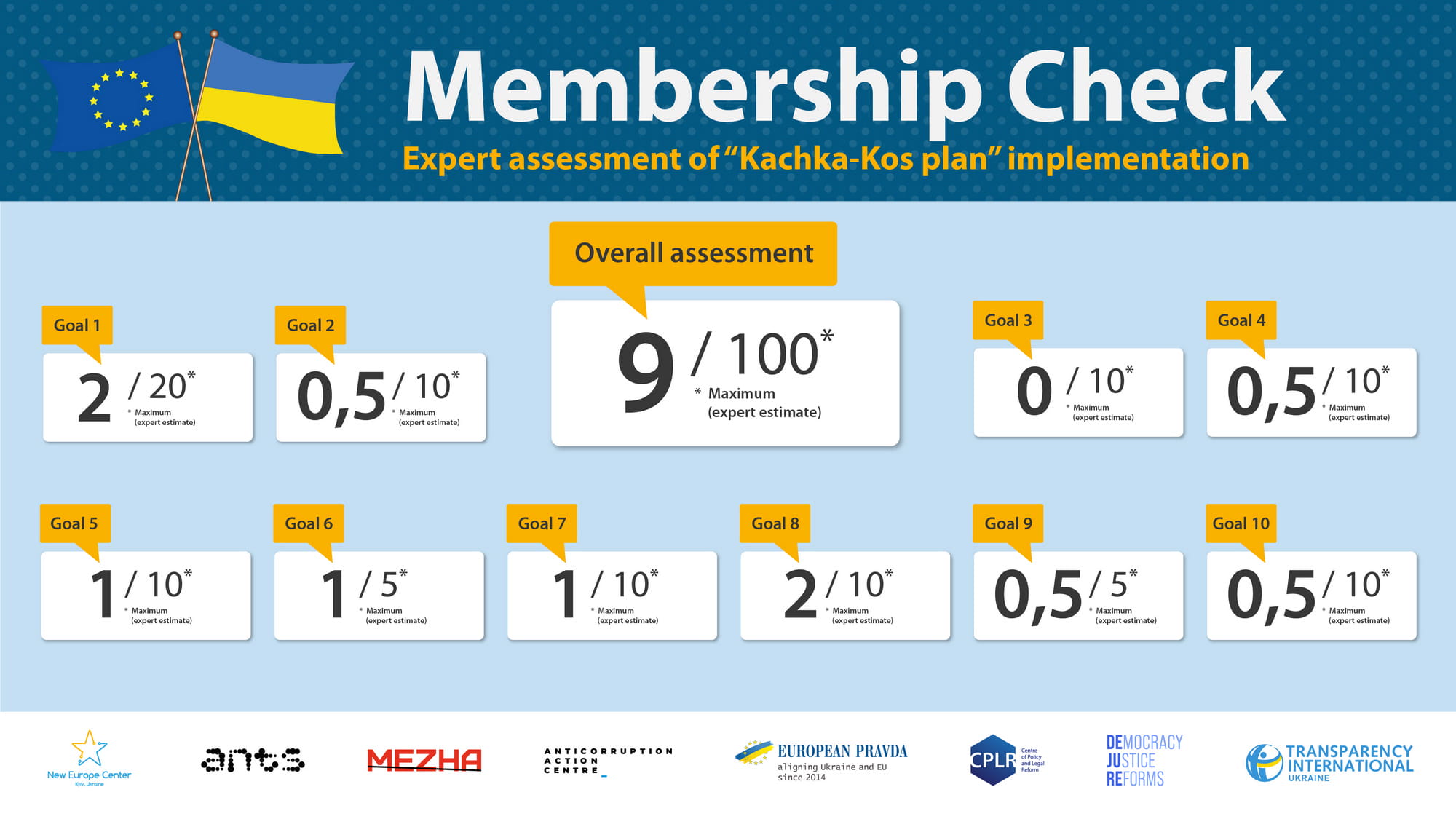
This result is a long way from acceptable. And if Ukraine continues to move at this pace, the complete failure of the plan is inevitable.
It is sad to write this, but that is the reality.
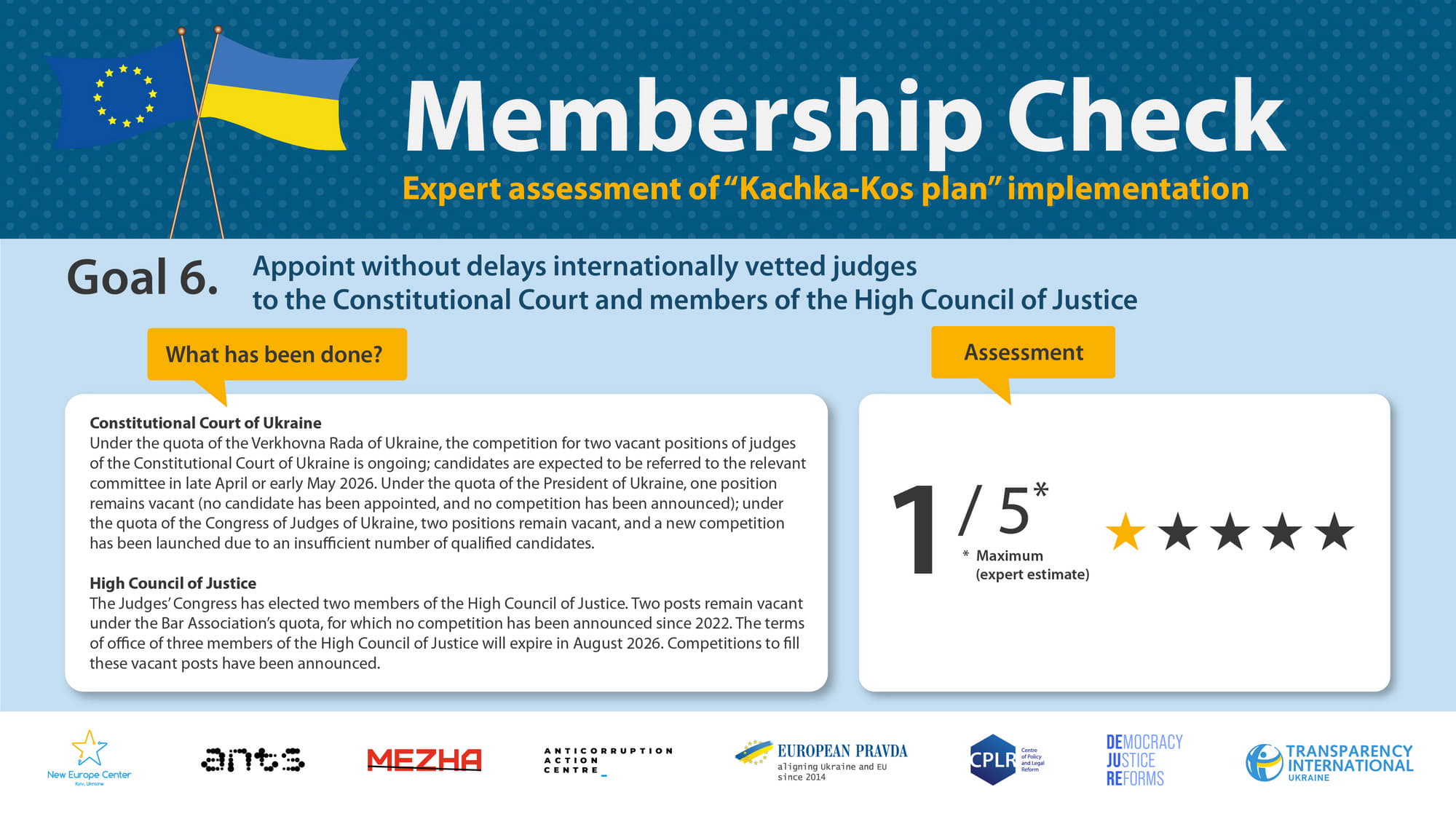
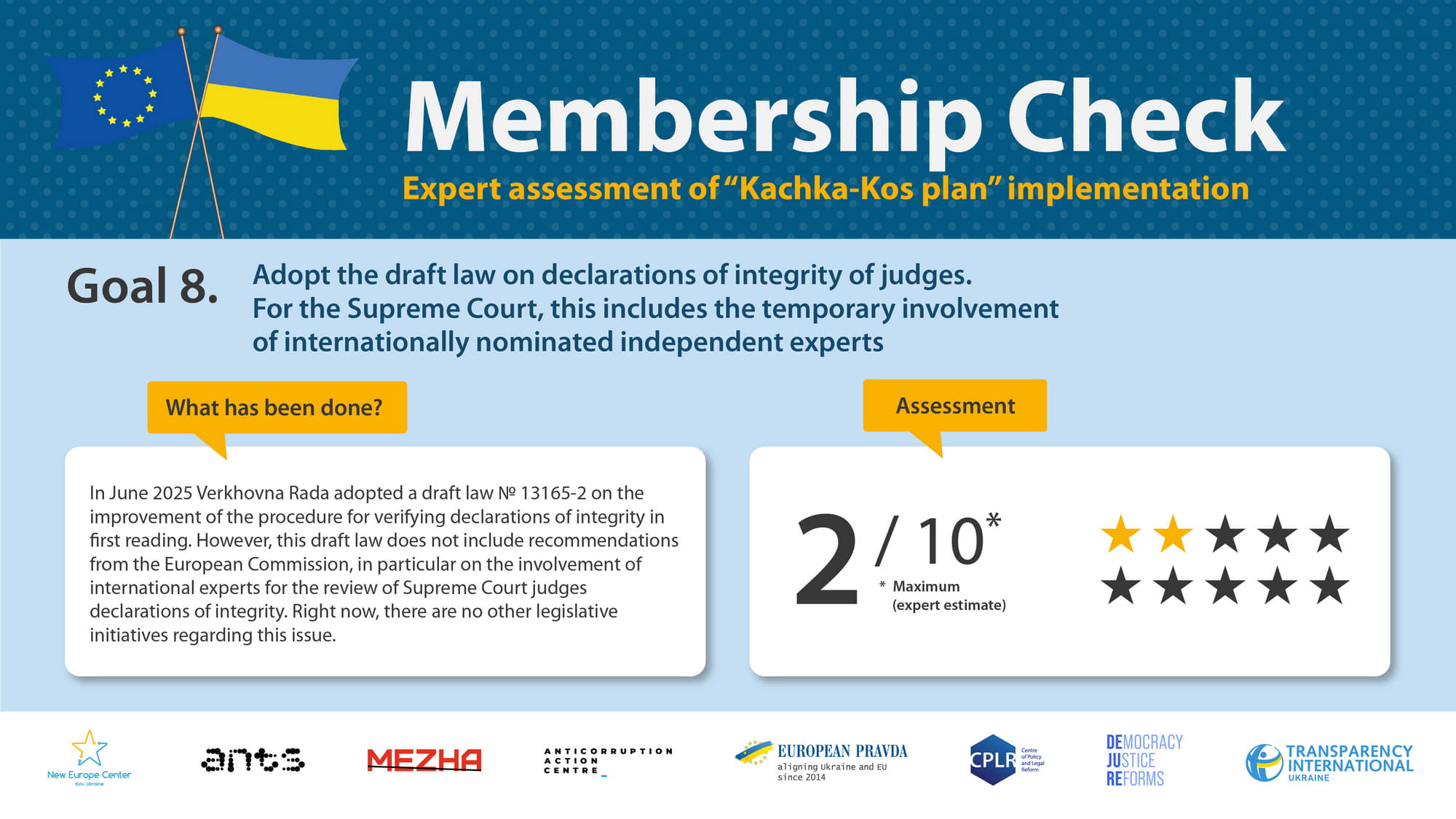
There are only two out of the ten points where Ukraine has achieved even 20% implementation – at the level of "a draft law has been registered". These are points 6 (Appoint internationally vetted judges to the Constitutional Court and members of the High Council of Justice) and 8 (Adopt the draft law on declarations of integrity of judges; adopt legislation aimed at improving the enforcement of court decisions on monetary and non-monetary obligations and digitalisation). Moreover, with regard to the latter even this assessment is stretching it a bit, because the draft law on judges’ declarations of integrity fails to meet a direct requirement of the Kachka-Kos plan: it does not apply to Supreme Court judges.
Point 6 is simpler, because this is an element of the plan where no reforms need to be adopted. Ukraine simply has to carry out what it has already committed to.
 |  |
However, four points of the plan are clear stragglers.
Two of them demonstrate the failure of prosecutorial reform, which the European Commission and experts were pointing out as long ago as last year. Despite these warnings, Kyiv currently gives no sign that it has listened to its European partners. According to the European approach, the prosecution service is part of the justice infrastructure, which is why "prosecutorial" requirements have been included in this plan.
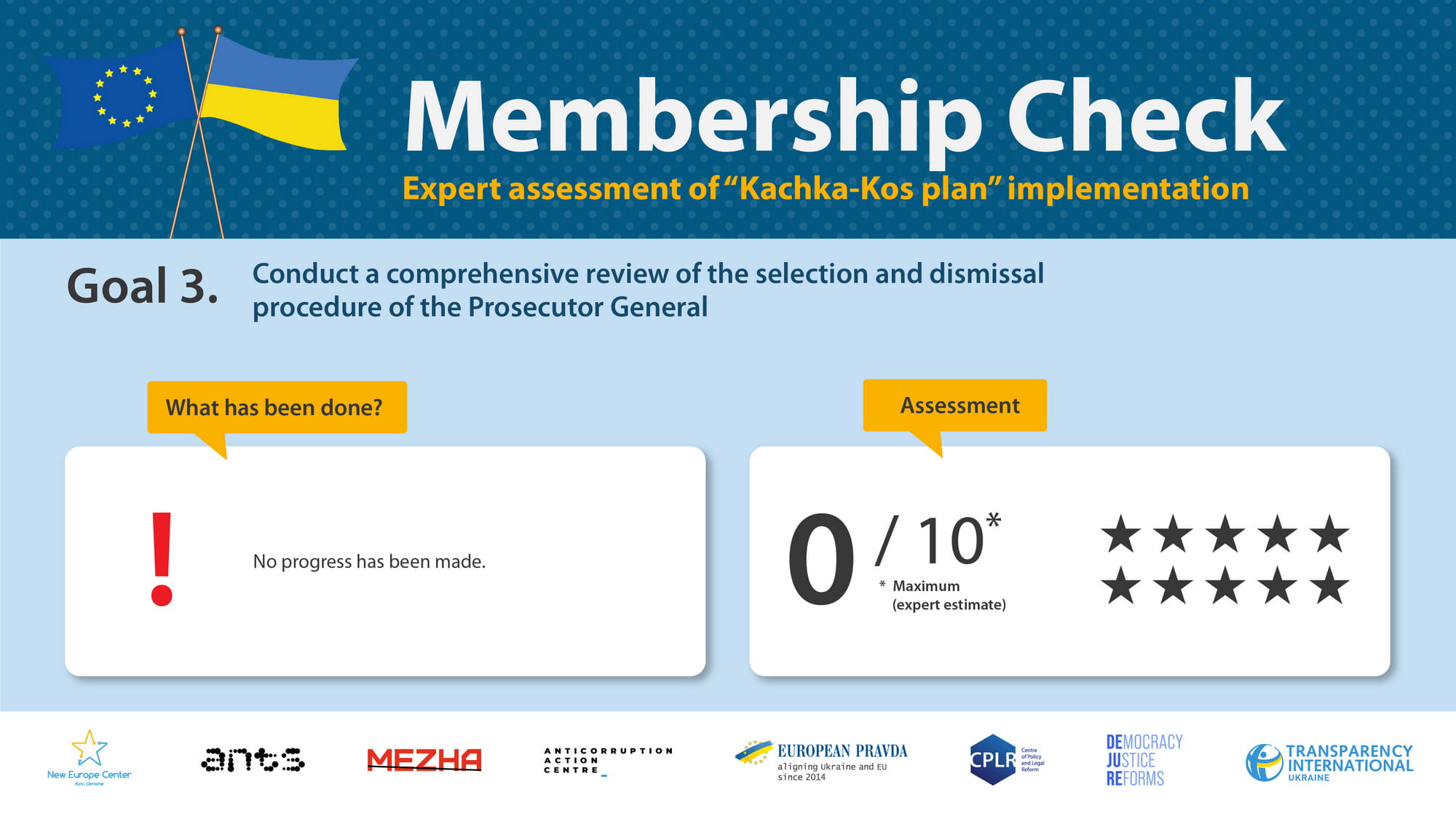
Thus, on point 3 (Conduct a comprehensive review of the selection and dismissal procedure of the Prosecutor General), Ukraine has a dismal 0 points and the note "No progress has been made".
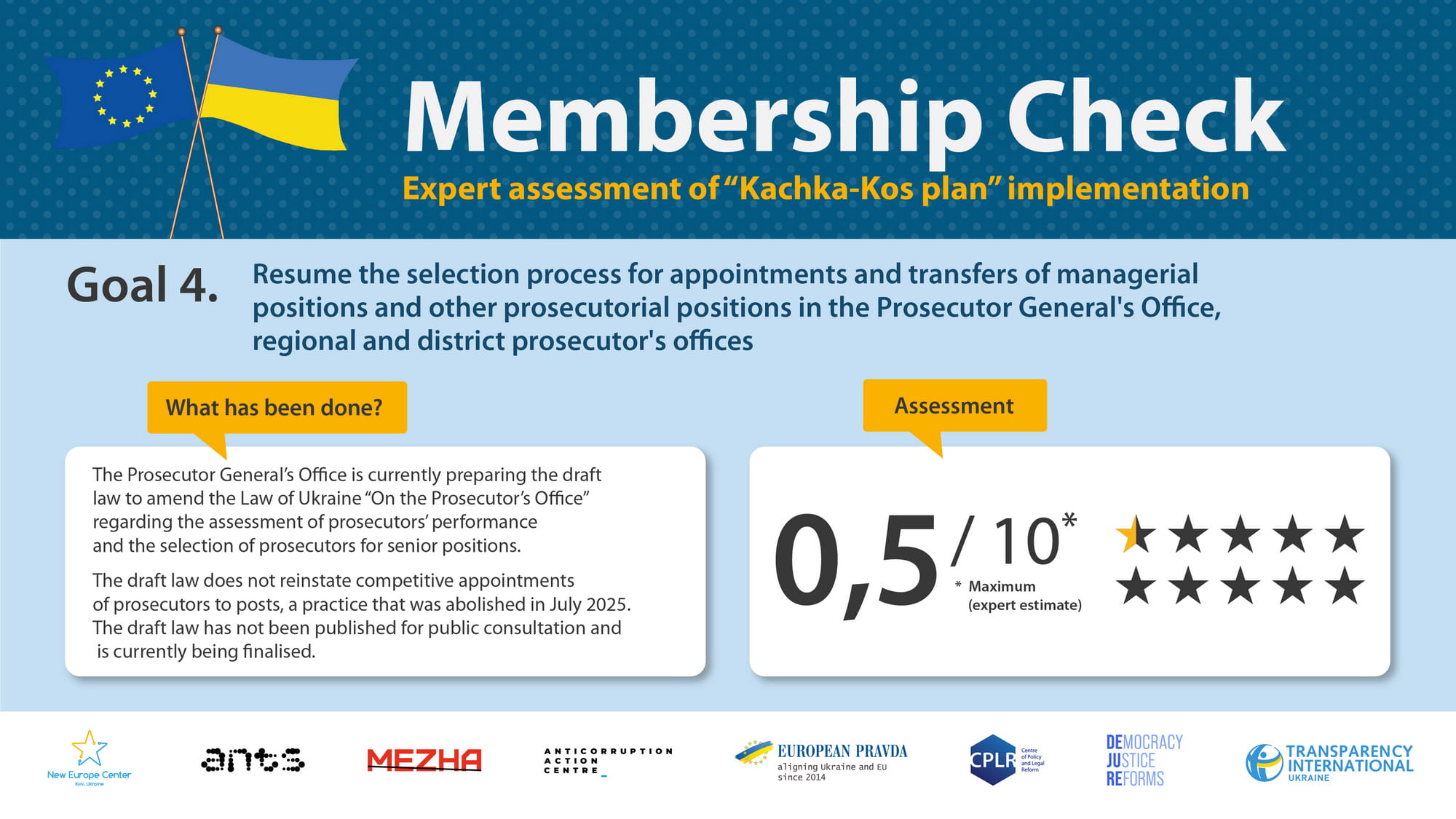
On point 4 (Ensure a transparent and merit-based selection process, appointments and transfers for prosecutors to significant positions), formally at least some actions and discussions have taken place, so Ukraine has 0.5 points out of 10. This reform has particular weight, as it is about reinstating anti-corruption reform after 22 July 2025, when parliament voted for and the president immediately signed a law rolling back anti-corruption reforms and introducing authoritarian changes to the functioning of the prosecution service. And while the anti-corruption framework ultimately had to be reinstated, the authorities "forgot" about the prosecution service and still appear to have no intention of tackling the problem.
 |  | |
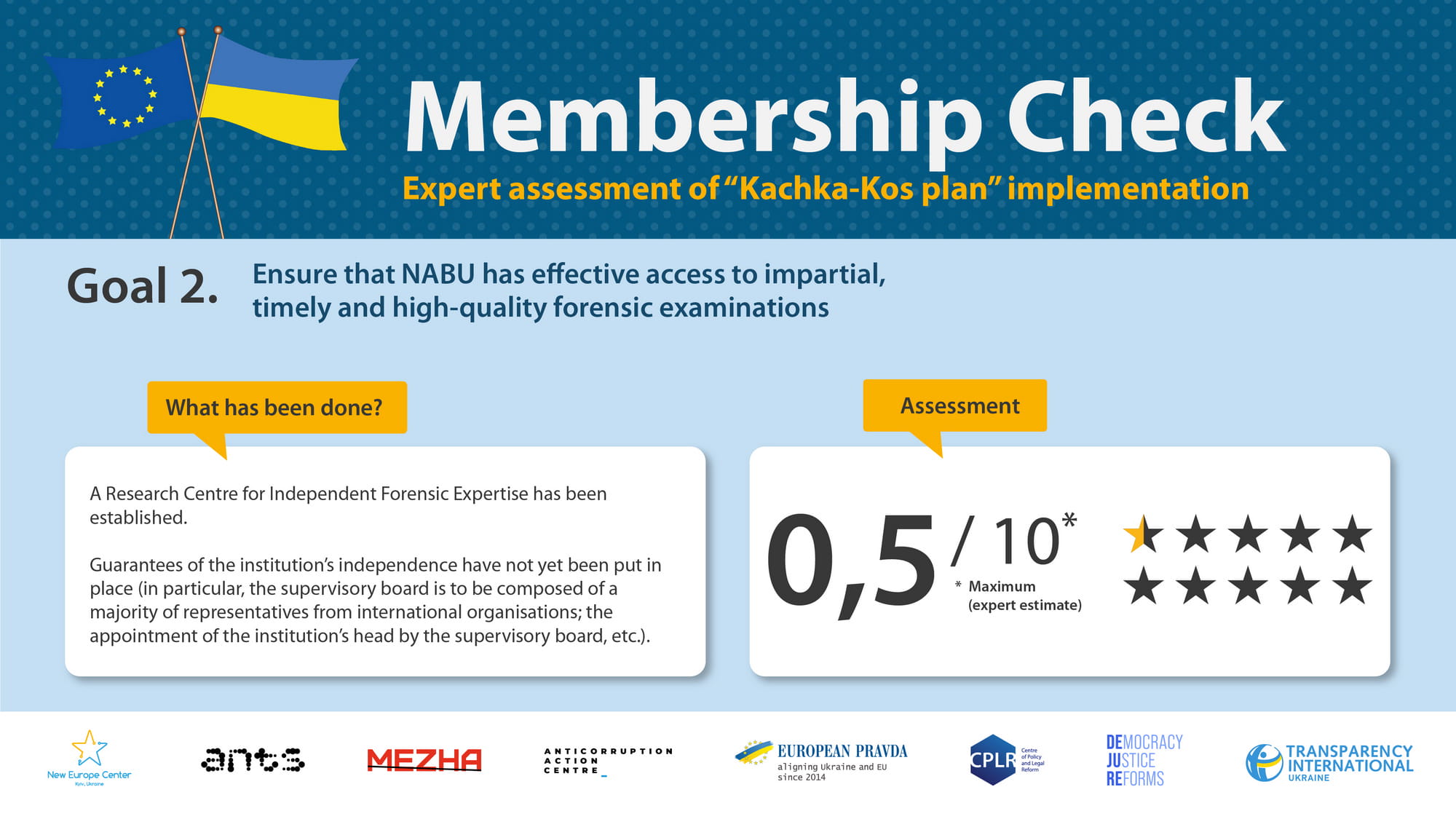 | 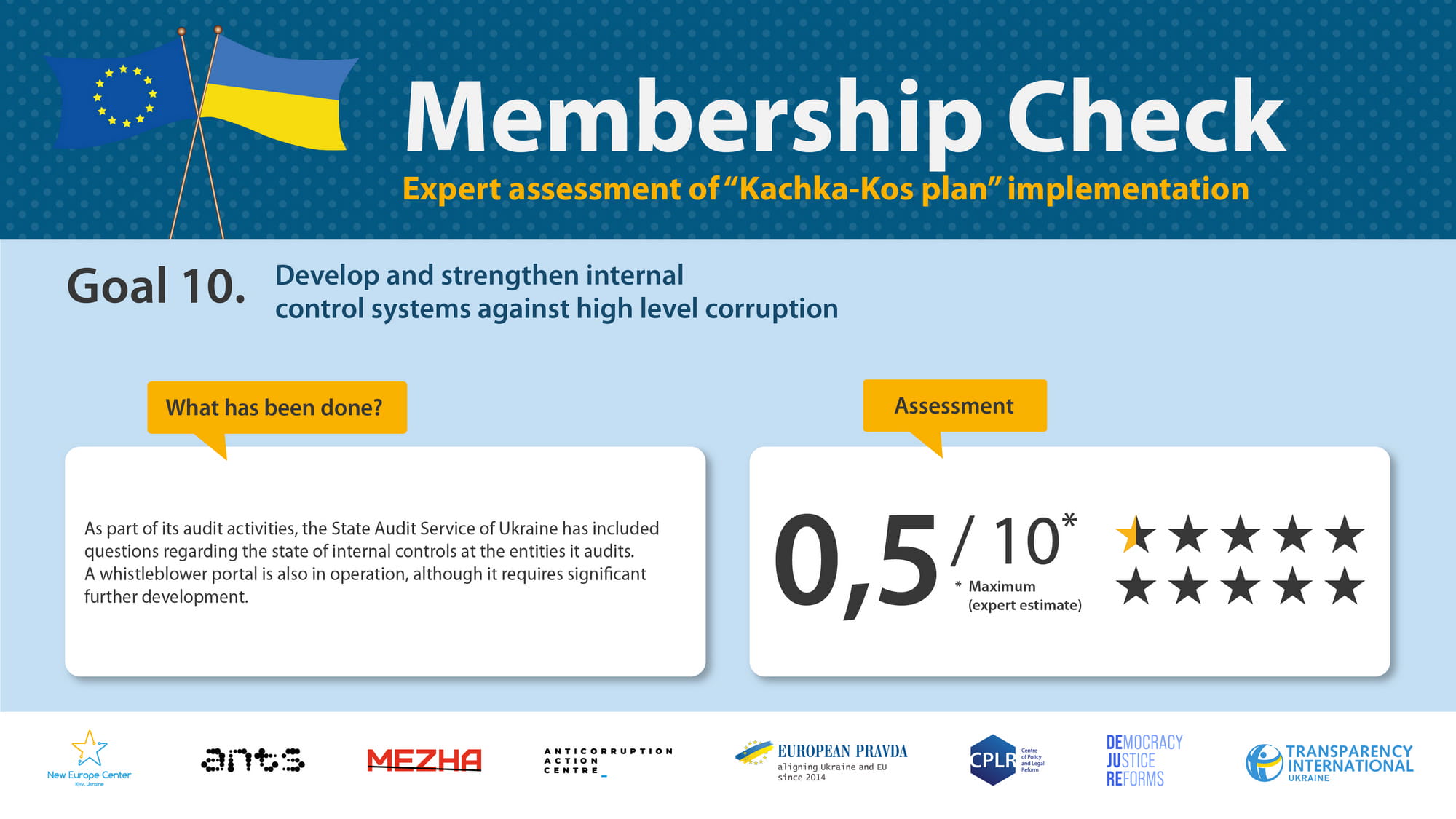 |
Two other points with extremely low scores of 5% each are point 2 (Ensure that NABU has effective access to impartial, timely and high-quality forensic examinations) and point 10 (Develop and strengthen internal control systems against high-level corruption). Needless to say, these elements are a litmus test for Ukraine’s partners – yet Kyiv has shown no visible progress in implementing them.
Three other elements could be called mid-level performers based on the results, since they currently have 10% of the points, which is slightly above the average score.
But can a sector be called mid-level if there are no tangible results?
After all, 10% corresponds to a level where there are only general ideas about how to implement a point, or statements by top officials, but no official draft decisions.
This is the case, for example, with point 1 on comprehensive amendments to the Code of Criminal Procedure. There have been statements (by, for example, Deputy Prime Minister Kachka) about Kyiv’s intention to implement this point, and there seem to be some initial draft proposals, but the document has not even been submitted for a government vote.
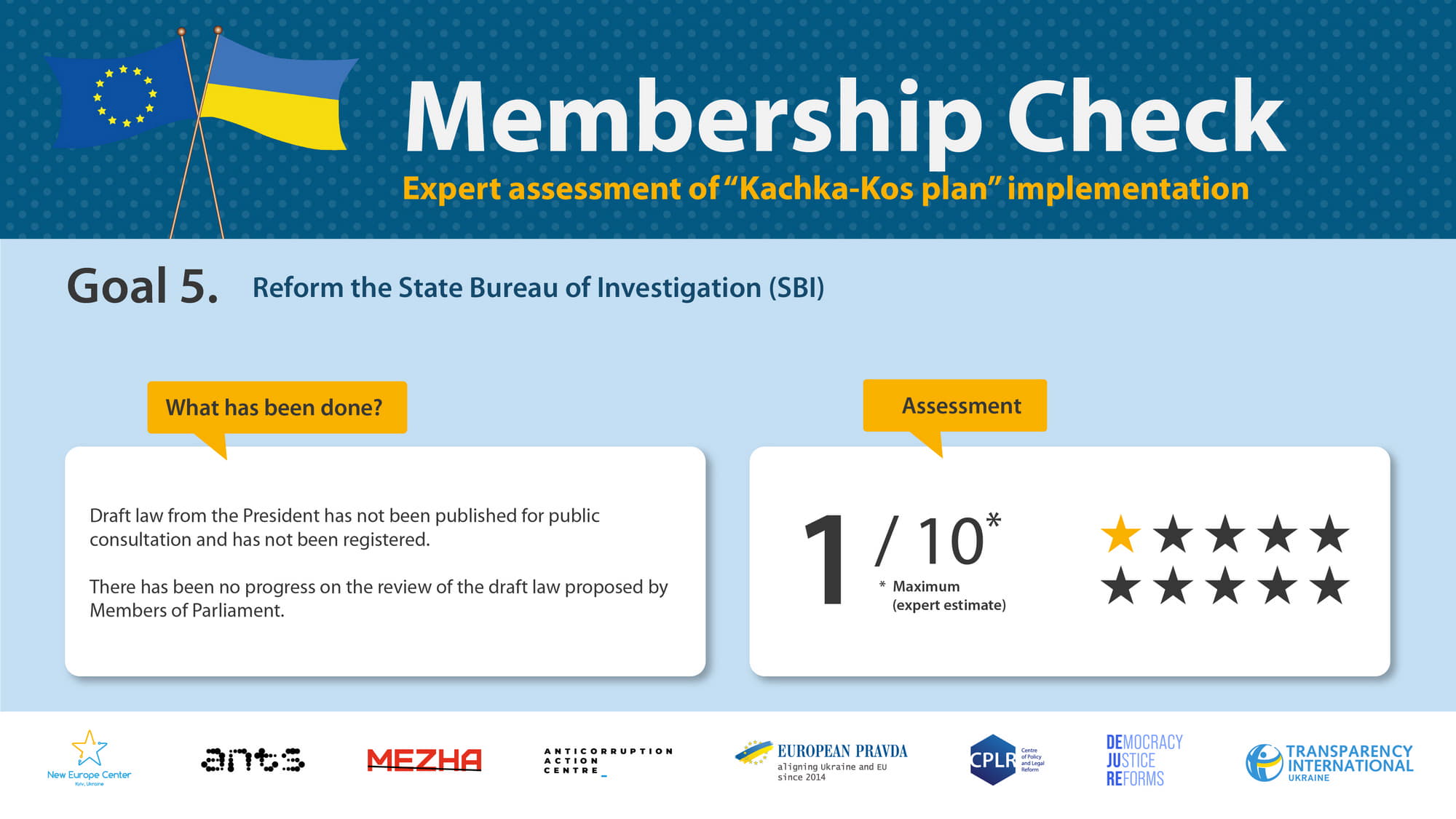
This is also true of point 5 (Reform the State Bureau of Investigation). There have been statements about the need for reform, but no documents.
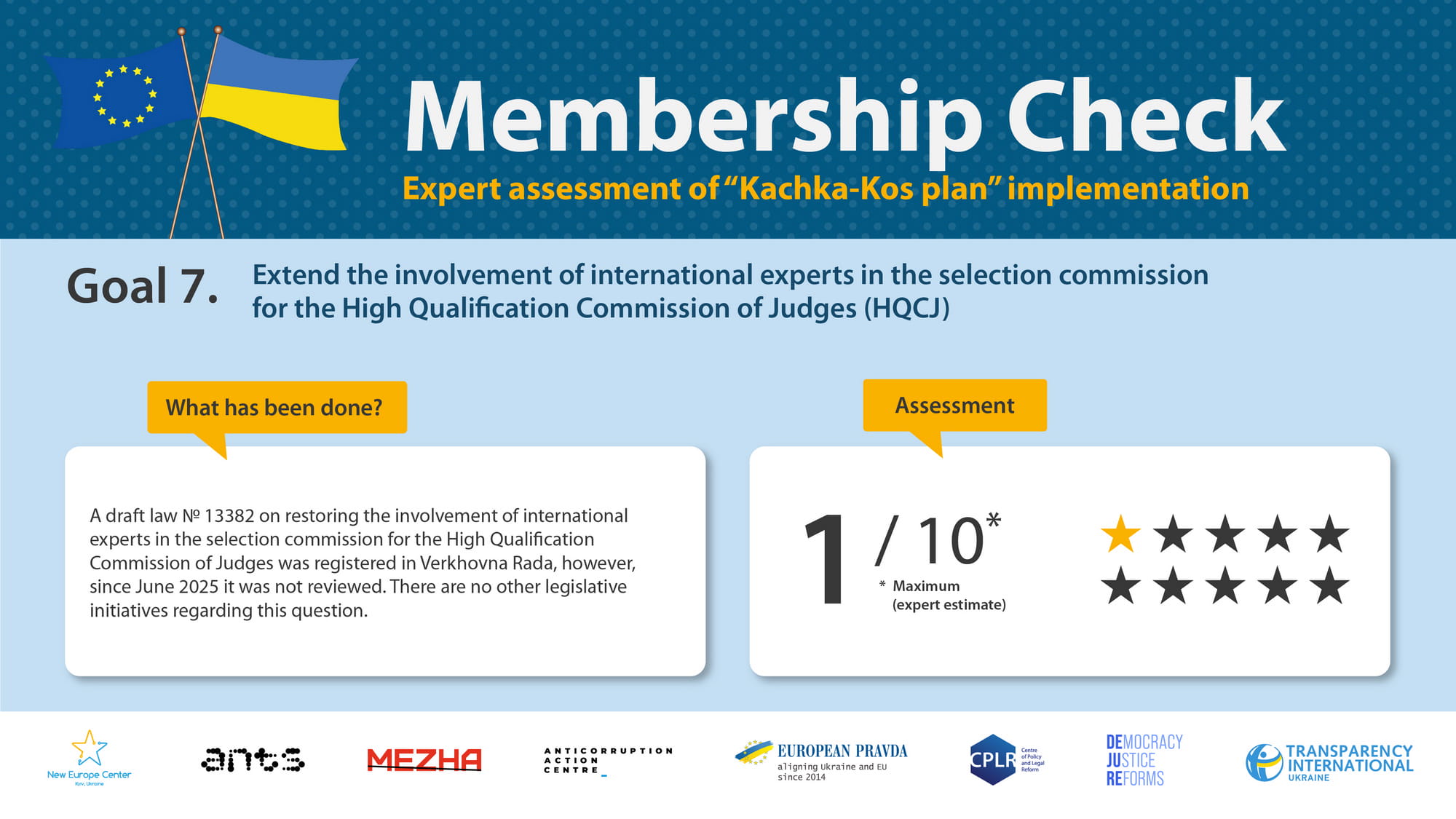
It’s the same story with point 7 (Extend the involvement of international experts in the selection commission for the High Qualification Commission of Judges).
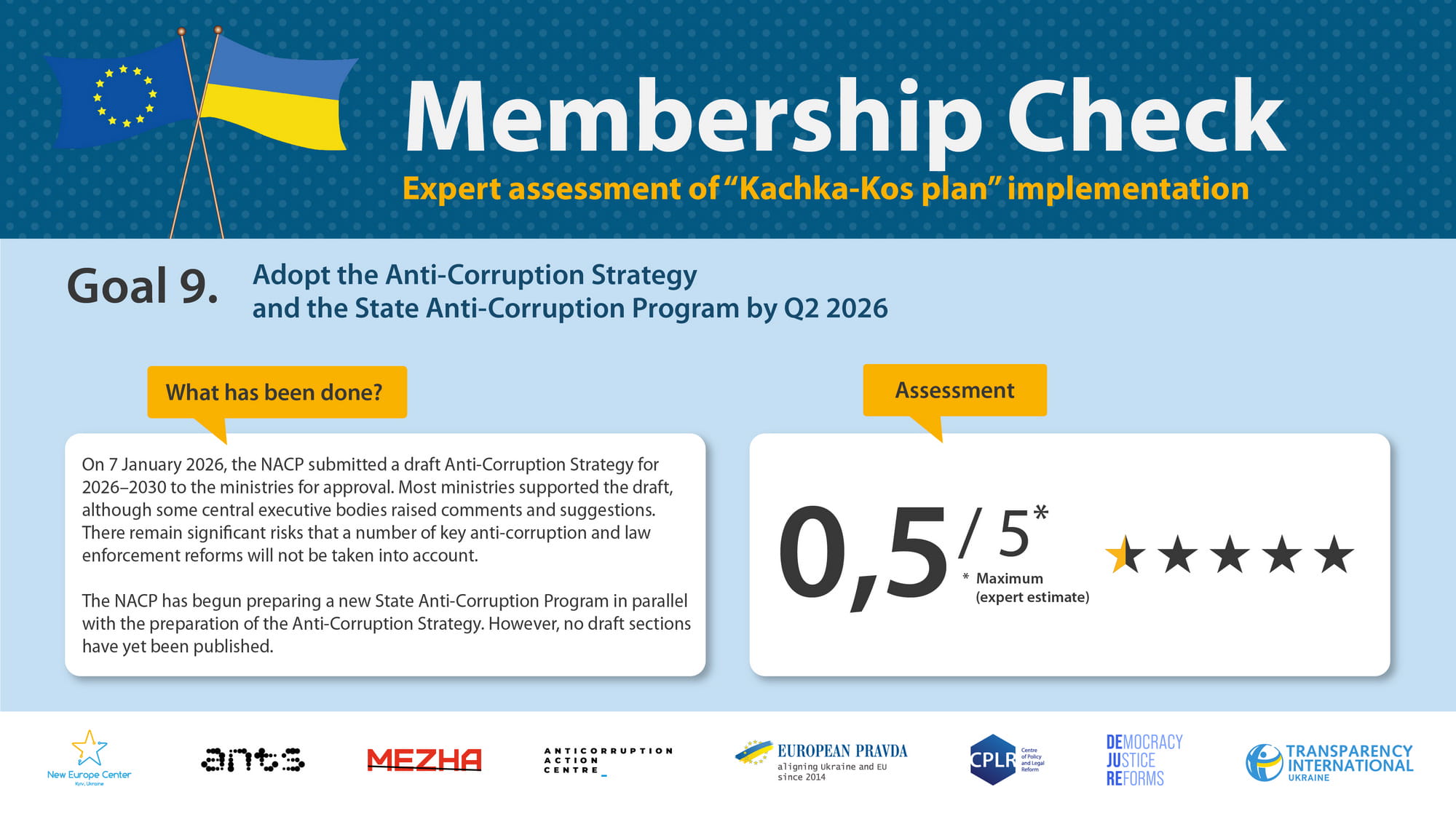
The situation is different regarding the approval of the Anti-Corruption Strategy and its implementation plan. This is not a reform as such, merely a strategic overview of the situation. Yet even these steps remain at an early stage.
 |  | |
 |  |
What should be done about this?
Ultimately, the Kachka-Kos plan does not stand alone. It is a concentration of the EU’s priority requirements for Ukraine within the accession process. All its elements must be implemented, both to restore EU trust and to meet the accession benchmarks used to assess readiness for membership. This means that progress on them is also close to zero. The New Europe Center has also published detailed conclusions by the consortium on each point, describing the link between the plan and the benchmarks.
So the situation as it stands is extremely alarming. And the delays in implementing the plan are already affecting Ukraine’s relations with the EU.
It’s true that in Kyiv, they may point out that parliament is not terribly functional at the moment. But this explanation doesn’t wash.
First of all, as far as the EU is concerned, it is fundamentally irrelevant who is slowing down the implementation of changes. Either Ukraine fulfils its commitments or it does not. After all, it is not Ukraine's parliament, government, etc. that are joining the EU, but the state as a whole.
Secondly, it isn’t always parliament that’s holding things up. In many cases, laws have not even been drafted.
Thirdly, the narrative about a "non-functioning parliament" is a very dangerous one. If parliament can’t pass laws, then how can one speak about moving towards EU accession? Hundreds of laws must be passed on the road to EU membership. If Ukraine is not capable of this, how can EU accession be possible?
From the government to parliament and the president, Ukraine must do everything necessary to prove to the EU that it can carry out fundamental reforms and renew this work. Progress on the Kachka-Kos plan is the ideal instrument for this.
Sergiy Sydorenko
Editor, European Pravda
Study by the Membership Check coalition