UK military chief: Putin is at the core of this war, but people in Russia support his views
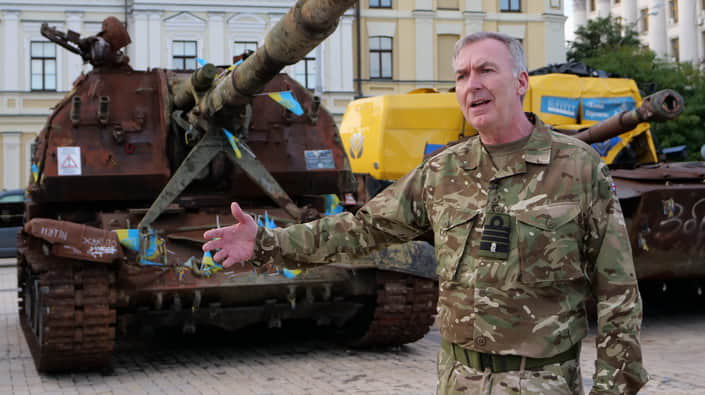
The name of Admiral Sir Tony Radakin is unknown to most ordinary Ukrainians (and he does not often agree to speak with journalists), but those who have met him have only positive things to say about him.
His position alone speaks volumes. Since 2021, Radakin has served as Chief of the Defence Staff of the United Kingdom – one of Ukraine’s key partners in resisting Russia. And, as the British proudly note, there is no other foreign military chief whom President Zelenskyy meets more frequently than Tony Radakin. This is entirely natural, given the role played by Radakin personally and by the UK military in supporting Ukraine. It’s worth remembering that it was London that broke several taboos that Western donors had previously been constrained by – most notably when it began supplying Western tanks and long-range missiles to Ukraine despite opposition from the United States and several European partners.
Currently Radakin, together with his French counterpart, leads the military dimension of the Coalition of the Willing and is conducting negotiations on post-war security guarantees for Ukraine.
Admiral Radakin will leave his post on 2 September. This week, he visited Ukraine together with his successor, Richard Knighton, currently Chief of the Air Staff, to introduce him to his Ukrainian partners.
Before departing, he met with European Pravda to give his final interview as Chief of the UK Defence Staff. In this conversation, Admiral Radakin reveals some details of the negotiations on security guarantees, explains why he believes in Ukraine’s victory, and recalls his talks with the Russian military leadership.
"We get into specifics of Article 5 – the security guarantees for Ukraine"
Let me start with security guarantees, because this is definitely the key issue for Ukraine. You have been taking part in the negotiations on this matter. Do you see a common position emerging among the allies?
I think there’s a very definite common position, which is to support the opportunity for peace. And that has gained momentum with President Trump. It's also a reflection of a bold position by President Zelenskyy and the willingness to have an unconditional ceasefire.
And then you've got а range of countries – the European countries, and the frame of the Coalition of the Willing led by the UK and France. You’ve got an America that is looking to support it too.
The crucial thing is: can we assist with the opportunity of a potential ceasefire and ideally a just and lasting peace? And how do we as the militaries come together to do that?
That envisages some of the language we use around safe seas, safe skies, secure borders for Ukraine, and supporting Ukraine's armed forces to deter aggression and defend aggression if need be. That’s the frame. I won't go into the detail, because it's such a crucial time, of what that might mean when we use the language of security guarantees. We are currently in discussion, and we’re having a further video conference on Thursday to detail what will be the support from individual nations to Ukraine once we have either a ceasefire or the opportunity for peace.
You use the term "security guarantees", not "assurances" as we had under the Budapest Memorandum. Is that a common position?
That's the language that emerged from the Washington meeting last week. It's fresher and it's stronger than it has been before. And that's linked to the drive from President Trump, a demand and an enablement for a ceasefire or a peace opportunity.
Both of us – military chiefs and diplomats – are working to support our leaders who are clear in their responsibility to try to enable this to happen.
I understand that you can’t go into detail, but one element is already public. It has been announced that the security guarantees or arrangements should resemble NATO Article 5, but without NATO backing. What does that mean?
At this stage, I can only give quite a vague answer.
Sometimes there’s a misunderstanding about Article 5. People think it commits nations to an automatic response when nation X has been attacked. It doesn't. It commits nations to come together to see how they will best respond.
In the talks on Ukraine, we are much closer to a more generic and broader approach to collective security.
When we get into specifics of Article 5, or the details of a security guarantee [for Ukraine], it’s about the friends of Ukraine who are working to give Ukraine the confidence and the assuredness that Ukraine's future is going to be safe and secure.
I'm not going to go into the details of how we reach that, what that entails in order to get that [confidence in security], but that's what the conversation is about.
"The guarantees would include British boots on the ground"
Would a military presence on Ukrainian soil be part of these guarantees?
The UK and France have been very clear that we would look to put troops forward into Ukraine. We would look to support so that Ukraine has European jets in the air and safe skies, and to also join some of the existing commitments between Türkiye, Romania and Bulgaria in terms of having a Black Sea that is safe as well.
So the UK and France have made that really clear.
Now we’re having the conversations about who the other partners are going to be and about their level of commitment for when this moment arrives.
What about boots on the ground? Or will it be only air and sea patrols?
The British prime minister has said before that it would include British boots on the ground. But the predominant role will be in supporting Ukraine. Ukraine needs to reconstitute its brigades, to regenerate them. You will get our continued support with some of the things that you already see. The Ukraine Defence Contact Group; NSATU, the NATO mission; EUMAM, the European Union Military Assistance Mission. You’ve also now got the PURL mechanism for America to provide more kit and for Europe to fund that American kit.
All of those would continue because we are all clear that Ukraine needs that continued support.

The massive difference is that in February 2022, [European] nations said they would support Ukraine, but they didn’t say that they were pushing their forces forward to Ukraine. Now, in the summer of 2025, nations are saying: Yes, we will look to put our forces forwards. And the conversation is just detailing how many of those nations [are in that pool] and what it will look like.
The UK is in the leadership, together with France, of seeing what that frame is for other nations to then plug into.
Let me highlight the key difference from February 2022 that we would like to see. Back then, as the attack became imminent, Western embassies left Kyiv one after another. Are there assurances that if there is a new attack, things will be different?
I'm really proud of what the UK has provided to Ukraine throughout. It's nearly £22 billion, nearly £5 billion this year, and a political commitment from the very outset to support Ukraine.
That support in February 2022 was support from afar. It included ammunition, equipment, cash support, logistics and so on.
The difference with 2025 is a political commitment of nations that are saying that they will put their forces forward.
It's not for me to go into the detail when it's such a sensitive time and to describe what that longer-term commitment will be.
But is there a firm commitment that in the event of a new war, some allied forces would remain here?
The conversations we're having are precisely around the question that you asked. And it's kind of two– or threefold.
One is that when the ceasefire emerges, that we cement that ceasefire, and we give confidence to the people of Ukraine that they are now on a slightly different path for their future. And that links in with the ambition for Ukraine to join the EU, to have stronger armed forces in the future, to return to the things that we all enjoy in terms of peace, prosperity and a successful democracy and so on.
That then is coupled with a longer-term journey, and the assurances and commitment to Ukraine in the longer term. And that is a very delicate, a very political conversation. I'm supporting it, but it would be wrong for me to detail the intricacies involved.
The discussion is running really quickly. It’s less than 10 days since the Alaska summit, and just over a week on from President Zelenskyy in Washington, and we've already had a series of meetings. I was in Washington last week on Tuesday; national security advisers had a VTC on Thursday. Military chiefs followed that on Friday. I hosted a video conference with General Thierry Burkhard from France on Monday. We are having a further video conference on Thursday as part of this momentum.
So people should be reassured that there is some momentum and there is a drive there. But we've got to be sensible about not playing all of this out in public.
"It will also include space and cyber security in the future"
What makes the United Kingdom so determined to support Ukraine?
I think that's a really interesting question.
If I take the United Kingdom in terms of its values and what it means to be British and what it means for UK prime ministers, it’s a clarity about the need to support democracy. That aggression must not pay.
It's also following up on the UK being one of the first countries to recognise Ukraine's independence 34 years ago.
It feels very natural and instinctive for the UK to step forward in those circumstances.
The UK is a P5 member, it's a nuclear power, it's the sixth largest economy in the world. There’s a weight that goes with that as to how the UK ought to behave.
And this is about a war in Europe – it’s about an illegal invasion.
And the UK under four successive prime ministers has been clear about the need to support Ukraine. For me as a senior official, I’ve had the value of both the government of the day and the opposition of the day being incredibly clear and united in supporting Ukraine. This has never been a polarising issue for the UK politically.
After the seizure of Crimea in 2014, we created a mission called Operation Orbital for supporting Ukraine and having a stronger relationship with some of your land forces and your maritime forces in particular. [This refers to the UK’s large-scale training mission – EP.]
Also, as a close ally of America, we end up in a brokering role of trying to bring them in support of Ukraine.
Do you see some of these projects being revived after the war?
Absolutely!
Before the war [the full-scale invasion – EP], there was a big deal, several billion, for supporting Ukraine's Navy. I came to Odesa in 2021 when HMS Defender was there.
Now, during the war, we have an even stronger relationship.
After the war we will have Operation Orbital++. It will be even stronger.
I think the commitment will be across all domains, not just maritime and land as it was before 2022. I think it will also be air, and for the future Ukraine, it will also include space and cyber. Modern warfare is a five-domain warfare, and you keep safe by being proficient in all domains. That’s the longer-term journey for Ukraine.
"This war is a disaster for Russia militarily"
You mentioned your visit to Odesa in 2021. I also remember that you visited Moscow in February 2022.
Yes, I met Gerasimov and Shoigu [Valery Gerasimov and Sergei Shoigu, at the time Chief of the General Staff of the Russian Armed Forces and Russian Minister of Defence – EP].
Do you feel you failed in any way at that time?
I went with Ben Wallace, the UK defence secretary. There were some elements of those conversations that we would keep private. But I’m not too sure that we failed.
We were really clear in telling Russia that we knew what they were envisaging, and telling them that if they proceeded with their plans, it would be a disaster for Russia. And this has been a disaster for Russia.
Russia is weaker now. Ukraine is never going to be subjugated to Russia. NATO is stronger, growing from 30 countries to 32 nations. NATO is on an even stronger trajectory in terms of its spending.
Russia has revealed to everybody its aggressive nature.
It's shocking that Ukraine is having to bear the brunt of that and the suffering, but Russia has triggered a response from all of us to support Ukraine and to bolster our own defences, so that we can continue to deter Russia and defend against Russia if new aggression emerges.
In the West, I’m used to hearing that this is "Putin’s war", not Russia’s. Do you agree?
I think it's both. At its core, it’s Putin. It's Putin's warped view of history and a warped view of where Russia's position is in the modern world, and his desire to go back to a Russia that had more physical territory, and it extended all the way into Ukraine. He even commented the other day about elements of Poland coming under Russia!
I think it's driven by him. But also it's his control.
If you're an autocrat with his level of control over decades, then your ability to shape, manipulate, influence your population to your view is enormous.
Let me highlight one of the aspects. Russia pulled out of Afghanistan incredibly quickly after the loss of about 16,000 troops. There was a mothers' protest and real anxiety in Russia for what looks these days to be a relatively modest cost.
I look now at the shockingness of a million Russian soldiers either killed or injured – and no protests! That is a reflection of the Russian state and the control that Putin has.
Does that also mean that Russia will not stop?
His intent will not stop in Ukraine. But he has been stopped in Ukraine already. He is never going to take Kyiv. He is never going to subjugate Ukraine.
This war is a disaster for Russia militarily. The incremental progress Russia is making in Ukraine comes at extraordinary cost. Pokrovsk is an area of 30 sq km, and it's been fought over for about 11 months now. Bakhmut is even smaller, and it was fought over for over nine months.
Russia is feeling the limits of its military power, and it can't support the despicable ambitions of Putin.
The idea that this war implies that Putin can take the fight elsewhere... I think it's the opposite! It's showing the limits of his power, the weakness of his military, because of the strength and the extraordinary effort of Ukraine. And that's what we need to keep supporting.
Recently you told a UK parliamentary hearing that Ukraine will definitely win. But what does victory mean for you?
It's for Ukraine to decide.
Ukraine has decided.
Okay, victory for me is a Ukraine that is safe and secure, that enjoys peace, that is a flourishing democracy, that has the opportunity to be on a journey to prosperity, that can contribute to Europe in every sphere.
To me, the contrast between a miserable grey Russia and a vibrant, prosperous Ukraine is what this is about. I am incredibly confident that that's the journey that we’re on.
This is a horrible time for Ukraine, but when you project forward, then it's Ukraine that really does have a bright future.
Sergiy Sydorenko,
Editor, European Pravda