Lithuanian FM: NATO membership is the most intimate relationship. We will be there with Ukraine
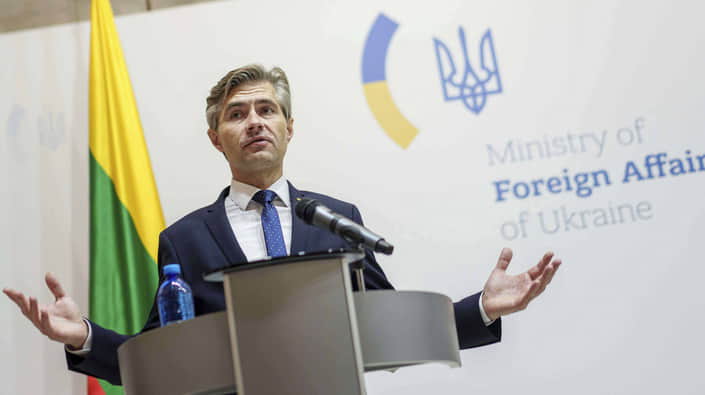
Lithuania’s Ministry of Foreign Affairs has been headed by Kęstutis Budrys since December 2024. There is no doubt about his personal commitment to Ukraine, nor about his clear understanding of the seriousness of the Russian threat. From early 2022 he served as the national security adviser to the President of Lithuania, and before that he was engaged in intelligence and security issues.
Budrys’s actions confirm this as well: he recently came to Kyiv to open the office of Lithuania’s Central Project Management Agency, a government institution that supports Lithuania’s partners, with a focus on Ukraine. Lithuania remains Ukraine’s most devoted partner in the pursuit of EU and NATO membership.
However, recent political developments in Vilnius, with the Dawn of Nemunas party potentially remaining in the ruling coalition despite its anti-Ukrainian stance, have raised doubts about whether Lithuania’s support for Ukraine is truly unconditional.
European Pravda asked Kęstutis Budrys this question directly in Kyiv. His response was clear: "Unconditionally, yes." He outlined the future government’s policy and said that Hungary’s attempts to block Ukraine’s progress towards EU membership is expected to be circumvented soon. NATO is more complicated, he admits, but even there, he says, positive signals are beginning to emerge.
"Ukrainians won't have any doubts"
Many in Ukraine are observing the government coalition talks in Lithuania with concern. Could this undermine Ukrainian-Lithuanian friendship?
No. My visit is an indication of the resolute continuation of Lithuania's foreign and security policy. One of its anchors is support for Ukraine, support for the defence of Ukraine, and support for Ukraine's path to the European Union.
We do this for many reasons, and one of them is Lithuania's and the Euro-Atlantic communities' interest in more security and stability in Europe. It is in our security interest to assist Ukraine. And it is continuing.
As you know, I was a member of the previous government, and my candidacy has been approved for Lithuania's next government, its 20th. In nine months in office, I have visited Ukraine five times. This time, I opened an office of the Lithuanian project agency in Kyiv, which is yet another confirmation of the tremendous work we are doing for Ukraine.
Additionally, in the security field, we are looking forward to further integrating the joint defence capabilities of NATO and Ukraine's defence capabilities. It is in our interest to use Ukraine's expertise, knowledge and defence industry production to protect NATO airspace.
And there are other areas of interest. We are cooperating with Ukraine in putting pressure on Russia in the form of sanctions, isolation and protecting fundamental principles, seeking a ceasefire and long-lasting peace
And after the new government is sworn in, I have no doubt that there will be another wave of strong steps from Lithuania. And Ukrainians won't have any doubts either."
You outlined a number of topics that I will return to, but let me clarify: the Dawn of Nemunas party remains in the coalition. We hear their statements (which many consider anti-Ukrainian – EP).
When we formed the previous government within the same party in it, the first item on the agenda was the first ever visit of the completely new government to Kyiv. That was on 20 December 2024. Within this coalition there was a unanimous vote in parliament on the resolution declaring that Lithuania will never, never recognise the annexation of Ukraine's territory. Neither de-facto, nor de-jure.
When it comes to Lithuanian foreign policy decisions, they're made and implemented by the president with the government. And our policies regarding Ukraine will continue.
"The EU should not be hostage of one state that is going to assist our enemies"
You mentioned Ukraine’s European integration. Is there a way to accelerate this process? After all, Hungary blocks any decision on opening negotiations.
Yes we do.
Of course, our top priority is to have a unanimous agreement within the EU about the enlargement.
Ukraine fully met the criteria to move forward – that was the conclusion of the Commission, and no one has doubt about it – but one country [Hungary] is continually constantly taking advantage of its right of veto. They are disrupting and compromising the enlargement process. This is very destructive. It undermines the roots and foundations of the European Union.
I will say it again: we seek that there will be a 27 [unanimous] vote, but if it is not, we are looking for alternative solutions.
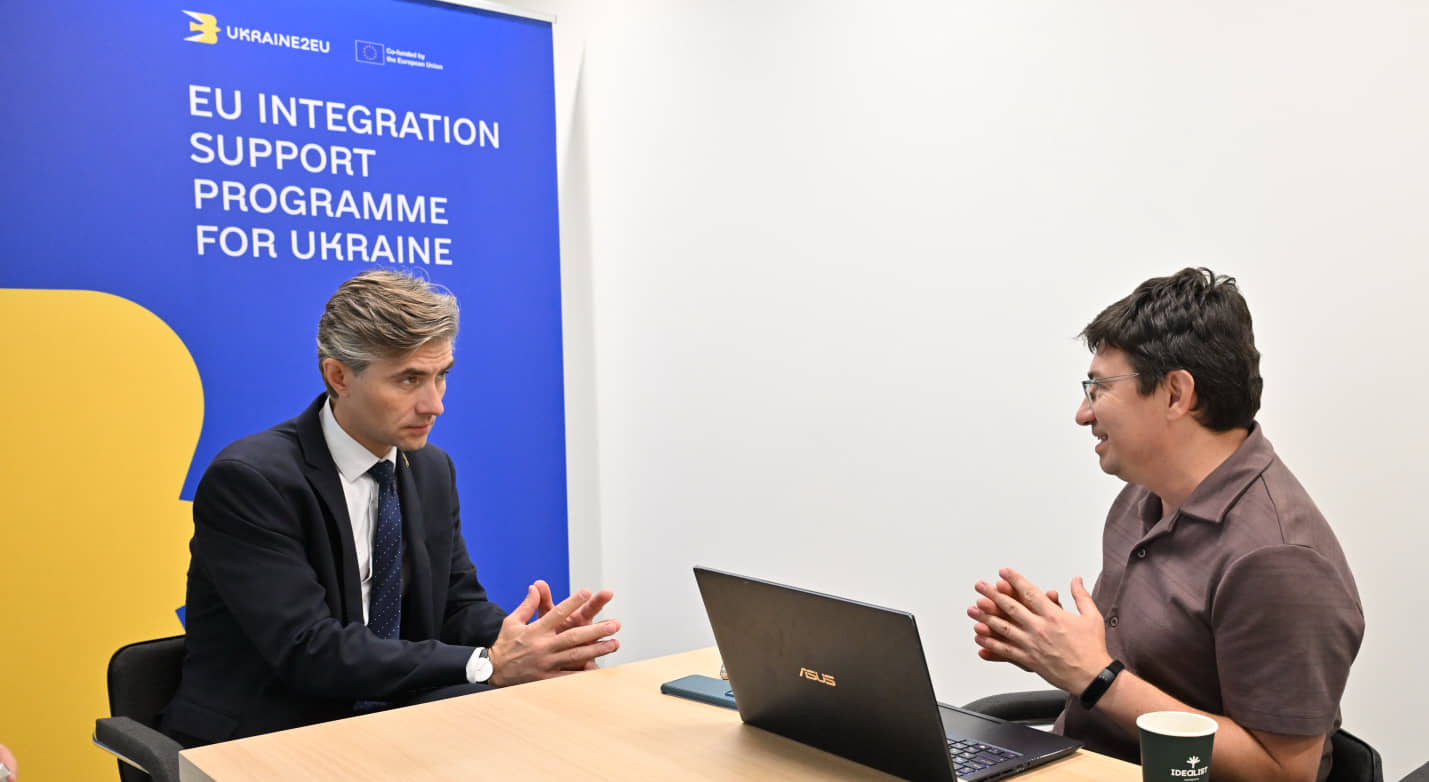
PHOTO: Lithuanian Ministry of Foreign Affairs
Plan B?
Yes, there's a plan B. We cannot be hostages, and there are ways we should keep moving ahead.
With the Danish presidency, we still have the opportunity and time to proceed with informal stages that would be finalised a bit later. This would be in accordance with the current methodology. It will show our respect for the agreed rules and would assist the reform process in Ukraine. It would also allow us to keep mobilised resources on the European Commission side, and attention from the member states.
Do you see support for that path among other member states?
I am really optimistic that we would be able to make the decision and to manage it. We have strong arguments to get the critical mass in agreement and to move forward.
It's not about some wording and definitely not about creating the illusion that we are still doing something. No! It's about keeping up momentum. It is about continuing to do what really matters – namely, reforms in Ukraine and preparing the European Union for enlargement. To do this, we need a mechanism. An informal negotiation process could be that mechanism.
So while we don't have a unanimous vote – because of someone's egotistical and disruptive actions – we have to proceed further that way.
I cannot allow myself, my country, or the European Union to be held hostage by anyone who is running in an election or who is going to assist our enemies. I don't know what their motives are, but I will not be in a position of weakness or be taken hostage. And we have the solution.
That way would help Ukraine with its reforms. But what will it change on the EU side?
It mobilises attention and resources. Otherwise, the EU efforts will concentrate on the accession processes of other candidate countries, and not on Ukraine. And I think that is wrong!
The entire process of EU enlargement has been revitalised precisely because of Ukraine's prospects of becoming a member of the European Union. It was Ukraine that set this whole machine in motion! We have seen progress with the Western Balkans because there is now an understanding that the EU must expand, first and foremost by including Ukraine. We cannot lose the engine that must be at the front of the train, namely Ukraine. And the energy for this engine is reform. That's how it works.
Let me clarify. "Plan B" should be launched now, this autumn?
Of course. The momentum is now, and if we will postpone it… I have seen it so many times. To keep the political focus where it is – is a difficult task.
"From supporting Ukraine, we have to move to integrating it"
Let's focus on war and peace. Is there a readiness to go forward with security guarantees in a situation when we have unpredictability on the other side of the Atlantic?
We still have not used all the instruments to put enough pressure on Russia to agree to a ceasefire. We have not!
For example?
Sanctions on energy were not applied to a full force.
And I don't agree with anyone saying "oh, we did a lot and it didn't work, so maybe we should do something else". No!
Still, there are Russian oil companies that are not sanctioned, like Rosneft and Lukoil, gas companies like Gazprom and Novatek. Leaders of the international organisations dealing with nuclear power are still taking photos with Rosatom.
This means that isolation has not been implemented to the level needed.
The shadow fleet is still blooming all over the oceans. We have not implemented sanctions in full force. We have to do it on the European Union side, coordinate it with Americans, and then we would be able to say that we have done everything required.
On the security side, Lithuania strongly supports future activities of coalition of the willing.
In addition, we see the EU enlargement as an element of the security guarantees.
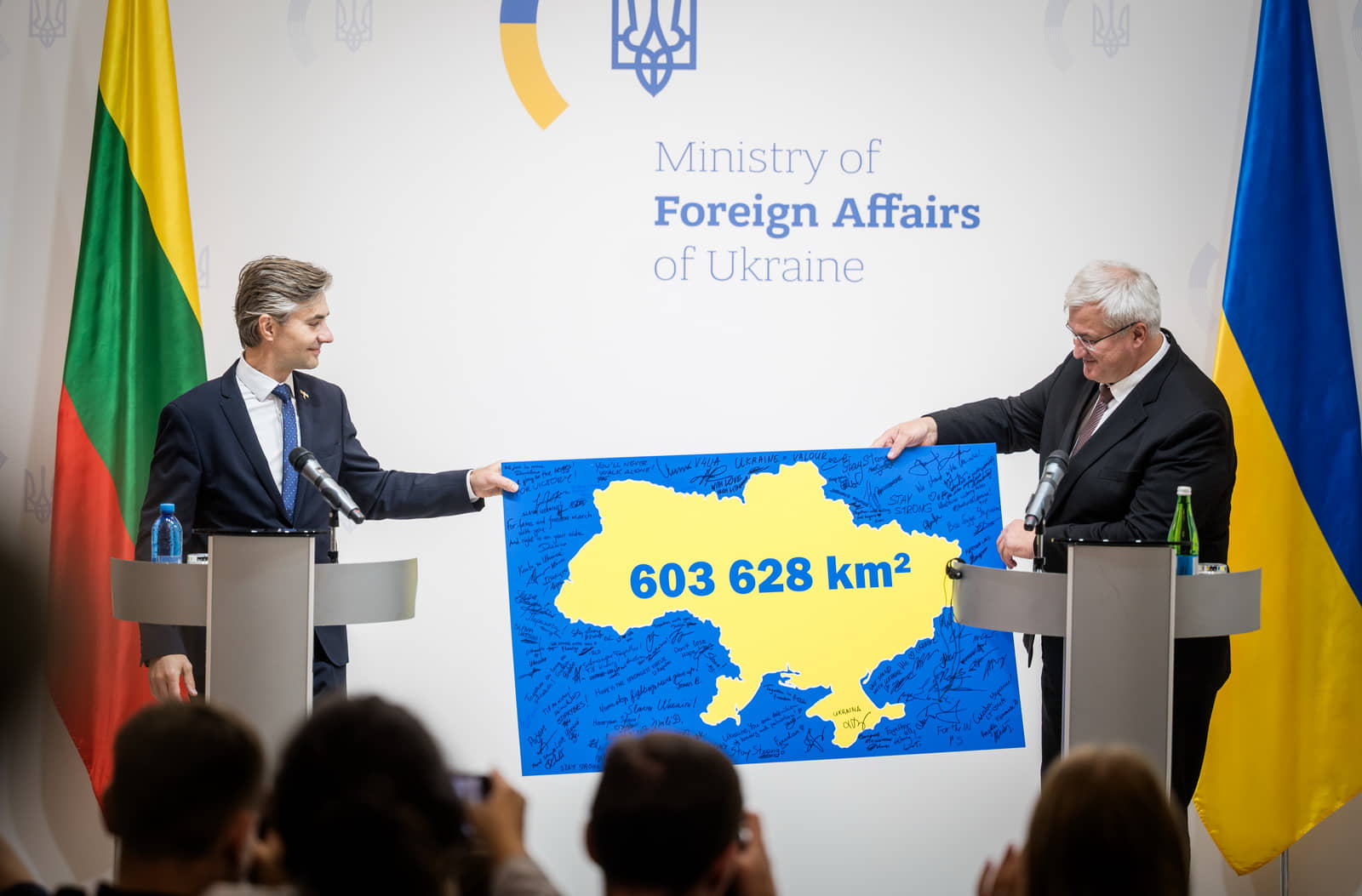
PHOTO: Ukrainian Ministry of Foreign Affairs
And we are in a position to protect the fundamental principles: the territorial integrity and sovereignty of Ukraine. And I brought your [the Ukrainian] foreign minister a sign of our commitment to this: a map of Ukraine signed by my colleagues in the Ministry of Foreign Affairs, with a commitment to protect and defend your territorial integrity.
We need to also enforce security guarantees, otherwise we will face a new Russian attack.
We all understand that the strongest military force, the most technologically innovative, are the Ukrainian Armed Forces. And it's our duty to keep supporting them both before the ceasefire and after it.
Lithuania committed two years ago to continue this support for 10 years. Our support this year has reached 1 billion euros. We commit to 0.25% of GDP each year.
Now, we are fundamentally reviewing our approach: rather than just providing support, we have to move towards integrating capabilities. This would allow us, for example, to protect our skies.
"NATO is not off the table"
So, in this case, Ukraine itself is acting as the guarantor of security for the EU and NATO’s eastern flank.
As a security partner – yes.
Given the technological know-how you have, and also your willingness to do so.
We all see how important it is as the threats are immediate, after what has happened a week ago in Poland, in Romania, and previously in Lithuania. So, we need capable and relevant air defence countering drones and other threats. And we know where to get all the knowledge on how to do it. This integrates us not only at the level of the defence industry, but also politically and at the level of inter-governmental policy.
I see Ukraine de facto as part of the European security mechanism.
Ukraine is not something outside the European Union and NATO, and Ukraine cares about more than just its own security.
When it comes to collective defence, we are speaking primarily about NATO. With an understanding of the importance of Ukrainian knowledge and skills in air defence, it should become obvious that Ukraine is a contributor to Europe's security. But why don’t we hear discussions about Ukraine's NATO membership? Why is this not on the agenda?
What we are witnessing now is a bottom-up process in relation to this process.
We had the top down discussions, Ukraine within NATO, where Lithuania strongly supported you. We have no doubts about Ukraine's future in NATO! And we stated it in the Hague Summit, I stated it more than once within NATO, and will continue because we believe in it and we need it.
But that's one approach, and there's another approach – how we integrate de facto, how we cooperate on the ground de facto. And then one day we will decide that the security agreements have become a de facto reality.
The EU is also playing a role here.
Just one year ago, EU and NATO cooperation was more or less focused on military mobility.
Now we have the SAFE instrument [the European Commission's Security Action for Europe initiative], amounting to 150 billion euro, and we see Europe's interest in investing and doing more on the frontline. Geopolitics is shifting here!
Will it shift to the point where Ukraine’s NATO membership is back on the agenda? Not in Lithuania – you are already on our side. But do you see other countries finally beginning to grasp the reality?
It's not off the table. It's on the table.
You know the language agreed at the NATO summit – "when the conditions allow". This means that once we reach consensus, it will happen very quickly, as was the case with Sweden and Finland's recent accession to NATO. But we must not waste time and should already be integrating more and more de facto. The security balance is already moving in this direction.
And I am confident that when that day comes, we will have all the arguments we need to commit to each other.
NATO is about first and foremost about Article 5. Article 5 is about me committing to you to die for your security because it is my security. This is how intimate it is. This is the most intimate relationship a human being can have. And yes, we will be there because de facto we are moving into that direction.
Sergiy Sydorenko,
Editor, European Pravda