Ukrainians have made it clear: they are not dying for a corrupt country. An interview with Michael Gahler
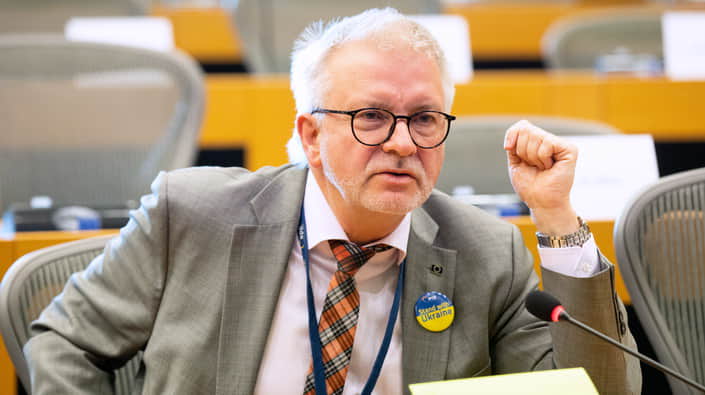
Michael Gahler has served as the European Parliament’s rapporteur on Ukraine since 2022.
Michael Gahler has been involved in Ukraine longer than any other Member of the European Parliament. There is no doubt that he knows our country better than any other Western European MEP. Back in the Yanukovych era, as a representative of Germany and the European People’s Party, he was one of the key MEPs constantly advocating for Ukraine and trying to convince the authorities to choose the European path.
In recent years his involvement has gone beyond knowledge to encompass formal responsibility: Gahler has been the European Parliament’s rapporteur on Ukraine since 2022.
This means that his opinion carries the greatest authority among other MEPs and in many respects shapes the position of the European Parliament as a whole. That is why European Pravda decided to talk with him during a reporting trip to Brussels – and it was well worth it.
There is a tradition in the EU that MEPs, being independent from national governments, can speak frankly about the matters that guide the European Commission and the member states. That’s certainly true of some of the things Michael Gahler says.
"We have to live up to our promises"
Will Ukraine become a member of the EU?
Yes, definitely.
Why are you so sure about that?
It's because on the one hand, the Ukrainians have decided that, and they are on a clear EU track. Also, the people expect their leaders to work towards this.
On the other hand, it's in our common European interest not to end this war with Ukraine in a grey zone, remaining an object of appetite for Russia, be it Putin or his successor.
The third thing is that in the long run, Ukraine will not be a burden but an advantage for the EU. I'm convinced about that – not only because you remain our toughest first line of defence and you are the only ones who know how to fight, but also because your reconstruction and rebuilding process will result in a boom for Europe as a whole. Your citizens are well trained and are experienced in multiple sectors, and they will contribute to our European Union in a positive way.
Of course, to reach that goal the country will have to fulfil all the relevant criteria, and they are tough.
So to sum it up: I believe you will be in the EU. I know that, yes, it is costly, and yes, challenges remain.
The European Parliament has traditionally been the most supportive of Ukraine. It adopted statements saying that Ukraine’s place is in the EU many years ago, but nothing happened until the full-scale war.
I accept question marks because we have indeed extended our promises to many countries.
The Thessaloniki 2003 summit sent a signal to the Western Balkans, but so far, only Slovenia and Croatia have joined; all the others are still outside. So we have to live up to our promises and at the same time, of course, see our set-up, our institutional functionality.
There is a difference between earlier times and now because of this dreadful war.
It is not only about Ukraine or Ukraine's territory. It is about who will be stronger in Europe – the dictatorship or the democracies.
That is why there is such a strong commitment now also from all member states to have Ukraine in the EU.
The reality is that although Article 49 of the EU founding treaty says that every European country can become a member,
it was never operational.
As we know, after the end of the Soviet Union, we had two tracks for European countries.
One was the integration track, as shown in the PHARE programme [initially called "Poland and Hungary: Assistance for Restructuring their Economies"; later also used for other countries], which was tailored for pre-accession and proposed for Central European states. For the post-Soviet space we had the TACIS programme [Technical Assistance to the Commonwealth of Independent States], which was also about reform and so on, but not directly with the objective of membership.
The Eastern Neighbourhood policy that appeared later was also aimed towards more democracy, making the countries closer to the EU with free trade and association, but still, the idea of membership was not obvious amongst the member states.
As you rightly said, the Parliament was always more open to Ukraine's accession.
Now we feel that our stance is confirmed by the rest of the EU. Since the full-scale war broke out, member states have realised that it’s not only in Ukraine's interest but in our interest too that Ukraine should end up in the European Union, in order to stabilise the situation all over Europe.
"We definitely won’t give carte blanche"
Let’s talk about the July events in Ukraine. Could they ultimately deprive Ukraine of its EU membership prospects?
No, because the reaction was a good one.
Whose reaction?
Both by Ukrainian civil society, and by the government and the Verkhovna Rada (the Ukrainian parliament) that nullified it.
Over the years, I have seen steps in the wrong direction in a number of candidate countries. But contrary to some other candidates, Ukraine is reacting properly when your friends tell you that it's not the best way. There really is this wish in Ukraine to be part of the European family. And when there is something that won't fly, you accept it.
These anti-corruption bodies are really important to your European future.
I recall when NABU [the National Anti-Corruption Bureau of Ukraine] was set up, as well as SAPO [the Specialised Anti-Corruption Prosecutor’s Office] and the High Anti-Corruption Court, how much we were involved – not for our sake, but to guarantee from the outset that these institutions were clean. They really became the flagships of anti-corruption. When all of a sudden we saw an attempt to get them under the control of the prosecutor general, a political appointee who is de facto under government control, that was clearly a step in the wrong direction.
By the way, I think it was done quickly and in the summer, perhaps, because somebody thought we wouldn’t be there and would miss it – that was a mistake, because we are always there!
Then it was quickly rolled back.
I use this as a positive example about Ukraine. It proves there are mechanisms to settle these issues. It also showed that even in wartime, people are ready to take to the streets to say: We are not dying for a corrupt country, but we are defending our democracy on the front line.
You meet with Ukrainian officials and MPs. Do you feel that they understand how important this is for the EU? After all, back in July, the President’s Office proposed this idea, and Parliament supported it.
It’s a learning process. This understanding is there, more and more.
Yes, there are still people in Ukraine who are returning to old habits. They are still there. They are not automatically gone. Not only the Ukrainian legal framework, but also your mindset will make it impossible to return to those old times. The expectation of the people is that Ukraine will become a normally functioning democracy.
And once the war is over and there are fresh elections, I think we will see that those in the Parliament who don't think anti-corruption is that important or are expecting personal profit from politics will not stand again.
Has Ukraine managed to restore the EU’s trust after July?
Over this issue, yes. That is settled. But of course we remain vigilant for future occasions. We will always keep a close eye out.
For now, trust is restored, but we definitely won’t give carte blanche.
We will stay vigilant, including with regard to the selection procedure for the important positions.
We will continue that after formally opening the first cluster – perhaps after the Hungarian elections in April.
"You won’t complete the negotiations in a year or two after the war"
Do you believe accession talks are frozen until the elections take place in Hungary?
Well, if we find another way, or if Mr Orbán [the Hungarian PM] changes his mind…
He won’t.
He won’t.
You already know what you have to do in the negotiations. Let me stress, it is not a negotiation in a technical sense.
Because "negotiation" insinuates that you sit on one side and the other party sits on the other side, and then you meet in the middle. But in the accession process, at the end of the negotiation you’ll be sitting on our side. So it is clear what you have to do.
I have a good example from when I was the Baltic Desk Officer in the German Foreign Office in the 90s. The decision was taken to start talks with the first group of candidates, and the only country from the Baltic states in that group was Estonia. Latvia and Lithuania were desperate, but I told them, "No worries! You have to do the same as the Estonians. So talk with them about what they’re doing, and do the same before you formally negotiate."
That is my suggestion to Ukraine as well. We have several candidate countries who are in a negotiating process. Also, ask the latest member, Croatia, how it was when they were negotiating at the beginning. Thanks to the screening process, you know where you are already fine and where you have deficiencies. You can work with that even without the formal go-ahead.
It will open in April one way or another. Either Mr Orbán will be over, or he will have got some other hints that he had better not block the decision.
Everything is in your hands. Don’t forget that it's not only about voting in the Verkhovna Rada. The decisive thing is the practical implementation of EU rules on the ground.
Indeed, implementation is important. But it’s also a lengthy process. It turns out that it will take much longer than many people in Ukraine expect.
Well, it won’t happen in one or two years, or even one or two years after the end of the war.
Is there a link between our accession and the end of the war?
There is no precedent for a country at war joining the EU. If that happened, the EU would have to activate the European equivalent of NATO Article 5, which is Article 42.7. To put it simply, we would have to self-trigger the EU joining the war. As it requires unanimity, I don't see that happening.
You need to be realistic here.
What is possible is that if at some point a ceasefire comes into effect, before the entire territory of Ukraine is liberated, then we will have a situation similar to West Germany's membership of the EU despite the fact that it did not control East Germany. And after the fall of the Berlin Wall, the German constitution was activated in East Germany and it became part of the EU automatically, as the EU recognised Germany as its member.
Now we have the same situation in Cyprus. The moment a solution is found and Cyprus is reunited, EU membership and EU laws would start to be applied throughout the whole territory.
It could be the same with Ukraine.
If there is at some point a ceasefire when not everything is under government control, then there is nothing to prevent us from negotiating your accession.
And the subject of the negotiations would be Ukraine, not part of Ukraine. Our counterpart in those negotiations would be the government of the whole of Ukraine within its internationally recognised borders. And if the entire territory is not yet under government control, those parts will join the EU at the moment when they do return under government control.
"We don't even know whether Putin will attack the EU"
This point is very important to us. Can you say for sure that the occupied territories will not prevent us from joining the EU?
This aspect will definitely not prevent it.
But let's not forget that in theory, any member state can use any pretext for not greenlighting your membership. We need unanimity for enlargement.
It's impossible to predict how it will evolve. We don't know what the composition of the different governments in the EU will be when your accession is on the table. We can't rule out worst-case scenarios. We don't even know whether Putin will attack the EU at some point because he thinks that Europe is weak enough and cannot defend itself.
I'm not going to speculate about how things will be in the next few years.
But what is very clear to me is that when the situation is stable and settled, the accession process can be finalised with or without full control of the territory.
But when a country joins the EU, it’s not just a political decision – it’s based on economic calculations. You need to know the country’s GDP, population, and other parameters. For the occupied territories, all of that remains unknown.
Of course. Ukraine is a big country. That would be addressed with transitional periods.
This is not a new instrument for the EU. We’ve had them with other countries. This is how it works. When Ukraine joins the EU, a transitional period [when some regulations of the EU common market do not apply for a specific time period – EP] is applied to the part of the country that is under government control.
And when other parts of Ukraine join later, similar transitional periods will be applied.
This will ensure that your accession process is not hindered, and that the uncontrolled territories are not misused to challenge your accession – either by some forces in Ukraine, or certainly by the Russians, or by us Europeans. We’ll also have to see how we would arrange that, how finances would be shared and so on.
Could financial or business considerations become an obstacle to Ukraine’s accession?
We settled that with the big enlargement in 2004 as well. There were 10 countries coming in and we had similar – although not exactly the same – discussions on agriculture.
The difference was that Poland, and other candidates that were former communist countries, had an ineffective agriculture sector and would have been unable to compete if we had let them into the EU without protection. The question was how we could preserve and protect them from being exposed to our strong businesses.
Now, in Ukraine, it’s the opposite. You are so big and so effective that you would crush parts of our agriculture sectors.
Consequently, I'm pretty sure that Ukrainian agriculture will not be fully integrated from the first day of your membership. We will have transitional periods, but the terms for the transitional period will not be worse than those that applied before accession. Step by step, it will come to full integration. You trade with the EU now. It definitely won't be worse.
You are strong in agriculture. Your products are needed globally. You can easily sell them on the global market. Humankind is growing. We see bad harvests every year everywhere. You will compensate for that transitional entry into the EU market by having sales globally.
My forecast is that we'll find a compromise, as has happened with every single country that has joined the EU.
The issue you have raised is one that’s often perceived in Ukraine as a possible obstacle to joining: that Poland or another neighbour might block membership for economic reasons, because Ukrainian business is a competitor – it is a threat.
Look at the previous enlargements, particularly the 2004 "Big Bang".
Those countries were definitely competitors for the old member states. And yet we digested it. As I said, it will be a well-calibrated way. Nobody will be overcharged on either side. We have experience in this regard.
Sergiy Sydorenko,
Editor, European Pravda,
From Brussels