We don't need Orbán to tell Ukraine how to join the EU: an interview with commissioner Marta Kos
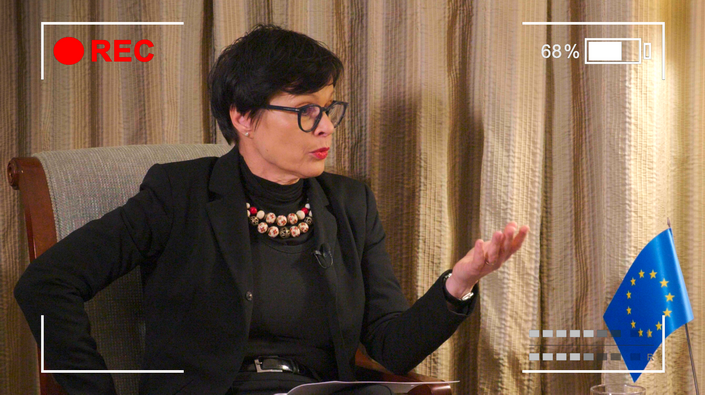
Marta Kos is the European Commissioner for Enlargement. If you had to describe her role to someone unfamiliar with the EU’s bureaucracy, the simplest and most accurate description would be "the EU’s point person on Ukraine".
Although the enlargement portfolio (and Kos’s remit) covers ten countries, four of which are considered frontrunners, Ukraine carries particular weight. The commissioner does not deny this. In our interview, she referred to Ukraine several times as "my candidate country".
We met on 24 February, shortly before the end of her visit to Kyiv on the anniversary of Russia’s full-scale invasion against Ukraine.
The main topic of our conversation was obvious: the European Commission’s initiative on new rules for the accession of candidate states to the EU. The drafting is in its final stage, Kos said. We also discussed the accession negotiations that are already underway with Ukraine; the slowdown of reforms; the consequences of the events of July 2025; and whether joining the EU is possible with occupied territories and a war on.
"We live in times when there is no international order anymore"
Marta, I’m glad to see you again in Kyiv. How many times have you been to Ukraine now?
As a Commissioner, I am here for the fifth time, but I'd been to Ukraine before.
It is a special visit, I would say, because last year when I was here for the third anniversary, I thought that I would never come back for the anniversaries of the start of the war during wartime. But it’s happened again.
Today, when I was standing on the Maidan, I was very emotional, because I can explain many things rationally or also emotionally, but I can't explain how Russians can deliberately kill people of Ukraine because they wanted to go their own way.
And I asked myself: what did we do wrong in Europe in the past that war has come back?
What is your answer to that question?
My answer is that there is so much of the animal instinct in people around the world that it brings out the worst in them. This answer is emotional, not rational.
That's why I'm so happy to be your commissioner.
Because we are fighting Putin’s system. Putin wants to subordinate everybody around him, prevent everyone from being economically developed and having a democracy.
This means that Ukraine is on the right path. And what you are doing doesn't only have to do with Ukraine – it has to do with protecting values on a broader scale. European values! That's why I support Ukraine on its path to the EU.
Recently, in Munich, you said that the EU needs to reconsider its approach to admitting new members. That triggered a very broad reaction in Ukraine.
Thank you for bringing this information to your citizens.
Yes, indeed, the methodology we are using today is made for a world which doesn't exist anymore. It is made for a world where we have peace, when there is enough time for the reforms and alignment with the European legal order.
But today we live in times when there is no international order anymore.
We live in times where the big superpowers like the US, China and Russia are working based on spheres of influence. We are living in times where for the first time in the enlargement processes, we have adversaries from the outside who would like to see not just our candidates like Ukraine to fail, but also the EU.
That's why we are already working on different possibilities regarding how to align the methodology with the challenges we are confronted with today. When I say that we don't have time, it is not just that Ukraine doesn’t have 10 years to negotiate. It is also about us.
So our task now is first to present the options, possible scenarios, and then to discuss with the member states what we can do.
We have already heard many ideas from different European leaders on how we should do this, but the Commission is now preparing the draft. We are in the end phase of drafting possible scenarios, and then we will discuss them with the member states.
We are preparing for the discussion with the member states on the changes in enlargement, because the European Commission cannot do this by itself. We need EU-27 support.
"Change or die!"
Will this project be ready in a month or so, or in a few months?
Several months, of course. Yes, this is a debate. But this is about the future of Europe.
It is a clear task: we have to be good at presenting why we think that one scenario is better than the other.
Is there an understanding within the EU that embarking on a revision of the EU’s fundamental treaties is not an option, because that would make it impossible to move quickly?
We can do a lot without changing the treaty. I agree with you completely. It would be very difficult to change the treaty now. But we can do quite a lot without changing it.
There are some possibilities which we haven't used in the past but could use in the future.
It is also important to stress that Ukraine has not stopped the accession process. The technical process is going on. As one could read in your article, we have benchmarks, which are set by the member states…
Did you have a chance to read that article?
Of course I did! Of course.
And with that list it's clear what Ukraine has to do, especially on the field of rule of law and on the 10 points which I agreed with [Ukraine’s] Deputy Prime Minister [for European Integration] Taras Kaсhka in Lviv at the end of last year.
These are the priorities where we'll be very strict that the reforms should be done.
As I understand it, we are talking about fast-track accession to the EU. Will it be possible to set a date for Ukraine’s accession?
I don't know if it would be a fast-track accession. We have to agree with the member states on how we do this.
But what I know, and this will be really the position of the European Commission, is that full membership is possible only with the full-scale reforms that need to be done by Ukraine.
That's why I also cannot speak about the date. But of course, you know, personally I would say as soon as possible, when Ukraine fulfils the criteria.
Could there perhaps be another stage besides full membership?
We will see. We have to see how the discussion with the member states will go.
I'm pushing my team all the time. I believe we have to be innovative, that we have to think outside the box in times when there is no box.
And we cannot just stay the same.
"Change or die!"
That is what our president [Ursula von der Leyen] once said, in the sense that we also have to accommodate new challenges at a time when we as the European Union are attacked, not just from the East, but also from the West.
"We cannot do enlargement against the will of the citizens"
I want to return to the events of July last year, when there was a setback in reforms in Ukraine. At the time, many said that trust in Ukraine within the EU had been undermined. Can we say that this is in the past now?
No, not at all. This will stay forever.
Let me share my own experience. When I was told by members of my cabinet what had happened, at first I really couldn't believe it. And the first question was: why is Ukraine doing this? You know I thought: they really have to know that they will have to reverse everything, otherwise they will never be able to attain EU membership.
So yes, it was about trust. You are right.
You can change the laws however many times you want, but you can’t bring trust back overnight.
I got so many phone calls – from international financial institutions, representatives of the member states, from inside the European Commission where 1,000 people are working, not just from my service, for the Ukrainian integration process. And they all wanted to know why.
Once trust is not fully there anymore, then whatever your partner is doing, you put a little question mark: is this okay? Why are they doing this?
If you trust somebody, you can accept even a very difficult decision. But as soon as you don't trust 100%, you start questioning, even in areas where usually you would not pay special attention.
So do you still have questions?
Sometimes, yes.
But what gives me trust is your civil society.
When I saw that you, citizens of Ukraine, went out demonstrating against your government…
During martial law.
During martial law. And you know, I was waiting to get news of a Russian drone attack [on the protesters]. How much courage you have to do something like this! But I know that this was not the first time in Ukraine. It started in 2014 on the Maidan, when you demanded that your government, your politicians, do the right thing.
That's why I'm more relaxed, because I know that civil society is really playing an important role in Ukraine.
And, for instance, I know now there is a survey out that 72% of Ukrainians support EU membership, and when they were asked about the benefits, the answer about fighting corruption is very high, as well as the possibility of prosperity.
This is the society I want to see in every candidate country. You're ready to fight.
And 72% is not even that high – we have had higher figures. And the rest are not against EU membership: mostly, people simply do not believe that accession is possible.
You have made a very important point.
I would be surprised if it was 100%, like in the old communist times. You lived there – I lived there, too. But of course I was also asking myself – and thank you for this answer – what is the rest? What is the rest of the people, the other 28%?
You said some people perhaps don't believe in it. Probably there are some in Ukraine who would still love to go with Russia – I don’t know.
Even if it's very few, almost zero, this is a challenge for your politicians, but also for us. And I will explain to you why this is so important.
Whatever we do, we cannot do the enlargement process against the will of the citizens. And this is where I see another very important task. This is actually what my team and the whole European Commission are explaining to the member states, to our European citizens: why integrating Ukraine into the EU is so important.
"Elections must be free and fair because this is the basis of every democracy"
Ukraine is currently under martial law, which limits democracy. These restrictions are established by law, but they still don’t seem to be compatible with the EU.
I think everybody understands that there are some restrictions under martial law. But I always stress that these restrictions must be justified and proportional.
It should not mean that you cut off all human rights. Or that you cut all power balances, so that, for example, the parliament has no power anymore and the government does everything. This is what we really handle with care.
Every candidate country has to prepare a roadmap for the functioning of democratic institutions. It requires that you have a division of powers, that parliament is really working, that it works in a transparent way, that parliament – not the government – is the one that passes most of the laws, with transparency.
Do you expect elections in Ukraine in the near future?
Ukraine will decide this by itself.
What I expect is that those elections will be free and fair, because this is the basis of every democracy, meaning that people will be able to decide how they want to vote.
Under the new possible enlargement scheme, could Ukraine join the EU during an active war? Putin could keep the war going for years. Would that mean he effectively has a veto over Ukraine’s membership?
No, Putin will never have a veto on the future of Ukraine. He is making your life really hard. But there is one thing where Putin has zero to say, and that is your EU membership.
Yes, we could have more difficulties, because one part of your territory is occupied and it is unlawfully part of the constitutional order of Russia. But we have great capabilities inside the European Union to find a working solution, when it is necessary, to the most impossible challenges.
We have already granted Ukraine candidate status knowing what is happening with one part of the country – especially because we knew what is happening with part of the country.
We think that it is a necessity that you become a member of the European Union, because nobody can deprive you and your people the right to decide about their own future. Ukrainian citizens in the occupied territories didn't have this chance.
"These 10 points are what is really important"
It was announced in Lviv last December that Ukraine is beginning "frontloading" [a kind of hybrid accession negotiation process bypassing Orbán]. Has this process developed further? Some things are already known – the article you referred to mentions that the EU has provided us with accession criteria. Is there anything else?
I would never have thought about this wording – hybrid negotiation – but let me be clear. First, it is not a hybrid, it is real. And second, it is not actually negotiations, it's the adoption of EU law.
What we are doing now – frontloading – is because we don't need Orbán to tell you what you need to do to become a member. And you don't need Orbán to tell you what you will be doing.
This is a process between us. Based on what was decided in Lviv, we had explanatory meetings with your teams from Ukraine to go through all the benchmarks for the frontloaded clusters, to ensure that Ukraine understands what each and every benchmark means.
And now, the homework has to be done.
There will be an assessment by the EU.
Yes. And we are doing this in the enlargement report, where we go through all the clusters, we do the assessment of how far a country has come in the accession process. It will be published in November this year, and we started last week.
We know exactly for every step what our candidates are doing on the specific benchmarks, what needs to be done on the specific reforms or areas.
In Lviv, you also adopted a reform plan in the areas of anti-corruption and the rule of law, known as the "Kachka-Kos 10-point plan". What is the status of this document?
One of the reasons why we adopted this 10-point plan is to rebuild trust with the member states because of what happened on 22 July.
The 10 points mostly have to do with fighting corruption. This is for the orientation for your government, but also for us.
Sometimes the amount of what needs to be done is so huge that you don't see the big picture in the sense of what is now the most important. But these 10 points are what is really important. We expect that Ukraine will fulfil them.
Within this year?
This is what we agreed in the paper.
Have you heard that Ukrainian think tanks are now preparing to monitor the implementation of this plan?
Yes, of course. I met some of them in Kyiv to get a better picture – to have a view through some other glasses, not just our own, those living in the Brussels bubble.
"Up until now, you have been very quick. Now it has slowed down"
Will Ukraine and Moldova remain coupled on their path to the EU? There have been several attempts to separate us.
You started together. You were granted candidate status together. The so-called frontloading started together, and for the rest of the three clusters it will hopefully happen soon under the Cypriot presidency.
Yes, you are together.
But we will see what time will bring when you have to start delivering the reforms. As you know, EU accession is a merit-based process, and that means that if you deliver with the same speed as Moldova, you will stay together. If not, then your ways will separate.
Under the new enlargement methodology, are we also supposed to move forward together?
We will discuss this with the member states, but in my personal opinion we have, as I always say, four frontrunners, which are Montenegro, Albania, Ukraine and Moldova.
And they are supposed to remain together, as I understand it.
Montenegro and Albania are much further ahead in the accession process than Ukraine. You are a bit further back – but no worries, you can also run fast.
What are our current reform speeds? Some in Ukraine say we are moving quite fast. Others disagree. What is your view on this?
Until now, you have been very quick. We've had the fastest screening process, frontloading…
But I'm worried that because of the situation in the Rada [Ukrainian parliament], the processes could slow down. And this shouldn't happen. I have met the Speaker and a delegation of the Rada. I meet them all the time. And my message is very, very clear: the accession process or your future membership is not a project of the government. It is a project of the whole nation.
In the Rada we have the representatives of the whole nation. They have to do what the people want. But I would like to see unity in making the reforms or adopting the reforms also in the future. Up to now, you've been great.
It's not a tragedy if it's postponed for a few months, but if you have more and more delays, then we will have to react.
But it is possible to catch up?
Yes!
Once again, you have done a lot. If I compare what Ukraine is doing with the Western Balkan countries – I don’t want to do this, but just to give you hope that it is possible – you are doing so much better than they are in these reforms! And you are at war, your people are dying, families are without fathers and mothers and grandfathers and grandmothers, and with all of this, you deliver.
They are not at war. They've been at war, it's also not that easy.
But you are delivering. So there is hope.
And once again, I would like to stress that there is no accession process without hiccups. Sometimes it goes a bit faster, then it goes a bit slower. But it is also the responsibility of me and my team to help you, since you are a candidate. I have the huge responsibility – I’m getting emotional now – of taking care of you, taking care of my candidate country, Ukraine, to be ready to become a member of the EU.
So, yes, there are hiccups, but we are there with my whole team and the president of the European Commission, Ursula von der Leyen.
When my country [Slovenia] became a member of the EU, we saw the accession process mostly through economic glasses – how much money we would get, how much our GDP would increase and so on. But there are three or four main areas or answers as to why the European Union was established decades back.
It’s about peace, it’s about freedom, it’s about prosperity and security. But we only thought about prosperity!
Because of Ukrainians, now we know what it means not to live in peace. Because of you, we know again what it means not to live in freedom. Because of you, we know that we have to take more care of our own security – with your help.
Sergiy Sydorenko
Editor, European Pravda