Plan B for Ukraine: how Orbán was barred from blocking Kyiv's EU bid
Exactly 20 days remain until the Danish presidency of the Council of the EU formally ends. There are even fewer days – only six – until the final summit of this year, after which no substantive decisions will realistically be possible.
Kyiv had pinned great hopes on Denmark, as Prime Minister Mette Frederiksen had personally promised to find a way of bypassing the veto that Hungarian Prime Minister Viktor Orbán is using to stop Ukraine joining the EU. However, in six months, none of the ideas for overcoming Hungary’s veto have worked out. All attempts to persuade the Hungarian leader to lift the blockade on Ukraine have, predictably, failed.
All of this had threatened to turn Denmark’s presidency into a story of failure, since it had made the issue of Ukraine its key priority in the EU.
But then a miracle happened.
In the autumn, the Danes and the European Commission began working on an initiative known as frontloading. On 11 December, at a specially convened meeting in Lviv, this idea became a reality.
And the Hungarians did not ignore this meeting – they travelled to Lviv as well.
What does this mean in practice?
Formally, the clusters will remain "unopened", but on a technical level, the accession negotiations have been unblocked. In Lviv, Ukraine was officially presented with the EU’s negotiating position for three clusters, and the other three are expected in early 2026.
What happens next is the usual negotiation process. Kyiv could even "complete the negotiations" before Orbán’s veto is overcome. Later, once the Hungarian problem has been resolved, chapters could even be opened and negotiated simultaneously.
This opens up a path to rapid readiness for accession – but only if Ukraine implements the necessary reforms.
The EU’s decision on Ukraine’s accession: who took it and what has been decided
Discussions in Brussels about how to get round Hungary’s veto and unblock Ukraine’s path to accession have been going on for over six months without any visible results until now. But Denmark set itself the goal of doing this before the end of its presidency, and at the last possible moment, it has achieved that goal.
Marie Bjerre, Denmark’s Minister for European Affairs, could not hide her joy. "I am very proud that the Danish presidency has taken a new approach towards enlargement," she said before the meeting where the decision was to be announced had even begun.
Enlargement is handled by the General Affairs Council, a special configuration of the Council of the EU. All 27 member states are represented on it, and normally any decision in this area must receive unanimous support. But the new Danish scheme bypassed this requirement. Essentially, they decided to proceed without any formal decisions being made by the EU Council at all – only a unilateral decision by the Danish presidency, backed by the European Commission.
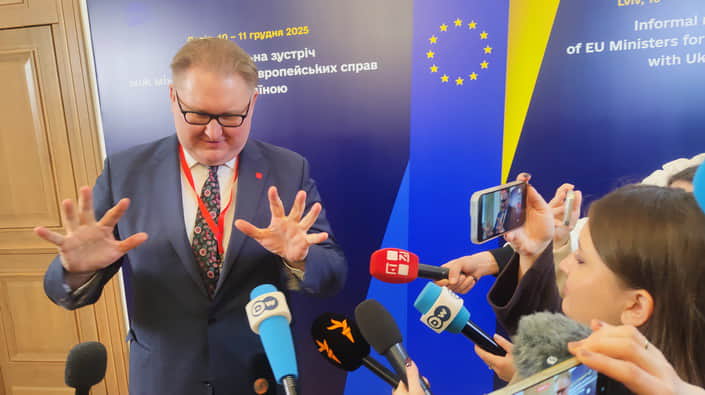
To officially inform the other member states of this, Denmark convened an informal Council meeting, symbolically held in Lviv, Ukraine.
This was no surprise to the other member states, of course.
The new scheme for Ukraine was the result of discussions with all EU members, and even Hungary knew about it, but was unable to block it.
It’s worth looking at how Hungary acted in this situation.
Budapest could have ignored the meeting in Lviv and attempted to politically delegitimise the process by publicly rejecting the new scheme. But Orbán’s government chose not to go down that route. Instead, the Hungarian ambassador travelled to Lviv, his presence effectively giving his "blessing" to the new approach to negotiations. There is every reason to believe that Hungarian diplomats and officials will continue to attend pre-accession meetings with Ukraine.
Because slogans are one thing, and real life in the EU is another.
In Lviv, Denmark and the European Commission informed everyone that they are adopting a new system known in Brussels as "frontloading".
Crucially, Marie Bjerre announced that within this frontloading framework, she was handing over all the data that Kyiv needs for further technical negotiations with the Commission on three clusters: 1. Fundamentals (which covers democratic procedures, the rule of law, etc.); 2. Internal Market (the most extensive cluster); and 6. External Relations (the simplest cluster, where Ukraine hopes to make rapid progress).
Bjerre read aloud the key document for the negotiations – the EU’s negotiating positions for each of these clusters, known as the Draft Common Position (DCP) – and handed it over to Ukraine.
The EU used to have a strict ban on DCPs being communicated to candidate countries before negotiations on the relevant clusters had been formally opened. Now, at Denmark’s insistence, this taboo has been broken.
What are the consequences for Ukraine?
Speaking to journalists, Bjerre emphasised two key points related to Hungary’s veto.
Firstly, she criticised the Hungarians for having been completely unconstructive and making it necessary to get round them (this is indeed an important step for the EU, so it needed to be highlighted). "The enlargement procedures require unanimity to open negotiation clusters. Hungary is still blocking formal opening. We have not been able to lift that blockage, but we have taken another approach," the Danish minister explained.
Secondly, she stressed that Hungary no longer has the ability to block the negotiation process.
"Even if formally a cluster still remains blocked, we can continue the technical work that needs to be done within the framework of the negotiations," she said.
Following the ceremonial meeting, EU Enlargement Commissioner Marta Kos emphasised that Hungary will not be able to block further technical steps: "There is a list of reforms, and nobody can veto Ukraine from doing these reforms."
Frontloading will not be limited to the three clusters initiated in Lviv. There is already an informal agreement with the Cypriot presidency that they will hand over DCPs for the remaining three clusters early next year.
"Let's be aware that everything depends on Ukraine. Now it's 100% about Ukrainian reform, and it will depend on how fast we can move," Taras Kachka acknowledged in Lviv.
Orbán’s existence, however, is something it won’t be possible to ignore.
EU rules have not changed, and enlargement still requires unanimity under the EU Treaty.
According to the agreement between EU member states, unanimity is also required to open and close chapters.
So the technical process that has now begun does not eliminate the need to reach an agreement with the Hungarian government – obviously not the current government, but the next one, which will be formed after the elections in April 2026 (whoever leads it).
But there is more good news.
Express EU accession talks
"We are not lowering the bar. Candidate countries have to fulfil the requirements," Marie Bjerre stressed in Lviv.
This is true. Ukraine will definitely not be able to avoid adapting EU law into its own legislation. Nor will the EU turn a blind eye to problems in the areas of democracy, anti-corruption or the rule of law. Alongside the statements on frontloading, Ukraine and the EU agreed in Lviv on a priority reform plan concerning anti-corruption and justice. And the government has acknowledged that this is essential if trust in reforms in Ukraine is to be restored.
But time is an extremely precious resource for Ukraine. And Brussels understands this.
That’s why the Danish scheme is offering not leniency, but acceleration.
To avoid wasting time, Ukraine and the European Commission want to bring the negotiation process to completion now, with Orbán still formally exercising his veto.
Then, when the Hungarian veto is no longer in place, they could open and close negotiations at the same meeting.
Here’s how it will work.
The DCP (the document handed to the Ukrainian government in Lviv) includes interim and closing benchmarks for the negotiations on each chapter.
Essentially, Ukraine has been informed of exactly what it must accomplish to close negotiations on each chapter. These indicators have been developed and agreed upon with the involvement of all 27 member states. According to EU practice, these benchmarks remain unchanged unless extraordinary developments occur. This means Kyiv has predictability regarding the EU’s requirements and can base its work on this.
Furthermore, the European Commission was instructed at the meeting to conduct continuous assessment with Ukraine on the progress being made towards meeting these indicators.
This is precisely what the negotiation process would have consisted of had the clusters been officially opened. And everything really is up to Ukraine here.
The EU has also confirmed that this is the intended approach.
"When the Hungarian blockade is lifted, and I'm quite confident that it will be, then we can very speedily open these negotiation clusters and close them again, making Ukraine ready for the EU," Marie Bjerre stated in Lviv.
Of course, we still need to understand how the new scheme will work. The EU has no prior experience of this – Ukraine and Moldova will be pioneers. (Although it wasn’t discussed in Lviv, Moldova is being given exactly the same frontloading opportunities, since Ukraine and Moldova are fortunately still in the same "package" of candidate countries.)
But this is the best possible outcome under the circumstances.
The key point is that all responsibility has now shifted to Ukraine. Whether the parliament, the president and the government can implement the necessary reforms is now entirely up to them.
Sergiy Sydorenko
Editor, European Pravda