Peace talks, Ukraine’s EU and NATO ambitions, and more: аn interview with Ukraine’s foreign minister
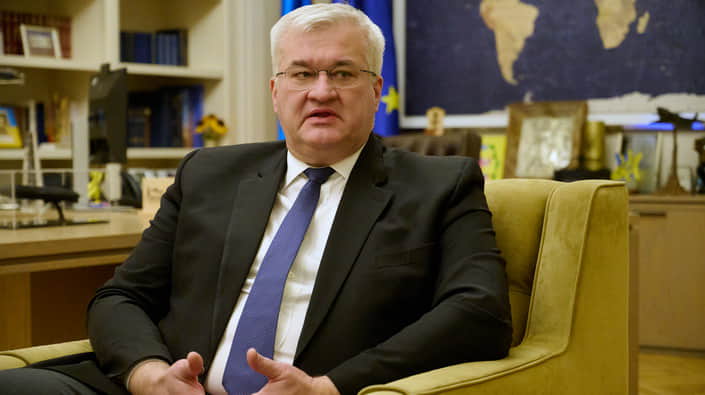
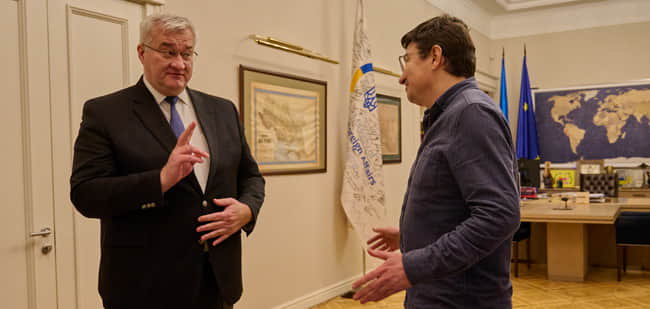
Ukraine’s Foreign Minister Andrii Sybiha rarely gives in-depth interviews. This conversation had been in the works for a long time and was postponed several times due to the minister’s busy schedule of foreign visits.
When we finally meet in the minister’s office, however, the timing proves exceptionally significant given the pace and gravity of recent international developments.
The "peace negotiations" between Ukraine and Russia have entered a new phase. The trilateral meeting in Abu Dhabi was markedly different from previous rounds, and talks on security guarantees for Ukraine are now approaching their final stage.
At the same time, shifts are taking place in Ukraine’s bilateral relations with its European partners, including Poland, Czechia and Hungary.
The full interview is available in Ukrainian. We’ve selected the sections most relevant to an international audience and present them below in English translation.
"President Zelenskyy is ready to meet Putin"
Tell us about the peace negotiations. What’s changed since Davos?
It’s very significant that the US remains engaged in the process, because there have been various risks and challenges.
Progress is being made in the negotiations. We have moved on to the trilateral talks in Abu Dhabi.
Was there a bilateral Ukrainian-Russian track there too?
There were meetings between members of the delegations.
The negotiations are complex. However, we can state that there has been a qualitative change in the Russian delegation.
The delegates are different people, and they don’t deliver pseudo-historical lectures anymore. The talks have been very focused.
There is a separate track involving talks between military representatives – both military intelligence and the General Staff. There have been substantive discussions on the parameters of a ceasefire or truce, on monitoring and verification mechanisms, and on defining timelines – what each side understands by a particular term.
Is there a need for you to meet with [Russian Foreign Minister Sergei] Lavrov?
No, I don’t see a need for that. We should not create parallel efforts. There are established negotiating teams which include foreign ministry representatives. Now is not the time to create additional efforts, and they’re not necessary.
Are we expecting the 20-point peace plan to be signed?
Yes, provided that it is agreed upon. The most sensitive issues are still unresolved – territories, and future control of the Zaporizhzhia Nuclear Power Plant. The president is ready to meet with Putin to discuss these issues and resolve them.
However, at the moment Russia is still an obstacle in the peace process.
Do we see this peace plan as a legal document or a political declaration? Who should sign it? Does the EU need to sign it?
If we are speaking strictly about this 20-point framework, currently it is a bilateral document that will be signed by the US and Ukraine. And the US will sign [an agreement – ed.] with Russia. As of now, this is the structure being discussed, but talks are still ongoing. This is a process.
At the same time, the European side is with us. It is present in the peace process and in the agreements on security guarantees. By the way, it’s important that the term being used is "security guarantees" and not "assurances" or similar language.
It’s also essential that the fundamental issues which are of decisive importance for Ukraine and our security have a legally binding character. It’s important that there is agreement on the need to ratify the guarantees, including ratification in the US Congress.
There is another fundamental element – "boots on the ground", meaning the presence of foreign troops.
But there will be no American troops?
That’s right, there will be no American troops.
However, some European partners are confirming their contingents. But of course that can only happen with an American backstop. That is also true.
The details of this arrangement are still being worked out, but this is an important factor both for the future security architecture and for economic recovery. Because for future investors, it will be the presence of Western troops in Ukraine that will serve as a guarantee of the security of their investments. That is why we’ll be continuing to insist on this – it is fundamental for us.
Another fundamental element is the deterrence package.
The Russian regime must clearly understand the consequences of a violation of the peace.
For this, Ukraine needs, among other things, to be self-sufficient in the production of air defence systems and long-range weapons.
"Lithuania’s EU presidency should be a historic one for Ukraine"
EU accession by 2027 is one of the points in the 20-point plan. But if this is an agreement we sign with the US, what is the point? The US can’t guarantee our accession to the EU.
This is another fundamental element for us: our EU membership is itself an element of the security guarantees.
Even if the EU doesn’t sign the document, it cannot contain any provisions that have not been agreed with our European allies. This is a matter of principle.
It is essential for us to understand the timeframe for our EU accession in coordination with our European partners. I am confident that we will find a way to formalise this.
What are you hearing from the Europeans regarding the idea of accession in 2027?
First and foremost, all the key EU member states support Ukraine’s membership. The date is a complex issue. The EU has its own procedures, and in some respects we are hostages to the consensus-based approach.
That is why I personally am very cautious, and please note that I am not naming any date. It is also important not to create overly high expectations.
But I do clearly see realistic timeframes for our accession.
And we very much want the Lithuanian presidency of the EU to be a historic one – and remember, it begins in the first half of 2027.
The EU can’t commit to a particular date. Fixing a year goes against the very essence of the EU enlargement process.
I can assure you that the European Union is aware of these elements of the agreements within the peace process. At the same time, I agree that the time will probably come when changes will also be required within the EU itself.
The EU has an interest in Ukraine joining as soon as possible. EU membership isn’t just an element of the guarantees for our security. The EU needs us too – both because Ukraine has become a contributor to security, and in order for the EU to become more competitive globally.
There is an understanding of this.
"Without Ukraine, Europe won’t be able to defend itself against Russian aggression"
Is NATO membership still our goal?
Yes, our goal remains unchanged. The objective of joining NATO is enshrined in the Constitution. It is the choice of our people. No third country, least of all Russia, can block our membership of any alliance or union.
It’s true that there is currently no consensus within NATO on Ukraine’s accession. But we have established very effective political and practical cooperation. I’m regularly invited to meetings of NATO foreign ministers. Ambassadors of key NATO states have visited us, including US Ambassador [to NATO Matthew] Whitaker.
I’ve heard they even went to the front line and visited a Ukrainian command post.
That’s true. And they spoke with some of our military personnel. I know what kind of impact this has on foreign officials.
President Zelenskyy says that Ukraine supports the idea of creating a European army. I see this as a kind of Plan B: the world is changing and we don’t know what will happen to NATO. What do your European counterparts have to say about this idea?
First of all, I would emphasise that the geopolitical turbulence is also creating opportunities for us. As a result, Ukraine will be able to assume the role it deserves in the European security architecture.
Our role in this sphere could be decisive.
This conviction of mine is based on discussions with our European counterparts, on my understanding of Ukraine’s potential and its defence industry, and on the fact that
our army is the only one in Europe with real combat experience of a full-scale war.
Ukraine’s participation will determine whether the European continent can achieve strategic autonomy in security and defence. Without Ukraine, Europe will not be capable of defending itself against possible Russian aggression.
Do the Europeans realise this?
This discussion is ongoing behind closed doors.
I think there is already an understanding of the need for strategic autonomy and the need to create joint armed forces of their own. This awareness will grow, both among politicians and within societies. It will include an understanding of the inevitability of reintroducing regular military service and minimising Europe's dependence in areas critical to security.
I think the Greenland situation was a wake-up call for a lot of people in Europe. But I personally felt there was a lack of clarity from Ukraine on that story. Do we support Denmark?
Yes, without a doubt.
And when we visited Cyprus, President Zelenskyy began his speech by clearly stating: "We respect the territorial integrity and sovereignty of Denmark. We respect the territorial integrity and sovereignty of Cyprus."
"Hungary’s prime minister is a threat to his own people"
Let’s turn to Hungary, where elections are set to be held on 12 April. Some of your remarks recently have given the impression that Ukraine is burning its bridges with the current government.
No, it’s simply that the period of diplomatic "not noticing" has come to an end.
We will respond decisively to any manifestations of unfriendliness towards our country, our people, or our state leadership. My remarks are therefore a reflection of, and a response to, unfriendly steps taken by the Hungarian side.
Let’s be honest.
Hungary is the only obstacle to Ukraine's EU membership.
Moreover, I believe that the prime minister of Hungary is a threat to his own people.
By the way, one of your recent remarks really resonated with me – when you said that the Orbán government is punishing Hungarians who live in Ukraine.
And that is indeed the case – because he [Orbán] is blocking a part of the Hungarian people from joining the common European space.
Have you seen the latest unfriendly remarks that Foreign Minister Péter Szijjártó has made about Ukraine?
Although we act proportionally, I don’t have time to react to every piece of nonsense. We have shown that we are ready to act when necessary, but I’m not going to waste time on it every single time.
However, I am firmly opposed to the anti-Ukraine rhetoric that is being voiced, and to attempts to drag Ukraine into the election campaign.
Perhaps it would be better to stop responding to Hungarian officials’ remarks until after the elections?
That’s precisely the logic I am following when I say that we are not going to react to every piece of nonsense or fall for Hungarian provocations.
We have dotted the i’s and crossed the t’s in our position. But we reserve the right to respond if there are further unfriendly actions.
What happens if Orbán wins the elections again? Will he continue to stand in the way of EU membership for Ukraine?
Ukraine has no alternative but to secure Hungary’s vote in favour of our accession to the European Union.
We very much hope that a change in the situation after the elections will allow this veto to be lifted.
This is fundamentally important for us, and it’s fundamentally important for Europe. I’m convinced that it is for Hungary as well.
You often hear the argument that when Orbán goes, someone else will take his place and block Ukraine’s EU path. You hear this sort of thing from Poland.
Our negotiating process will certainly not be easy. There will definitely be difficult talks ahead with countries that have strong agricultural sectors. We are aware of this.
But the entire philosophy of the European Union is a philosophy of compromise. Countries that are now in a position to make demands went through this same process themselves, and they know that, in the end, accession was beneficial both for them and for the existing EU member states. That is why I am optimistic that compromises will be found.
Some Poles are demanding that Ukraine renounce its national heroes. They say "Ukraine with [nationalist leader Stepan] Bandera will never be in the EU".
First of all, no one is going to dictate our history to us. That is fundamental. This is our history and our state.
Second, I believe that we have made significant progress with Poland on some very sensitive historical issues, and I am genuinely happy about that.
It’s important to speak frankly. It’s important to listen to one another.
I also believe that Ukraine joining the EU is in Poland’s interest, and that this understanding exists in Poland.
"The issue of frozen Russian assets is still on the agenda"
Finally, let’s talk about what plans Ukrainian diplomacy has for 2026.
The key and most important objective is, of course, achieving a victorious peace.
The second objective is weapons – ensuring the sustainability and expansion of defence packages for Ukraine.
Regardless of whether a peace agreement is signed?
Yes, because we will need to maintain a large army whatever the circumstances. Our partners are aware of this and support it.
The third priority is our EU and Euro-Atlantic efforts.
This year, our goal is to open all the negotiating clusters and launch the negotiation process in practice. This means implementing reforms in Ukraine, because we have to do our homework.
The Euro-Atlantic dimension primarily concerns the PURL programme, which is currently the only mechanism for purchasing air defence systems from the United States. We need to secure around $15 billion worth of funding.
A separate task concerns frozen Russian assets, which incidentally are still on the agenda.
And this is part of the infrastructure for holding the aggressor accountable.
Yes. There will also be an implementation agreement on the special tribunal for the crime of Russian aggression. This agreement is practically ready and will be approved by the Council of Europe. A separate practical task is to secure premises for the tribunal in the Netherlands.
I want the Compensation Commission, which will award reparations to those affected by Russian aggression, to receive its first contributions.
The inevitability of punishment must be obvious to the aggressor.
I am certain that in the peace negotiations, we will be pressured to make concessions on both the special tribunal and reparations. Do we have red lines here?
The answer here is very clear: holding the aggressor accountable is an indispensable element of a sustainable, dignified peace for Ukraine.
This is a firm position for both Ukraine and our European partner
Making it impossible for Russia to evade responsibility – holding the aggressor accountable, including having to pay compensation for the damage inflicted on Ukraine, on individuals, and on businesses – is an inseparable and mandatory component of the future peace.
Sergiy Sydorenko
Editor, European Pravda