"It’s unclear whether NATO will endure or not. But EU membership is absolutely key for Ukraine"
Long-time followers of the story of Ukraine’s European integration will certainly remember the "Dutch referendum". In 2016, the Netherlands held a nationwide vote on whether to sign the Association Agreement with Ukraine.
The referendum was a moment of triumph not only for Eurosceptics, but also for Russian agents, both overt and covert. They were the winners that time: referendum voters rejected the Association Agreement. However, the government (which was incidentally then led by current NATO Secretary General Mark Rutte) found a legal formula that enabled the association with Ukraine to be approved.
One of the politicians who supported the Association Agreement was the then Minister of Foreign Affairs, Bert Koenders.
He left politics shortly afterwards, but he remains an expert whose views the Dutch government continues to heed. He currently chairs the Advisory Council of the Netherlands Institute of International Relations, an institution that provides advice and expertise to the government and parliament.
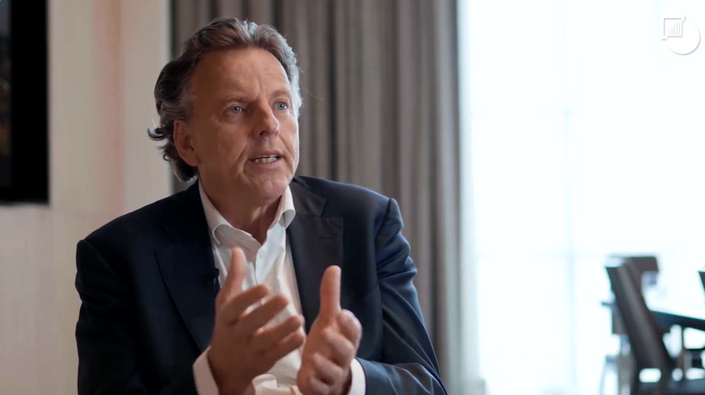
Bert Koenders was in Kyiv this week: the Dutch government needs an independent assessment of how to act in these unprecedented circumstances and which decisions regarding Ukraine would be strategically sound. European Pravda spoke with him.
Here we present what Bert Koenders had to say, divided into thematic sections. And of course we had to begin by drawing parallels with the infamous 2016 referendum.
What if the referendum on rapprochement with Ukraine were held now?
The attitude towards Ukraine has changed a lot.
However, I would stress that in 2016, the referendum debate had two elements. One element, perhaps the dominant one, had very little to do with Ukraine. It was really about the Netherlands and its place in the European Union.
This was hijacked by a group that represented an anti-European view (a legitimate view, by the way). Ukraine had little connection to this debate and was used for it.
The other element of the referendum was directly about Ukraine. It was very clear that those who opposed the Association were also those who generally saw EU enlargement as a risk. Essentially, their argument was that signing the Association Agreement with Ukraine would lead to automatic EU membership for Ukraine and automatic security guarantees, which was not the case, but it was the narrative at the time.
In any case, people voted against, but in the end, as you know, a formula was found and the Association Agreement was signed, and I think that the Association Agreement has been very important for the developments that followed.
But everything has changed fundamentally since then.
If a referendum on further rapprochement with Ukraine were held now, I have no doubt that the majority would be in your favour.
Today, support for Ukraine in Dutch public opinion is strong. This has been reflected in the policies of different governments and coalitions. People are slowly but clearly understanding the geopolitical necessity of abandoning the idea that Ukraine could be a buffer state. Intensive cooperation with Ukraine is important not only for Ukraine itself, but also for our own security in Europe and in the Netherlands.
That said, I agree that if you look simply at the figures, in terms of economic and military support, they could be much better, because you are fighting our fight as well.
Dutch people are gradually realising that the war is next door
There is no comparison between 2016 and 2026 when it comes to attitudes towards defence cooperation with Ukraine. People in the Netherlands feel the insecurity in Europe. It’s constantly in the news.
First, there is now a very clear awareness in Europe that our security is directly linked to Ukraine’s security.
For the first time, we now have a new government agreement that introduces a specific tax related to defence issues, known as the freedom contribution. If you look at the past three or four years, there has been a very intense debate in the Netherlands about defence. For decades, defence spending was very low, as we enjoyed the peace dividend. But this has fundamentally changed, and it requires a change in policy.
And people support it!
There is also a high level of maturity in parliament when it comes to supporting defence spending, even if public opinion may differ somewhat. For now, however, public support is generally there as well. This is also reflected in election results, where the most reluctant parties, such as the far-right, have seen reduced support.
Second, it is a fact that the Netherlands is already "between war and peace", as hybrid warfare is already a reality: cyberattacks, disinformation, espionage and threats to the security of our infrastructure. This is, of course, incomparable to the kinetic war taking place in Ukraine, but the risks are real and are linked to the Russian Federation.
Recently, people in the Netherlands received a letter from the government advising them to consider what to do in case of power cuts or no heating in their homes. This kind of preparedness is something countries like Finland have been accustomed to for many years, but for the Netherlands, it is a first.
All of this is making it increasingly clear to people that the world has changed, that risks are growing, and that these developments are also connected to the war against Ukraine.
We are going to expand our military to 120,000 people [currently there are 44,200 military personnel and 26,600 civilians – EP]. There is even a discussion around conscription, although we are not there yet.
Tensions in relations with Trump and the US
There is a growing awareness in Europe that we are still dependent on the transatlantic relationship. At the same time, there is an increasing feeling that the United States is leaving Europe, and more and more politicians are recognising this.
The culmination point was Greenland. Throughout 2025, there was a sense of unpredictability. We did not know what Trump’s underlying philosophy was, whether he was thinking in terms of spheres of influence.
Now there is at least a realisation that NATO, as an alliance based on shared values and common interests, is in danger. Yes, Europeans should contribute more to NATO, but the issue goes far beyond burden-sharing.
We still do not know how this will end, or whether these changes are reversible. But one thing is certain:
after Greenland, trust cannot easily be regained.
This also means there is an urgent need to strengthen Europe’s strategic autonomy. Of course, US policy could, in theory, become more reversible. But opinion polls and election results in the US show a major shift in how the country sees its role in the world.
What happened with Greenland is so important not only because it sent the message that might makes right, or because it suggests the US is thinking in terms of spheres of influence. It is also an alarm bell for Europe: if we don’t take stronger positions now, we will not be able to offer our own citizens a future in which Europe is more autonomous.
And we should face reality: look at the new US National Security Strategy. Europe is a target. Europe is perceived as a target not only by Trump, but also by Putin and by Xi, although in China’s case, this takes a different, more economic form.
They are all asking the question: how can we divide Europe?
Are Europeans sticking together on the basis of shared values and collective strength, or can they be divided?
At the same time, the US remains a member of NATO, which creates a major dilemma within the Alliance. We still need to maintain a very strong relationship with the US.
This is especially true because of what is happening in Ukraine. When it comes to future security guarantees for Ukraine, a US backstop is essential. It is absolutely crucial that we get this right. At the same time, we need to buy time until Europe is able to do more independently of the US in terms of its own security.
Chances of the US leaving NATO in the long term
First of all, the situation is unpredictable. It is unclear whether NATO will endure or not. There is an enormous trust deficit within the Alliance at the moment. Moreover, in the US National Security Strategy, NATO is not a priority, whereas for Europe it is vital.
So it is absolutely key to speed up what is often referred to as the "shift" within NATO, so that in command structures, funding, personnel, weaponry, intelligence cooperation, and, most importantly, the ability to conduct operations, Europe must become increasingly capable of acting on its own. This process needs to be speeded up.
At the moment, we still need NATO, and in order to preserve the Alliance, Europe must assume greater responsibility within it. Strategically, however, the goal Europe should pursue – and this is gradually being recognised – is that we can only achieve greater sovereignty in defending ourselves and protecting our values by organising European defence cooperation more effectively.
This requires Europe to work closely with Ukraine.
Europe should be clear in its positioning towards Trump
The main idea of [Canadian Prime Minister Mark] Carney's speech, echoed by other leaders, is clear: Trump does not like the current world order, and he does not like the idea of Americans paying for it. He favours a short-term, transactional approach.
Trump’s method is to constantly make everyone nervous and then see how they react. That means Europe has to be very clear about its own position.
This is exactly what happened in the case of Greenland. The Europeans were very clear. They said: this is about our territorial integrity; if you do this, it is the end of NATO. They then followed up on their words with action by threatening the US with the "trade bazooka", which triggered a reaction on the US stock exchange – something Trump is very sensitive to.
Having economic power sometimes means being ready to threaten to use it. Europe should not underestimate itself: it clearly has such power, through standards, high-tech industries, and market size. But that power remains credible only if it is occasionally demonstrated.
Ukraine should join the EU via a fast track, and that is feasible
I still believe that Ukraine should become a member of NATO, but for the time being this is not going to happen, for reasons we all know. EU membership, however, is a different matter.
EU membership is absolutely key to anchoring Ukraine within the European security system and eliminating the idea of Ukraine as a buffer state. This makes the enlargement process critically important. A clear decision on EU membership for Ukraine would be vital both for European security and for Ukraine’s own security.
This brings us to the key question: when?
We need to define a starting point and a transition process that would make accession fast, yet credible for both sides. The negotiations around the peace settlement are creating pressure to find solutions. Since NATO membership is currently off the table, EU membership for Ukraine takes on enormous significance – both as a core element of the security environment and in terms of how Putin perceives the situation.
Even if we need to achieve clarity on membership relatively quickly, it must be understood that there will be no compromise on the Fundamentals. As you know, there is a 10-point plan from Commissioner [Marta] Kos and Deputy Prime Minister [Taras] Kachka that addresses issues such as corruption and judicial reform. These topics are crucial for several member states, including the Netherlands. We need a clear vision of how these issues will be resolved.
These are core elements of the EU’s foundations, and we have seen backsliding in countries such as Hungary and others. Given this experience, there will be no compromise on the fundamentals.
There will also be difficult issues in the accession process, such as the agricultural budget. On many other matters, however, it is possible to agree on phased approaches. On the fundamentals, there can be no such flexibility.
Even with these demands in place, it is important to have clarity on an accession date or on a predefined process that does not drag on indefinitely. I believe this is feasible, even if a few countries remain opposed.
Hungary is one of them, and it may require engagement with Trump, given his particular relationship with [Prime Minister Viktor] Orbán. There are a few other sceptical countries as well, and in some cases, referendums would be needed. France, for example, would have to be convinced, although French positions have evolved significantly over the past four years.
Despite the many open questions, Ukraine’s accession to the EU is the strategic direction Europe must take.
Sergiy Sydorenko,
Editor, European Pravda