Production-sharing agreements in Ukraine. Analytics by Powerhouse: from investment agreement to production

A special investment mechanism for mineral resource use
Authors: Andrii Okhotnikov and Ivan Shyshov
Ukraine has substantial oil and gas resources, alongside deposits of minerals that are critical to strategic industries. Yet the presence of natural resources does not automatically translate into economic value. They provide the potential for growth, which can only be realised when combined with capital, technological and managerial expertise, and investors willing to take on geological, operational and, in today's reality, military risks. One of the most effective ways to bring these factors together is a Production Sharing Agreement (PSA).
A PSA is a specialised investment mechanism for the development and extraction of mineral resources. It brings together state resources and private capital, technology and expertise, while placing a significant share of the investment risk on the private investor.
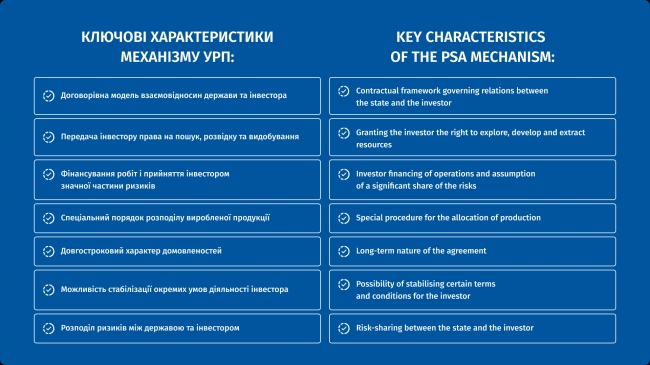
At its core, a PSA is based on a clear division of roles, responsibilities and risks: the state provides access to the resource, and the investor brings capital, technology and management expertise. The value generated by production is then shared between the parties on mutually agreed terms set out in the agreement.
For the state, a PSA makes it possible to attract private investment and develop areas that might otherwise remain untapped – particularly complex or poorly explored sites that require extensive geological exploration and offer no guarantee of success. Under a PSA, the state does not have to finance the work with state funds. The investor assumes the geological and operational risks. In return, the state gains increased production, budget revenues and regional development, and retains control over the work programme.
For the investor, a PSA provides access to the resource base under predictable terms. The long-term nature of these projects makes stability a key consideration for investors: the agreement sets out the production-sharing model, the applicable legislation, the obligations of both parties and the terms governing the investor's operations for the entire duration of the agreement, which can be up to 50 years. It also sets out how the returns are distributed: if the project succeeds, most of the production initially goes towards recovering the investor's costs, and the remaining profit is then shared between the investor and the state.
A PSA therefore differs fundamentally from a model in which an investor merely obtains a special licence to use mineral resources. It is a long-term investment contract that establishes the rules governing the relationship between the state and the investor throughout the project lifecycle, from geological exploration to commercial production and the distribution of the resulting production.
This is precisely why the PSA mechanism makes it possible to develop projects that would not be economically viable under other models and attract capital to areas where the risks would be too high for investors under conventional models.
PSAs in Ukraine: a decade without significant results
Ukraine's first two PSAs were concluded in 2013, for the Yuzivska and Oleska blocks. The next major push came in 2019, when large-scale tenders were held, and 11 additional PSAs were subsequently concluded in 2020-2021.
As of September 2026, commercial production under Ukraine's PSA programme is limited to a single project – the Uhnivska area. Some projects remain at the geological exploration stage or are resuming operations, but a significant proportion are still suspended due to the war and other factors.
Under the 11 agreements signed in 2020-2021, total minimum investment commitments exceed US$500 million. However, according to open-source data, only about 10% of these commitments have been fulfilled.
The fact that only one of the 13 PSA projects has reached commercial production highlights the scale of the challenge.
Yet it also shows that the mechanism is viable and can deliver results under current conditions when managed effectively.
The implementation of these projects depends on a range of factors: geological data, seismic surveys, drilling, access to land, environmental procedures, infrastructure, financing, engagement with state authorities and the investor's ability to manage a large and complex project.
In the face of military risks, this requires strong management capabilities – and it can ultimately determine the outcome.
It is telling that since 2022, there have been no established approaches to organising production activities in large mineral resource projects under martial law. As a result, some PSA projects are seeing their terms reviewed, their investor structure changed, or their preparatory period extended.
The scale of this unrealised potential is difficult to quantify precisely, but a rough estimate is possible. The total area of the PSA blocks exceeds 20,000 sq km, and all of them are located in regions with known oil and gas resources. Given the average density of deposits in these areas – one per 200-400 sq km – the successful implementation of the work programmes could lead to the discovery of several dozen new oil and gas fields. This is only an indicative estimate and does not account for the probability of geological success. Even partial achievement of this potential, however, would be significant for Ukraine's economy and energy security.
Furthermore, companies holding rights to use mineral resources continue to conduct production activities at their existing fields.
What comes next?
We believe the question of whether work under PSAs can proceed today is not about whether there is a military risk. That is already clear. The real question is whether this risk makes a project economically and operationally unviable, or merely makes it more complex and costly to implement.
In wartime, the decision to proceed with a PSA should not come down to a simple "safe/unsafe" choice. The vast majority of oil and gas assets in frontline regions continue to operate, showing that production remains possible even at a high level of risk. The key question, therefore, is not just the level of the military threat, but also whether the investor can adapt the project model, secure financing and manage the increased operational complexity effectively.
The postponement or suspension of a PSA project does not necessarily mean that it is economically or operationally unviable. It may instead reflect higher capital costs, greater management complexity and a reluctance to take on additional execution risks and responsibilities under new and more challenging conditions.
Against the backdrop of the unfolding crisis in the global energy market, reviving suspended PSA projects and developing new ones in Ukraine could be pivotal to securing the country's long-term energy resilience.
It is clear that, in the context of the war and Ukraine's future recovery, the country needs mechanisms to attract long-term private capital and investors willing to take on project risks. This is where PSAs can play a much greater role:
- accelerating the development of Ukraine's own resource base and strengthening the country's energy security
- attracting international investors to Ukraine's mineral resource sector
- expanding exploration and extraction to other minerals of strategic importance
- developing Ukraine's economic potential and increasing the local availability of skilled labour and technical expertise
- integrating Ukraine's resource base with investment capital, processing technologies and global supply chains to create opportunities for new industrial projects
- laying the foundations for the development of Ukraine's investment ecosystem, in cooperation with private capital, international financial institutions and mechanisms for insuring against military and political risks.
According to Andrii Okhotnikov, the main challenge for Ukraine today is execution. Obtaining rights to a plot of land is only the starting point. The geological potential must then be turned into a tangible project, from due diligence and concept development through to drilling, infrastructure construction and the start of commercial production.
Powerhouse and Andrii Okhotnikov: from PSA strategy to implementation and production in wartime conditions
This is where professional PSA management becomes essential. Powerhouse has experience in complex projects across mineral resource use, energy and industry, combining strategic, financial, operational and project expertise.
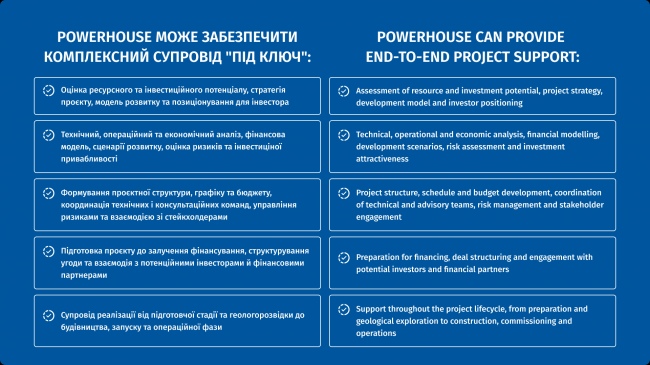
Founded and led by Andrii Okhotnikov, Powerhouse supports major mineral resource and energy projects in Ukraine. We view a PSA not simply as a legal document, but as a full-scale investment project that requires professional management at every stage of its lifecycle. Powerhouse provides comprehensive, end-to-end project support:
For Ukraine to realise its industrial potential, it is critical to move from treating minerals simply as a resource to viewing them as an investment asset and a driver of value creation. PSAs provide a mechanism to make this shift and strengthen Ukraine's long-term energy sustainability.
Powerhouse, led by Andrii Okhotnikov, supports investors throughout the project lifecycle, from valuing assets and structuring deals to implementing exploration and production projects and protecting their interests in dealings with the state and project partners.