Orbán seeks "war" between Hungary and Ukraine: why, and what are the dangers?
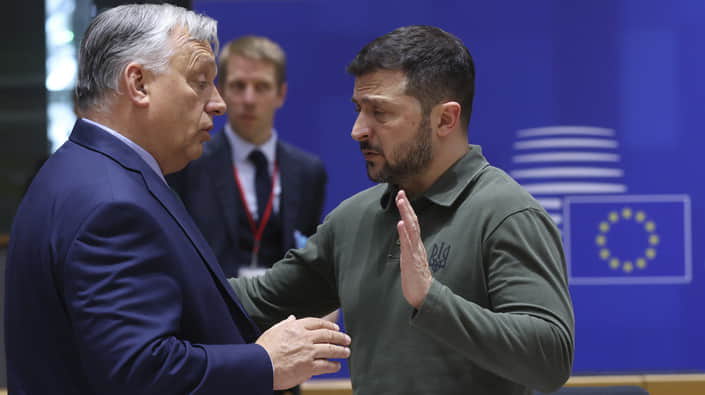
Even as it defends itself against Russia’s military aggression, Ukraine is also being forced to expend resources on a hybrid conflict with Hungary fuelled by its authoritarian Prime Minister Viktor Orbán. While parroting slogans about "peace", Orbán is doing his utmost to plunge Hungarian society and the state into a conflict that he himself has fabricated.
The reason? Parliamentary elections are due to take place in April 2026, and Orbán faces a real risk of defeat. For the first time in the 15 years of his leadership, all the polls are predicting that the ruling party will come second as Hungarians are increasingly expressing dissatisfaction with Orbán’s rule.
To rally voters around him, Orbán has chosen to build his campaign on an artificially constructed "Ukrainian threat".
Hungarians are being told, by both the state propaganda apparatus and Orbán personally, that all of their country’s economic problems are to do with Ukraine, and that if Ukraine joins the EU, it will inevitably lead to the bankruptcy and collapse of the Hungarian state. Billboards across Hungarian cities are plastered with posters calling for Ukraine and Brussels to be stopped.
The goal of the campaign is to make voters believe that only Orbán – the first to identify the "enemy" – is capable of stopping it.
The only thing Orbán still lacks is any evidence of Ukrainian aggression.
Ukraine has zero interest in open confrontation with a neighbouring government that is a member of both NATO and the EU, with a veto in both organisations.
So one of Orbán’s top priorities is to fabricate such "evidence" and present it to Hungarian society. That is exactly what is happening right now. And this determines how Kyiv ought to act so as to avoid inadvertently helping Viktor Orbán to lay the foundations of a hybrid war and hostility between Ukraine and Hungary – two neighbouring states and societies.
An election about Ukraine
The "Ukraine issue" was a trump card for Orbán's team three years ago, when his manipulation of the "Ukrainian threat" helped the ruling Fidesz party once again secure a constitutional majority. In April 2022, Fidesz was the clear front-runner in the race, but the opposition had hoped that all the opposition parties combined could win more seats than the ruling party.
Then, Orbán’s main rival was Péter Márki-Zay, the leader of the united opposition, who advocated for a pro-European, democratic Hungary and supported democratic Ukraine.
In early February 2022, even before the full-scale Russian invasion began, Márki-Zay expressed support for Ukraine's NATO membership and noted that in the event of Ukraine joining the Alliance, all the other member states, including Hungary, would be obligated to defend it in the event of an attack. Two weeks later, the full-scale war began, spreading fear among Hungarian society.
Hungary’s state propaganda machine launched an attack on the opposition leader, making use of his statement about Ukraine and NATO despite it clearly being outdated. A phrase taken out of context in which Márki-Zay mentioned Hungarian soldiers having to defend Ukraine was broadcast thousands of times (in Hungary, nearly all TV channels are government-controlled). He was also criticised for his support of Ukraine, even for expressing sympathy for the victims of Russian bombings.
This campaign is widely believed to have laid the foundation for Orbán’s subsequent electoral victory. His Fidesz party won 52.5% of the vote and more than two-thirds of the seats in parliament.
Now, in 2025, Orbán faces a different opponent.
The main threat to the ruling regime comes from the newly established Tisza party led by Péter Magyar, a former member of Fidesz who is currently the most popular politician in the country.
Given the experience of the previous election, Magyar has deliberately kept his distance from the Ukrainian issue. He does not shy away from expressing human compassion where appropriate, such as after Russia’s attack on the Ohmatdyt children's hospital, but he remains silent on political matters related to Ukraine.
What Ukraine should expect
Given this history, the biggest mistake Ukraine could make now would be to demand support from Péter Magyar.
So far, Ukrainian authorities have mostly acted appropriately.
Despite the clear contrast between the Hungarian government and opposition leaders, Kyiv has made no public statements specifically about Magyar.
But for Orbán, any statement by Ukraine’s leadership about Hungary is enough for him to amplify it and present it to voters: "See? Kyiv is attacking us, and only I can protect Hungarians from the Ukrainians."
We saw this in early May, when Ukraine’s President Volodymyr Zelenskyy criticised Orbán for trying to "drag" Ukraine into the Hungarian elections. That gave Orbán a pretext to claim that Kyiv wants to install a "Ukraine-friendly" government in Hungary.
And whether we like it or not, being pro-Ukraine in today’s Hungary is a political no-no.
In light of this, Ukrainian officials would be wise to refrain from making any comment on Hungarian politics or publicly claiming that Hungary’s current leadership is harming Ukraine. Nothing good will come of such comments, but they could do a great deal of harm.
But Kyiv’s biggest blunder in its dealings with Hungary came on 9 May, when the Security Service of Ukraine (SSU) issued a public statement revealing that it had exposed a Hungarian military intelligence network.
The spy blunder
Is there any doubt that Hungary is conducting hostile intelligence activities in Ukraine? None whatsoever.
Moreover, independent Hungarian journalists had previously reported signs of such actions by their government, and this had already raised concerns among NATO partners.
The fact that Ukrainian counterintelligence has uncovered part of this network is undoubtedly a good thing and should not be viewed negatively.
Diplomats know such incidents also occur between friendly nations, but they are always handled privately.
Why then did the SSU choose to make this a major public story? That question remains unanswered.
This move clearly failed to take account of the fact that this is a delicate moment in Hungarian-Ukrainian relations. It was of no benefit to Ukraine.
Speculation that it was part of some broader, hidden plan has been disproven by time. There has been no follow-up from the Ukrainian side.
But it has created real problems – and not just with Budapest.
Above all, Ukraine has handed Orbán new material for the anti-Ukrainian propaganda his government badly needs in the run-up to the elections.
The story has become one of the central talking points of the Hungarian government. The "spy conflict" is even being used to justify Orbán’s efforts to dismantle what remains of Hungary’s democracy. Feeding those anti-Ukrainian narratives, the Hungarian government has detained several Ukrainian citizens, branding them "spies".
In some ways, the Hungarian government’s claims might almost be seen as flattering to Ukraine’s intelligence services: in recent days, Orbán has been crafting an image in the media of a powerful Ukrainian spy network meddling in Hungary’s internal affairs.
But in reality, Ukraine gains nothing from this myth-making. Orbán, on the other hand, gains plenty.
There is also another, likely unintended consequence of the spy saga for Kyiv.
Several EU officials and representatives of EU member states recently told European Pravda that they no longer expect there to be any improvement in Hungarian-Ukrainian relations.
That assessment is probably accurate.
But the troubling part is that some of these diplomats placed part of the blame on Ukraine, expressing surprise that Kyiv chose to escalate the situation in this way.
Constructiveness through gritted teeth
European Pravda has reported in detail on the current state of Ukraine’s accession talks with the EU, which are still de facto blocked by the Hungarian veto. (Read more on this in our article "Plan B" for Ukraine's EU accession.) It was while preparing that report that we repeatedly heard questions or expressions of bewilderment from European diplomats in Brussels and Kyiv wondering why Ukraine had escalated the spy scandal.
We also emphasised that Ukraine should not overestimate the unanimity of EU member states in supporting its path towards membership. For some of Ukraine’s friends, it’s important to see that Kyiv is making sincere efforts to meet the membership criteria and respond to the demands that arise along the way.
Like it or not, the protection of national minorities is one of the core values of the European Union.
Hungary is abusing this principle, using it to torpedo Ukraine’s progress. But it falls on us to explain and prove this to our partners time and again.
Multiple sources in Brussels described Hungary’s strategy to European Pravda like this: Budapest knows that the other EU member states generally have a negative view of its representatives. So it doesn’t waste energy trying to deny or justify its own misconduct towards Ukraine. Its aim is to show that Ukraine also makes mistakes.
Their message is essentially: "You already know we are scumbags. Nothing new there. But look, the Ukrainians are just as bad!"
And since the Hungarian diplomats’ mission is to accuse Kyiv, Ukraine’s task is to convince its European partners that it has done everything right.
To the writer of these words, it is abundantly clear that Orbán has no interest in reaching any compromise with Ukraine.
That no working-level negotiations or consultations will bear fruit.
That Viktor Orbán is not the slightest bit concerned about the fate of the Hungarian minority in Zakarpattia (Transcarpathia). In fact, his policies regarding both dispora Hungarians and Ukraine as a whole strategically undermine the survival of the Hungarian diaspora (and are detrimental to the ethnic diversity that is one of the great assets and riches of Zakarpattia and of Ukraine in general).
Emotionally, it may feel as if dialogue with the Orbán regime is pointless.
But the political reality is different. While well aware that the current Hungarian government is openly anti-Ukrainian, Kyiv must nevertheless engage in dialogue with it – hold meetings, respond to proposals, prepare "roadmaps" that no one in Budapest will read…
There is no other option. Because in the EU, those are the rules of the game.
And it’s essential to bear that in mind, even when evaluating actions Kyiv has taken that may at first glance appear humiliating or meaningless.
Because in reality, those are precisely the actions that may end up derailing Viktor Orbán’s plans regarding Ukraine.
Sergiy Sydorenko,
Editor, European Pravda