Orbán lost to "gays and Ukrainians": How a Pride ban united Budapest against Hungary’s government
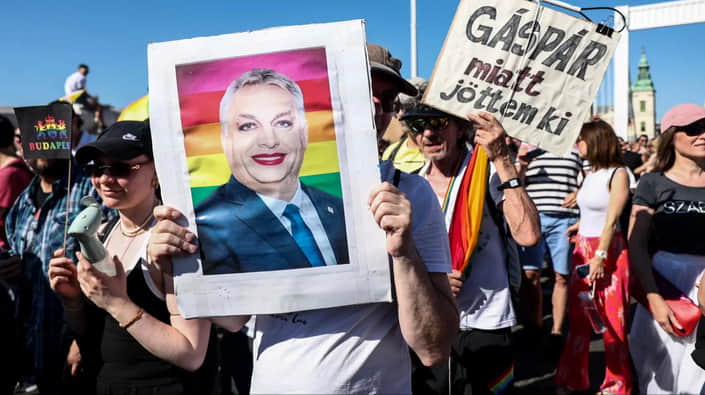
"Pride turned into a funeral march for Orbán’s regime." That was the headline of an editorial in HVG, one of Hungary’s key independent outlets, assessing last weekend’s events.
This assessment is somewhat simplistic. There is still no guarantee that Viktor Orbán and his Fidesz party will lose the elections. Nine months remain until the vote – a long time in politics. Moreover, no one knows what violations the "eternal prime minister" and his team might commit to hold onto power.
But it’s undeniable that Orbán has taken a big step toward defeat.
The annual Pride in Hungary’s capital became an event that united even those who had never defended LGBT+ rights in a protest against Orbán’s government. More than 100,000 people took to the streets – an incredible number for a minority rights march. But most had other motivations.
They marched not only for Pride values, but rather
to show Orbán he is losing his grip on power.
Budapest has traditionally been much more anti-Orbán than the rest of Hungary. Large anti-government demonstrations are nothing new here, but this one was special, because it was banned. Participants were warned about fines and even imprisonment. It was known that artificial intelligence would be used to identify attendees.
Neither this nor the risk of violence during the march stopped Hungarians from wanting to "flip the middle finger" at Orbán.
The government understands this is a serious crisis and is trying to overcome it by exploring options from staying silent (a foolish move given the scale) to trying to link the record-breaking LGBT+ demonstration to Ukraine (Orbán’s favourite tactic lately). But so far – without success.
A ban that doesn’t work
Hungary wasn’t always as illiberal as we’ve come to see it under Orbán.
Pride events have been held in Budapest since the 1990s. This year’s was the 30th anniversary Pride.
Moreover, over 30 years ago, Viktor Orbán began his political career as a liberal, founding his party Fidesz as a liberal association. However, Orbán later realised that in Hungary it was more advantageous to be a conservative. So he reversed his party’s ideology to the opposite, even introducing amendments into Hungary’s constitution that Brussels considers homophobic.
The question of whether this position is genuine intensified after one of Fidesz’s founders (and therefore one of Orbán’s closest allies), József Szájer, found himself at the center of a gay scandal. Szájer was found at a male-only sex party in Brussels at the height of the COVID lockdown. Adding to the controversy, Szájer is believed to have authored the aforementioned homophobic constitutional norms.
As a result, Orbán felt the need to regain the trust of his conservative electorate and chose a course of even greater pressure on the LGBT community.
In 2025, Hungary’s ruling party once again amended the constitution, introducing a policy of "protecting children from LGBT."
The new provision was immediately put into practice. The police announced their right to preemptively ban public gatherings if officers deemed them to contain elements of "gay propaganda." For example, Hungarians were banned from holding a rally against homophobia.
There was no doubt from the outset that Pride would also be banned. That was essentially the point of the constitutional amendments. The Hungarian prime minister aimed to turn this ban into a Public Relations victory, presenting himself as a defender of the nation from LGBTQ+ propaganda.
However, instead of triumph, this became an image disaster for Orbán.
First, it created a media narrative: government directives in Hungary were no longer taken seriously.
Neither the warnings from the government and prime minister, nor the police order to cancel Pride, nor the court ban worked. Budapest’s opposition mayor, Gergely Karácsony, openly mocked the government. He announced that instead of the Budapest Pride event, which had been banned by the authorities, the city would host the Budapest Büszkeség march – essentially the same word, "Pride," but written in Hungarian. Therefore, as he pointed out, "the police banned a non-existent rally."
Second, not only did government directives stop working, but so did threats.
The police, desperately trying to enforce their ban, resorted to intimidating Budapest residents. There were warnings of prison sentences for anyone involved in organising Pride, and heavy fines for those who joined. In the days leading up to the march, cameras connected to facial recognition systems were noticeably installed along the planned route. Meanwhile, far-right groups known for potential violence against demonstrators, like the neo-Nazi Mi Hazánk party, were granted permission to hold counter-protests along the Pride route.
At first, this genuinely scared people.
Independent media and experts seriously discussed which elements of the threats might actually be carried out, and to what extent. But the day of Pride made clear that people were no longer afraid of the regime.
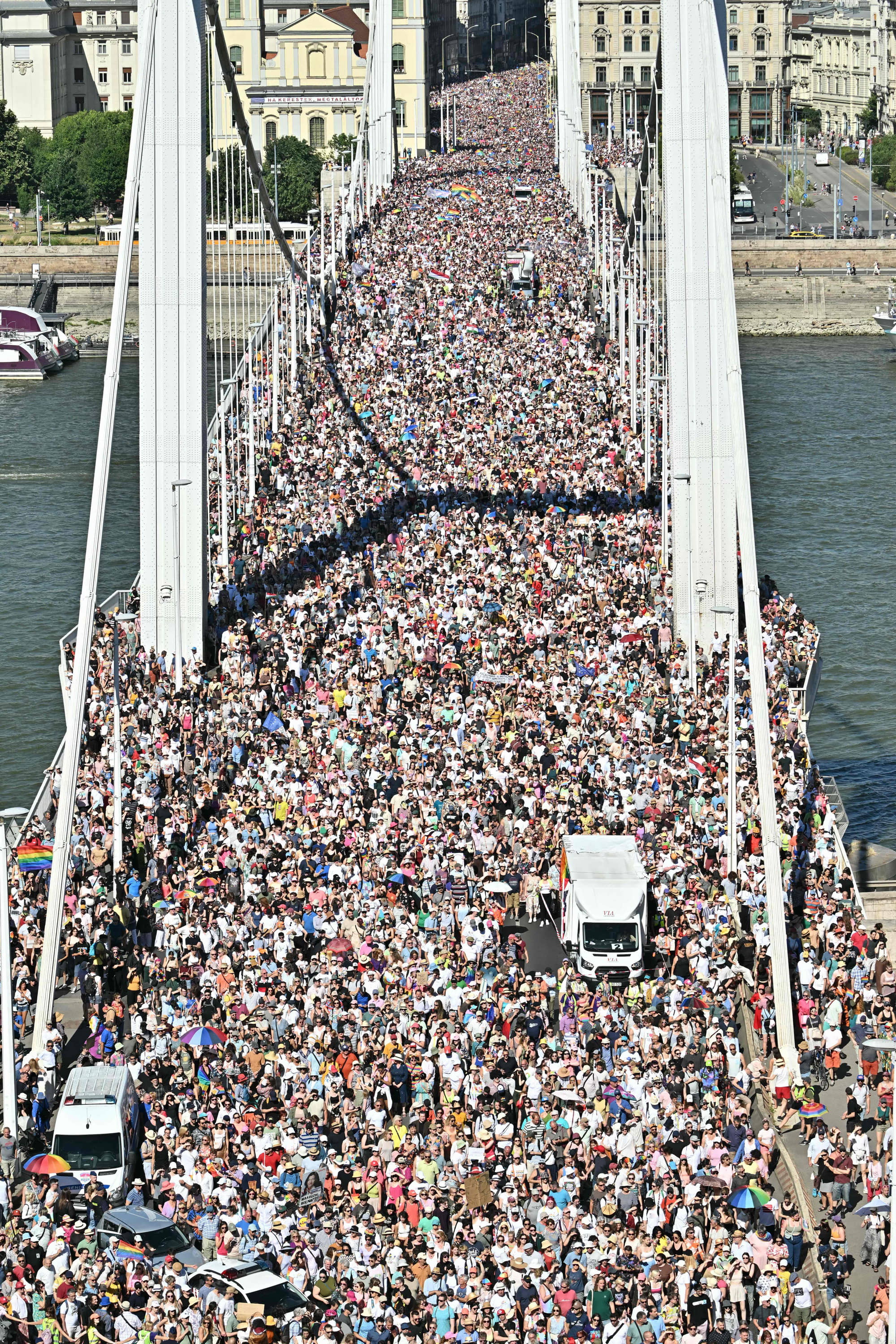
This photo shows only a fraction of the demonstration, which stretched across both banks of the Danube and exceeded the organisers’ expectations
According to organisers, 200,000 people took part in Pride. Independent media such as HVG estimated "over 100,000" attendees, a figure that does not seem exaggerated.
Meanwhile, the threats of punitive measures became the subject of jokes. "Let’s thank the police for our wonderful AI-camera photos they took of us," Budapest mayor Gergely Karácsony told the crowd from the stage.
The dictator stopped being feared and started to be ridiculed – a well-known sign of a regime’s decline.
Thirdly:
Orbán turned Pride into a protest against himself.
The size of Saturday’s rally was several times larger than previous Prides. The vast majority of participants had never attended an LGBTQ+ rights event before. This time, they came because their protest was directed against Orbán’s regime as a whole.
And – it can hardly be called a coincidence – videos began to circulate from different parts of Hungary showing young people at parties and festivals chanting anti-Fidesz slogans. A vivid embodiment of the saying about a dictator who becomes the subject of ridicule.
Masturbation to Orbán’s benefit
The Hungarian authorities, faced with a negative trend, began searching for a way out of this public opinion crisis. And it was clear they didn’t really know what to do.
At first, state-controlled media ran stories claiming Pride was a disaster for Budapest and its residents, who supposedly did not support it. The word "disaster" is a direct quote. For example, Mandiner, the youth publication of Hungary’s ruling party, insisted that this was how locals described the event.
Another popular narrative in pro-government outlets was that Pride united support for gays and Ukrainians.
"At the end of the Pride, Budapest mayor Gergely Karácsony promoted LGBT propaganda and supported Ukraine," complained Magyar Nemzet, the pro-government daily known in Hungary as "Orbán’s favourite newspaper." MN and other outlets like Origo quoted Karácsony as saying:
"While the [Hungarian] government mocks the people’s struggle for freedom, we do not confuse the aggressor with the victim, and we stand with Ukraine."
According to these journalists, this statement was supposed to outrage readers. But it was apparently ineffective. The next day, the government-aligned media stopped emphasising it. Likewise, the claim that Pride was poorly organised and that demonstrators were supposedly upset quickly disappeared from the news (stories like MN’s became subjects of mockery in other media).
The only thing that seemed to keep Orbán’s propaganda alive was the story about masturbation. This is not a joke – it was the main topic in absolutely all Hungarian pro-government media without exception.
During the Pride, Hungarian police published a press release about the arrest of a 36-year-old man who was allegedly masturbating "on a public bench" in the city centre, at the intersection of Szo and Pálne Veres streets.
And even according to official records, this incident happened outside the Pride route and an hour before the march began, meaning it was completely unrelated to the event. Yet the mention of this incident became a mandatory element in reports about Pride in pro-government media.
In fact, whether an outlet mentioned "masturbation at the Pride" (or at least in the context of the Pride) became a clear indicator of whether a website, TV channel, or radio station was pro-government. Even the rare pro-government outlets that admitted the man had been detained for "indecent behaviour" before Pride participants had even gathered still found ways to claim it was connected. "If we support sexual perversions, Hungarians will face such problems more and more often," explained Mandiner.
However, the masturbation incident didn’t help the authorities explain to their voters what had actually happened.
The next morning, the state broadcaster (which in Hungary is completely government-controlled) chose to simply ignore the record-breaking demonstration in Budapest. But this only raised more questions for the authorities, since the event was too obvious and well-known, and videos showing the city centre overflowing with people demanded explanations.
Eventually, the government settled on this narrative: yes, the Pride was massive, but only because it was supported by all opposition parties, including Orbán’s main rival, Péter Magyar. This was claimed by Viktor Orbán himself, as well as his political director Balázs Orbán, Orbán’s chief of staff Gergely Gulyás, and others. Thus, they argued, the entire Hungarian opposition consists of gay supporters.
A blow to the regime
This explanation has a fatal flaw: it is obviously false, as Péter Magyar, whom Orbán most wanted to attack – was actually the only major opposition leader who did not attend Pride, realising it would be used against him.
Magyar has, in recent months, skilfully avoided the political traps set by the government, and each time a major issue or event arises in Hungary, his popularity grows – and it happened again this time.
Without openly siding with the LGBTQ+ community enough to alienate his right-wing, conservative voters, Magyar criticised Orbán for weakening the country by fuelling hatred between different groups of Hungarians (which, incidentally, is true. It has always been at the core of Orbán’s strategy). Meanwhile, he argued, the opposition is uniting people against a common enemy, including during Saturday’s demonstration, which turned from Pride into a protest against the regime.
"Orbán has become the king of European Pride. No one before him has managed to mobilise so many people against themselves in one day," Magyar declared.
But the key point is that the Pride exposed Orbán’s weakness.
It is now obvious that the government genuinely tried to ban Pride – and failed.
"The state apparatus no longer carries out his baseless orders, and in some cases even defies Orbán... And yesterday it became clear that the police are unwilling to follow the prime minister into illegal territory," Magyar said. This statement likely exaggerates the government’s problems but hits Orbán where it hurts.
Hungarian political analysts agree the government has no strategy for defence. It has no counterarguments when Orbán himself unites so many people in opposition that it becomes impossible to hide.
Zoltán Vásáry, a political analyst quoted by Hungarian Radio Free Europe, agreed with this view: people took to the streets of Budapest "not because of LGBT issues, but because of the government’s actions."
"What happened on Saturday evening undoubtedly has significant political implications and demonstrates a failure by the Fidesz party," he said.
Another political analyst, Zoltán Lakner, concurred: instead of demonstrating strength and gaining political capital, the government ended up uniting its opponents.
Even on his right flank, Orbán lost support among key loyalists who expected the government to stop the Pride march, but it didn’t happen. Instead, the far-right, neo-Nazi Mi Hazánk party proved more effective than Orbán, managing to block Liberty Bridge, forcing the demonstrators to change their route. Now Mi Hazánk is now attacking Orbán from the right, seeing this as the perfect opportunity to steal some of the government’s support ahead of the next elections.
"Despite all the loud statements, Orbán and Fidesz once again refused to defend normality, and the law they passed is not being enforced," publicly said party vice-chair Előd Novák.
In short, the historically massive Pride benefited almost every player.
The far-right Mi Hazánk positioned themselves as the only force actively opposing LGBT rights in practice, not just words.
Liberals and leftists, who marched in the Pride column, demonstrated they are still relevant and can rally thousands, even if not all these people will vote for them.
Péter Magyar and his TISZA party managed to avoid radicalisation and convinced broad swathes of Hungarians that Orbán is no longer someone to fear.
The only real loser from Saturday’s Pride was Orbán himself. And in the trajectory of Hungary’s current government towards possible defeat, this blow could very well turn out to be decisive.
Sergiy Sydorenko,
Editor, European Pravda