A "European" reform in name only: How EU concessions underme the chance to clean up the Supreme Court
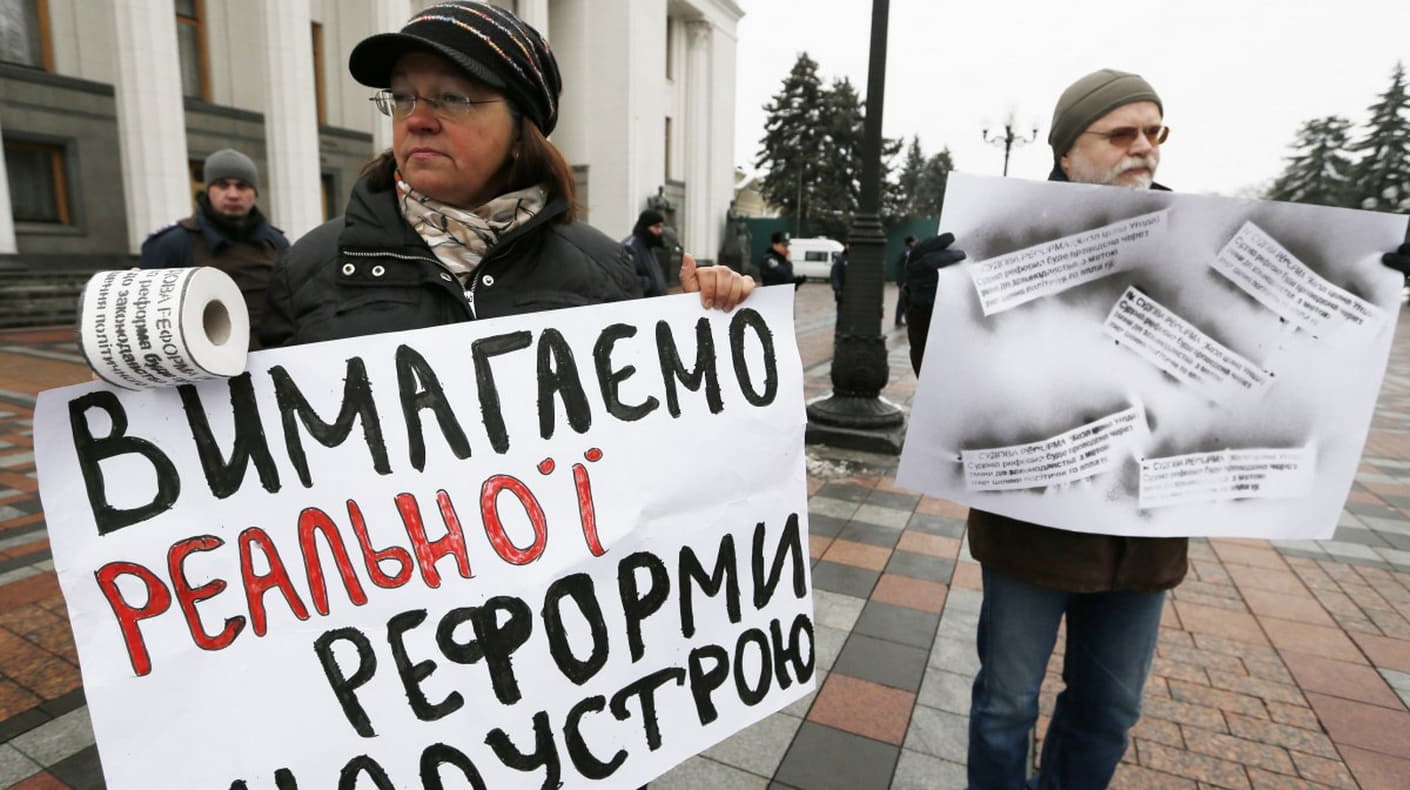
Ukraine has taken an important step on its path towards the European Union: in Luxembourg, the first negotiating cluster was finally opened–a block of reforms that Ukraine must implement in order to successfully advance accession negotiations.
This cluster, Fundamentals, is often described in Brussels as the backbone of the accession process. It is opened first and closed last, and the pace of the entire accession track depends on progress within it. In addition to judicial reform, the cluster covers reforms in anti-corruption, public procurement, and financial control.
The rule of law is particularly important in the context of Ukraine’s European integration. Yet, when it comes to justice and judicial integrity, Ukraine unfortunately remains far from being among Europe’s top performers.
Despite this, much has been achieved in recent years. The National Anti-Corruption Bureau of Ukraine (NABU), the Specialized Anti-Corruption Prosecutor’s Office (SAPO), the High Anti-Corruption Court (HACC), electronic asset declarations, and the reformed High Council of Justice (HCJ) and High Qualification Commission of Judges (HQCJ), renewed with the participation of international experts – all of these achievements emerged thanks to Ukrainians’ strong demand for reform and the significant role played by Ukraine’s international partners.
At the same time, initiatives that in reality move Ukraine further away from European standards
can be presented under the banner of "European integration".
Under the Ukraine Facility Plan, the Verkhovna Rada was supposed to adopt, by mid-2025, legislation improving judges’ integrity declarations and the procedures for verifying them. The reform was expected to introduce clearer declaration requirements, extend the verification period, establish more detailed procedures, and provide for clear legal consequences.
After missing the deadline by an entire year, Parliament finally adopted Law No. 13165-2 on this issue on 9 June 2026. The reason lawmakers ultimately acted is well known: nearly €400 million in funding is linked to improving the system for verifying judges. Moreover, European Commissioner Marta Kos, who visited Kyiv shortly beforehand, specifically urged Parliament not to jeopardise these funds and to finally take this step.
The paradox is that, under the guise of a European integration law, Parliament adopted a piece of legislation that moves Ukraine further away from the European Union, democracy, and the rule of law.
What are judges’ integrity declarations and why do they matter?
Every year since 2016, judges have been required to submit an integrity declaration. This is a special questionnaire in which a judge confirms, among other things, that they live within their lawful means, have not issued decisions in situations involving a conflict of interest, and have not attempted to obtain Russian citizenship.
If any of these statements are found to be false during the verification process, the judge is supposed to be held accountable – although, as discussed later in this article, the sanctions currently provided by law are far from severe.
The need to improve judges’ integrity declarations and the verification process did not emerge out of nowhere. In practice, the first phase of judicial reform following the Revolution of Dignity proved largely unsuccessful. After nearly 3,000 judges were assessed for integrity and professional competence, only 15 were dismissed, roughly 0.5%.
Dozens of judges lacking integrity made it onto the Supreme Court, which was built from scratch between 2017 and 2019 without the involvement of international experts. The scandal surrounding former Supreme Court Chief Justice Vsevolod Kniaziev and the record-breaking bribe allegedly paid to him, along with other judges ,some of whom have already received formal notices of suspicion, was merely a symptom of a flawed selection process.
It is also worth recalling how the Supreme Court spent years returning judges lacking integrity to the system. For example, it derailed the assessment process for nearly 180 such judges and allowed several dozen others, including the controversial Judge Inna Otrosh, to avoid completing the assessment altogether.
Moreover, the Court opened the door for all judges who failed the assessment to take what is known as an "honourable retirement" route. Instead of facing accountability, they were allowed to leave office while retaining substantial lifetime benefits and other privileges associated with judicial status.
Against this backdrop, the European Union has been calling on Ukraine throughout the past three years, in its annual reports, to "address corruption within the Supreme Court".
The only realistic way to do so today is through the verification of Supreme Court judges’ integrity declarations. Other mechanisms are no longer available: either the applicable limitation periods have expired, or those mechanisms have already been applied in a purely formal manner, while neither the Constitution nor the law permits their repeated use.
In fact, over the past ten years, no judge has been punished for providing false information in an integrity declaration.
The loophole that allows judges lacking integrity to avoid accountability is embedded in the law itself. Liability exists only for the intentional submission of false information. In legal practice, however, proving intent, as opposed to a mistake, oversight, or forgetfulness, is nearly impossible.
Even in the rare cases where intent was established, the penalties imposed amounted to little more than a warning or the loss of bonus payments for a month – hardly a meaningful incentive to change behaviour.
This is precisely why the demand emerged to "fix" the integrity declaration mechanism.
To make it effective, the law should establish liability for gross negligence when completing declarations, extend the maximum verification period to allow all relevant circumstances to be examined, and strengthen sanctions so that dismissal of a judge becomes a realistic outcome.
And one more element is critically important under current circumstances: international experts should be temporarily involved in the review of judges serving on the highest court, namely the Supreme Court.
All of these requirements are reflected in the Ukraine Facility Plan, the Rule of Law Roadmap, the Kachka–Kos list of priority reforms for 2026, and the accession negotiation benchmarks under Chapter 23.
Beyond the Supreme Court, this mechanism could also serve as an important accountability tool for judges in lower courts. For example, it could be used to review approximately 300 appellate court judges who have never undergone the qualification assessment that all other judges have faced.
This refers to a procedure introduced ten years ago that proved largely formalistic: even when a judge demonstrated incompetence or a lack of integrity, the most severe consequence was often little more than mandatory professional training courses.
How a "European Reform" was replaced with an imitation
The draft law on improving the verification of judges’ integrity declarations was postponed until the very last moment. As the deadline approached, it was suddenly introduced in Parliament allegedly given that international financial assistance depended on its adoption and that failure to act immediately could result in the loss of funding.
Yet instead of improving the mechanism, Members of Parliament voted to remove roughly half of the declaration requirements and render verification of the remaining provisions largely meaningless.
For example, judges are no longer required to confirm that their assets correspond to their income or that they did not issue rulings against protesters during the Revolution of Dignity. The verification period for most declaration elements was reduced to just one year, despite explicit EU requirements to extend it.
Liability remains limited exclusively to cases involving "intentionally false" statements, even though practice has demonstrated how difficult it is to prove intent. In addition, lawmakers introduced a number of harmful provisions, including the possibility of challenging verification results in court and an automatic "amnesty" whereby a judge escapes accountability if the review is not completed within six months.
In effect, rather than improving the mechanism, Parliament has further weakened a tool that was already ineffective.
This is not the first time Ukrainian authorities have committed to a reform only to exploit vague requirements or changing circumstances in order to replace genuine reform with imitation.
But this represents a new level of distortion of what is presented as a "European" law.
Lawmakers ignored the relatively detailed requirements set out in EU documents and adopted legislation that directly contradicts its stated purpose and produces the opposite effect.
If such a reform is accepted as fulfilling Ukraine’s commitments and all related funding is disbursed, it will send a clear message to the authorities: violations of obligations carry no consequences and will ultimately be forgiven.
That would open a Pandora’s box, creating a powerful incentive to repeat similar tactics in other areas of reform.
It is telling that the judiciary immediately understood the message of this "amnesty". Just hours after Parliament adopted Draft Law No. 13165-2, the Supreme Court reinstated Aliona Mazur, a previously dismissed judge of the Kyiv District Administrative Court (OASK) linked to the "Vovk tapes" scandal.
The continuation of this approach could encourage other influential actors within the government to replicate the "success" of summer 2025 to dismantle NABU and SAPO independence.
It is worth recalling that this desperate and highly damaging step for Ukraine was also preceded by a series of violations of EU integration commitments by the Ukrainian authorities, coupled with a persistent unwillingness on the part of the EU to acknowledge them.
The EU has leverage over reforms and that leverage must work
Over the past twelve years, key rule-of-law reforms in Ukraine have not occurred because the political leadership suddenly developed an internal desire to dismantle the old system. More often, they became possible when two factors converged: pressure from civil society within the country and clear conditions set by international partners.
This is how reforms in the fields of justice, anti-corruption, and law enforcement were achieved. International financial assistance, macro-financial programmes, visa liberalisation, candidate status, and now the EU accession process have all followed the same logic: reforms in exchange for political support, funding and progress towards membership in the European Union.
This is particularly important today, when martial law has significantly restricted the usual democratic tools for holding the government accountable. Elections are not being held, peaceful assembly is limited, and society has fewer ways to directly compel politicians to deliver on their promises.
As a result, the role of international commitments becomes even more important.
They remain one of the few effective levers preventing reforms from either stalling altogether or being reduced to mere imitation.
There is no shortage of examples of successful reforms carried out under strong international conditionality.
For instance, the reform of the Constitutional Court judge selection process, as well as the reform of the High Council of Justice and the High Qualification Commission of Judges, formed part of the seven steps Ukraine was required to complete when it was granted EU candidate status in June 2022. In other words, even the most significant changes to the judicial system were not initiated in isolation, but through a combination of domestic pressure and external conditions.
This is not because Ukraine is incapable of reforming itself. Rather, it reflects the enormous resistance of the old system. Without clear conditions, deadlines, and consequences for non-compliance, those in power almost invariably attempt to delay change, hollow it out or present formal measures as genuine reform.
The law on judges’ integrity declarations was also intended to be a reform implemented in exchange for funding and progress towards EU membership.
Instead, the authorities effectively sold their partners the title of the bill rather than its substance.
One often hears the counterargument that taking a principled stance on reforms could somehow harm the Ukrainian state. In reality, the opposite is true.
When international partners take a clear and consistent position, Ukraine is capable of securing parliamentary support even for difficult decisions. This was the case with restoring the independence of NABU and SAPO, as well as with other important legislation. For that reason, international partners should maintain the same level of clarity now and refuse to accept imitation reforms where genuine results are expected from Ukraine.
Especially because the EU currently possesses perhaps the strongest tools for supporting reform in Ukraine that it has ever had.
A €30 billion support package for the next two years, the launch of accession negotiations, and unprecedented public support for the EU among Ukrainians have created a unique window of opportunity. Ukrainians support not only EU membership itself but also the rules and standards without which membership is impossible.
In particular, 73% support international partners exerting pressure on the Ukrainian authorities to clean up the justice system and combat corruption. Meanwhile, 64% view Brussels’ requirements as a genuine effort to help Ukraine modernise.
The situation surrounding the law on judges’ integrity declarations can still be corrected.
The legislation can be revised and brought into line with the objectives for which it was originally created. Likewise, approaches to assessing Ukraine’s compliance with its rule-of-law commitments should be reconsidered when the authorities offer an imitation of reform instead of the real thing.
This is not a choice between supporting Ukraine and criticising it.
It is a choice between supporting genuine reform and accepting its imitation.
Mykhailo Zhernakov, Executive Director of the DEJURE Foundation
Tetiana Shevchuk, Lawyer at the Anti-Corruption Action Centre (AntAC)