Ukraine loses its pace towards EU. 2026 report reveals growing gap with Moldova and other candidates
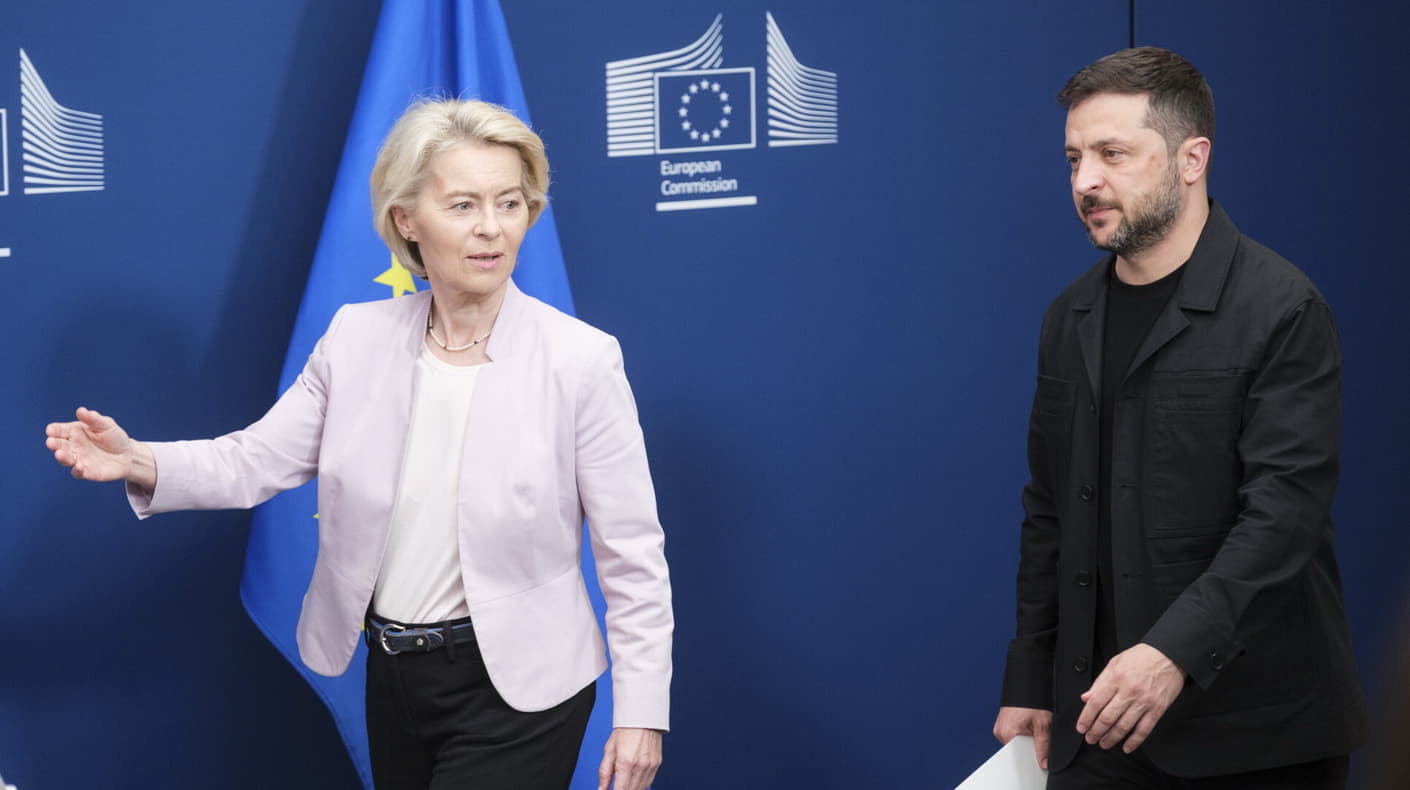
One of the key developments highlighted by the European Commission’s enlargement report and the roadmaps it prepared for four candidate countries was Ukraine falling behind Moldova on the path to EU membership. European Pravda has discussed this in the article: A record EU assessment despite stalled reforms: what's behind Brussels' optimism on Ukraine.
Of course, there is some good news here. The fact that Ukraine has made it into the group of four leading candidates is undoubtedly positive.
The EU in overall has made considerable efforts to convince Kyiv that European capitals are interested in seeing the process through to completion – Ukraine’s accession to the European Union. It would be a mistake though to think that the EU is ready to wait for Ukraine forever.
The European Commission’s report has revealed a serious problem.
Just three years ago, Ukraine was somewhere in the middle of the pack, moderately behind the Western Balkan candidates but with good potential to catch up, given its experience with rapid reforms. The situation has now changed drastically.
Among the four leading candidates, Montenegro is in first place and is expected to join the EU soon.
There is also one clear outsider – Ukraine.
The past three years have been almost entirely devoid of reforms in Kyiv. Meanwhile, Moldova has overtaken Ukraine, but that is not the only problem. It is risky that the gap will become irreversible unless the pace of reforms increases immediately.
The reason is that the other three candidates, including Moldova, have dramatically accelerated their reform efforts since the EU developed what could be called an "appetite for enlargement" – a fundamental willingness to admit new members. Ukraine, meanwhile, has been slowing down its reforms, providing arguments for those who doubt the prospects of its EU membership.
The European Commission’s documents emphasise that nothing irreversible has happened yet. Ukraine is being kept in the same group for political reasons, even at the cost of delaying Moldova’s progress.
To some extent, the story of 2013 has repeated itself. Back then, Ukraine and Moldova were both seeking visa-free travel to the EU, but Kyiv (then under Viktor Yanukovych’s government) was unwilling to carry out the necessary reforms. After a lengthy wait, the EU split the package: Moldova received visa-free travel, while Ukraine had to wait another three years.
If Ukraine fails to learn from that experience, a similar scenario will become inevitable again. The stakes, however, are now much higher: this time, it is about EU membership.
The last among the leaders
Although Montenegro has certain political issues with neighbouring Croatia, it is preparing to join the EU relatively soon. The European Commission forecasts that accession negotiations with Podgorica will officially conclude this year and that an accession treaty will be prepared. After that, only ratification by the member states will remain.
The roadmaps show that Albania is in second place, more than a year behind Montenegro. Preparation of the accession treaty, scheduled for the Montenegrins by the end of 2026, is planned for 2028 in Albania. Moldova is close behind Albania and is also expected to complete work on its accession treaty in 2028.
Ukraine comes next, significantly behind Moldova.
These figures come from the roadmaps – a new document that forecasts progress towards EU membership based on the European Commission’s expectations regarding the pace of reforms in each candidate country.
The current level of candidate countries’ readiness for membership is a slightly different matter.
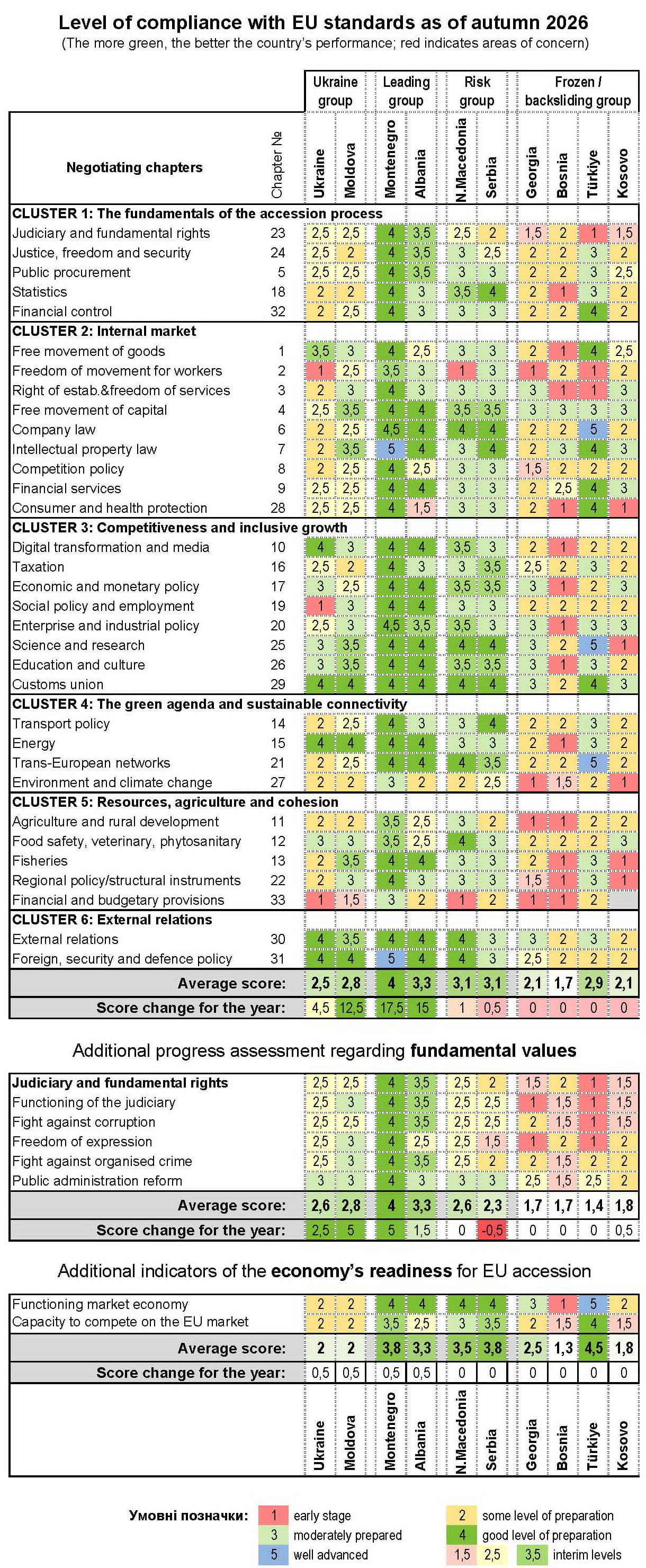
Every year, European Pravda prepares a chart of this kind. It allows readers to examine individual indicators in detail and visually assess Ukraine’s position compared with other candidate countries. Put simply, the more green there is, the better the situation in a particular country.
Among the leading candidates, the order remains the same: Montenegro first, Ukraine last. The gap between them, however, is quite different from what the roadmaps suggest.
The next illustration is even more revealing because it shows the changes over the past year. But we will come to that later.
First, let us recall where the figures in the chart come from.
The European Commission annually evaluates all candidate countries using a common methodology, producing what is known as the Enlargement Report. This is a very detailed analysis of each country's readiness for membership across all negotiating chapters and all the criteria established by the EU. It also examines the changes that have taken place over the preceding year.
The publicly available part of this document alone exceeds 100 A4 pages for each country. There are also working documents, including shadow reports.
Since all candidates are assessed against identical criteria and using a common methodology, we can compare both the extent to which they have aligned their legislation with EU law and the progress they have made in implementing reforms.
We have transferred the indicators for each country and each negotiating chapter into a table, calculated the average scores and added colour coding to make the results easier to understand.
Even this chart should serve as a warning signal for the Ukrainian authorities.
Three years ago, Ukraine's gap with the leading country was considerably smaller and certainly did not seem insurmountable. At that time, Montenegro’s average preparedness score was 3.1 points, while Ukraine’s was 2.3. Albania was between the two, and Moldova was significantly behind Ukraine, with a score of 1.9.
The picture is now fundamentally different.
The main surprise of 2026 is that Montenegro has reached a score of four points (more precisely, 3.98). In EU terminology, four points means "good alignment with EU law" – the level considered sufficient for full EU membership.
In other words, Montenegro has essentially completed the technical work required for accession.
The second major surprise is Moldova. Three years ago, it was the outsider among the enlargement countries. At the time, officials in Kyiv liked to repeat that the Moldovans were joining the EU by hitching a ride on Ukraine. We can still, paradoxically, hear this from Ukrainian officials today, even though the figures suggest that Ukraine is now more likely to be the one hitching a ride on Moldova.
Some people may dislike this, but it is Brussels that assesses readiness for accession, and its assessment leaves little room for interpretation. Over the past three years, Moldova has increased its score by almost a full point, while Ukraine has improved by just 0.2 points.
Albania, meanwhile, which was close to Montenegro in terms of readiness three years ago, has not demonstrated comparable growth during this period. As a result, the roadmaps place it closer to Moldova. Albania only began taking serious steps towards reform in the past year.
Now pay attention to the row in the chart labelled Change over the year. It is green for the other three leading candidates. For Ukraine, it is yellow. The remaining candidate countries, which are not among the leaders, are in the red zone.
This indicator is so important that it deserves its own section and its own chart.
Ukraine without reforms
In 2025, Kyiv made an active effort to persuade the European Union to change its approach to enlargement and agree to Ukraine's "political accession", allowing the country to cross the point of no return before completing the necessary reforms.
There was a rationale behind this idea, connected with the war, peace negotiations and the understanding that, for Putin, Ukraine’s EU membership is actually no less of a threat than its NATO membership. The thinking was that it would be better to present him with a fait accompli: Ukraine’s accession would already have happened.
But the idea failed.
Since then, the European Union has repeatedly explained to the Ukrainian authorities that any concept of "political accession" will not work. Reforms are a prerequisite for membership. And here we come up against a systemic problem. The Ukrainian government looks at the European Commission’s report and says: everything is going well after all; the EU confirms our progress, and that progress increases every year.
This is formally true. This year, the European Commission’s report once again gave Ukraine a slightly higher score, although it noted that in some areas this improvement occurred despite the actions of the Ukrainian authorities.
But what matters most is not the fact that progress is being made, but the pace at which it is happening.
The situation in Ukraine is close to catastrophic.
Kyiv is implementing reforms at an increasingly slower pace year after year.
For now, Brussels is making allowances for Ukraine. It argues that reforms are difficult to implement during wartime and that, for example, it is difficult for the Verkhovna Rada [Ukraine’s parliament] to hold votes during air raid alerts. These arguments are sometimes questionable. Air raid alerts certainly do not prevent MPs from putting an anti-corruption strategy or reform of the State Bureau of Investigation on the parliamentary agenda. Nevertheless, this support does not change the consequences of the problem.
This chart shows not only the current level of alignment with the European Union but also the extent of change over the past year. Cells with a blue background indicate areas in which a candidate country has managed to improve its rating.
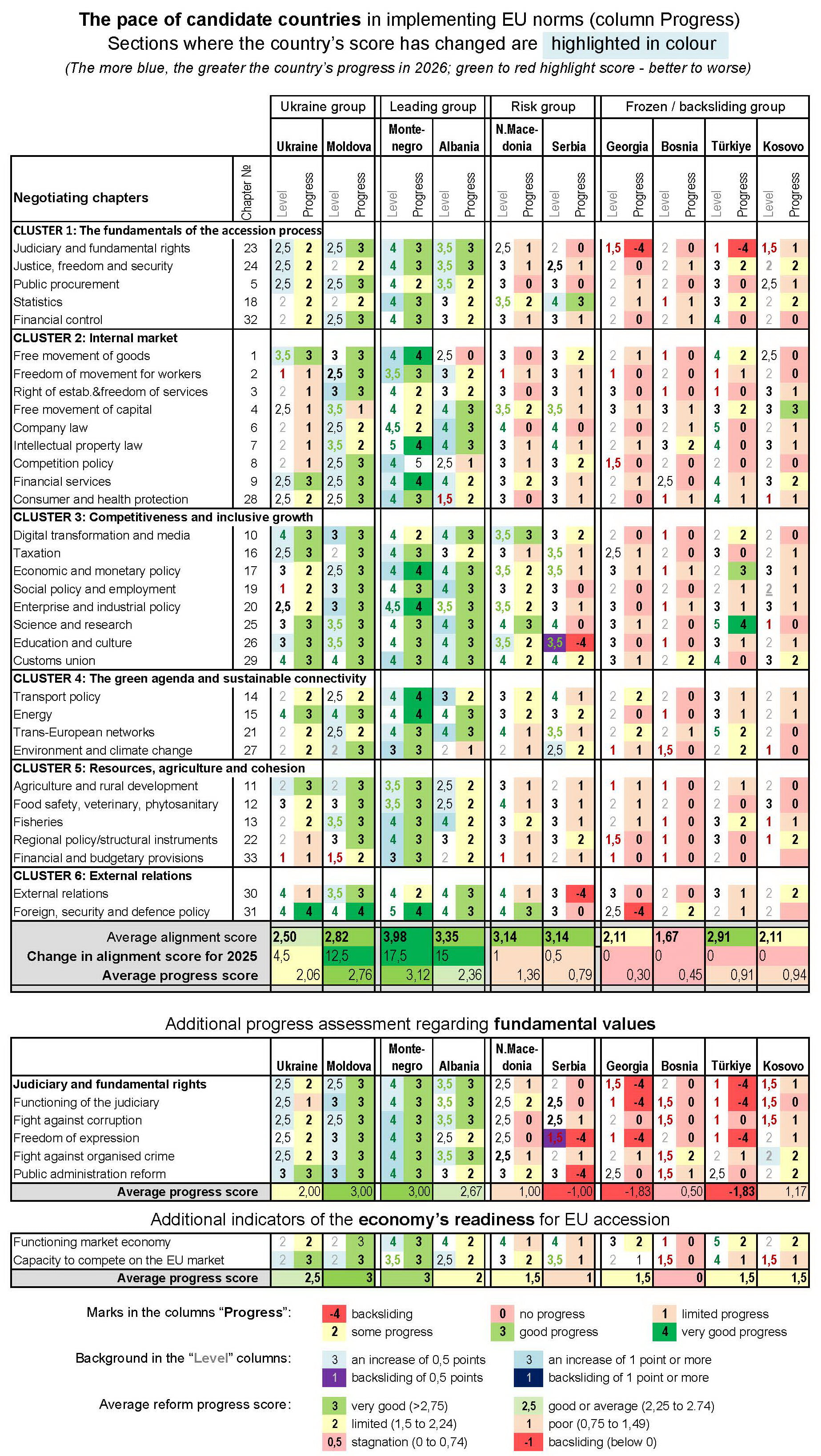
The chart makes it clear that three candidate countries are actively implementing reforms, and their pace is roughly comparable: Montenegro, Moldova and Albania.
Albania was just as slow as Ukraine for a long time. But last year, having realised that the geopolitical window for EU enlargement had finally opened, the Albanians dramatically accelerated their efforts.
The Ukrainian authorities did not do the same.
Moreover, some reforms have a time lag before their results become visible. This means that Moldova and Albania will almost certainly maintain a high pace of progress next year as well, because reforms currently underway will be reflected in the next assessment.
According to the European Commission, Ukraine has begun to show some acceleration this autumn. However, from this point onwards, it depends entirely on Ukraine, specifically on the Verkhovna Rada, whether this will mark the beginning of a much broader process, an attempt to catch up with the other candidates, or merely a short-lived burst of activity. In other words, whether genuine progress towards the EU will become a priority.
Last year, based on Ukraine’s progress, European Pravda calculated that at the current pace of reforms, it would take Ukraine more than 20 years just to reach the basic level of alignment. In today's geopolitical circumstances, that could mean an eternity.
After all, the window of opportunity for EU enlargement opened by Russian aggression will not remain open for several decades.
Unfortunately, Kyiv did not heed this warning last year.
This year, it must be heard. And the priority is clear: the fundamental reforms in the areas of the rule of law, human rights, anti-corruption and other related fields.
It is precisely in these areas that Moldova has demonstrated the progress that allowed it to overtake Ukraine and may even enable it to become the leading candidate once Montenegro joins the EU. And this did not happen because European Commissioner Marta Kos is particularly fond of Moldova's President Maia Sandu or for any similar reason. It happened because Moldova was genuinely changing.
Ironically, Ukraine is currently considering a bill that would introduce a small part of the legislation on a register of bank accounts and individual bank safe-deposit boxes, which is necessary for Ukraine to join the Single Euro Payments Area (SEPA).
Even this step has been unable to pass through the Verkhovna Rada. Among those opposing it are MPs who describe themselves as pro-European.
It clearly shows why Ukraine is standing still in its progress towards EU membership, while Moldova, Albania and Montenegro are moving forward.
And it is entirely up to Ukraine, specifically the Verkhovna Rada, to decide whether it will reverse this trend before the European Commission’s 2027 report or cement Ukraine’s decline from its position as one of the leading EU enlargement candidates.
Sergiy Sydorenko
Editor, European Pravda