France under Le Pen: how likely is her election victory and what would it mean?
During President Volodymyr Zelenskyy’s visit to Paris on 14 July, it was announced that Ukraine had ordered 16 French Rafale fighter jets and weapons for them. This is the first part of a larger deal for 100 aircraft. Ukraine also announced plans to order four next-generation SAMP/T air defenсe systems.
However, just a week earlier, some uncertainty had emerged over the implementation of such long-term and ambitious plans.
On the evening of 7 July, Marine Le Pen appeared on French television with a simple interpretation of a complicated judgment. "I am a candidate for the presidential election," she announced.
Hours earlier, the Paris Court of Appeal had upheld her guilt in the European Parliament assistants case. It sentenced her to three years in prison, two of them suspended, and one year of home detention under electronic monitoring. Yet it also shortened her effective period of ineligibility to one that had already elapsed. Le Pen could run for president on 18 April 2027.
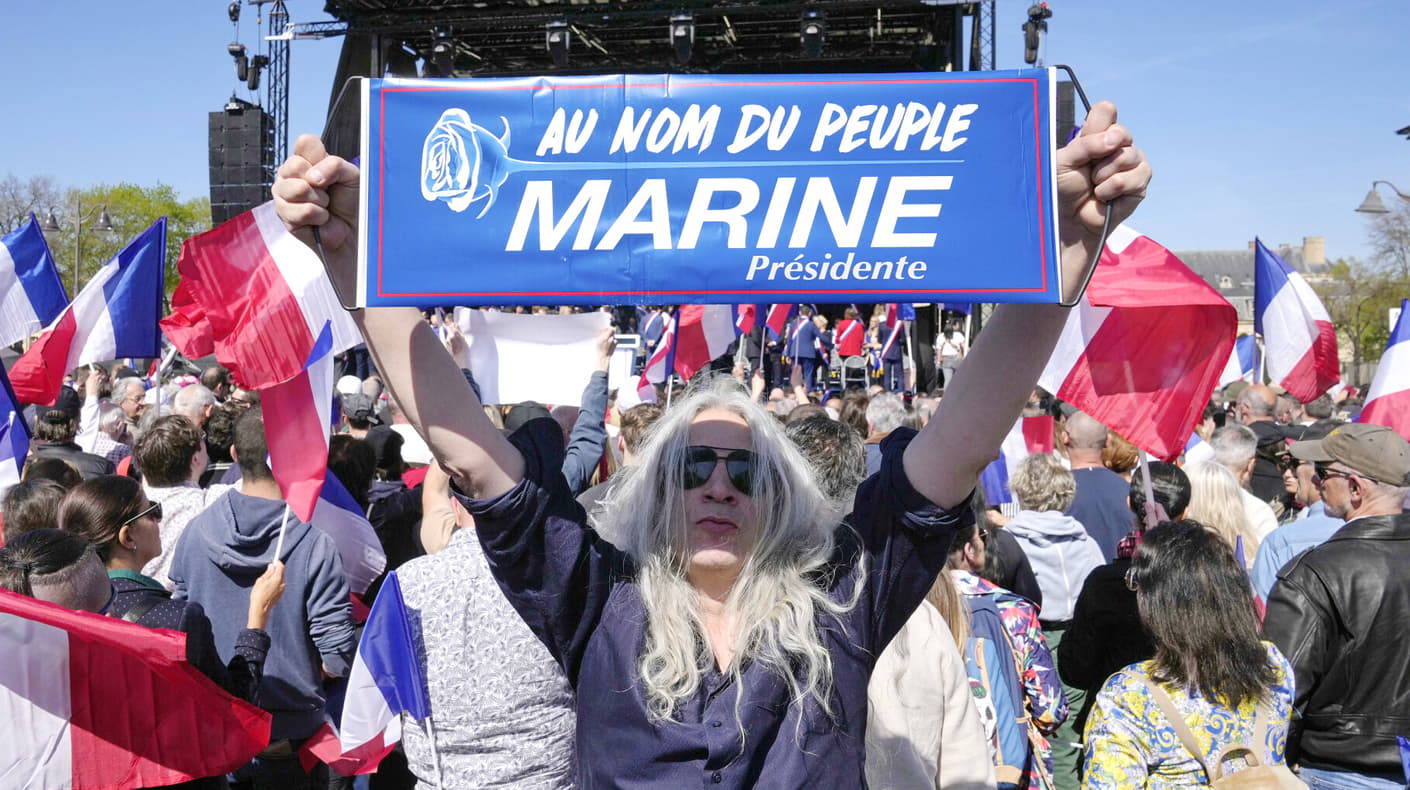
Two days later, the first voting intention surveys conducted after the ruling placed her at around 35 per cent in the first round. No opponent reached 20 per cent. The same polls showed her defeating most – if not all– of the rivals tested against her in a second round.
Le Pen has not been cleared. Nor has she become broadly trusted. Seven in ten voters reject her assertion that she is innocent, while earlier surveys show that a majority would be unhappy to see her become president. France is confronting a more awkward possibility. Voters can disbelieve her, disapprove of her and still choose her.
Four years ago, Emmanuel Macron tried to make one part of her record impossible to overlook. During their presidential debate on 20 April 2022, he told Le Pen that when she spoke about Russia, she was speaking to her banker.
The reference was to a €9.4 million loan taken out by her party in 2014. The exchange was watched across France. It did not stop Le Pen from winning 41.5 per cent in the second round.
Will the сourt ruling make a difference?
The appeal judgment was not a technical reprieve masquerading as an acquittal. All 12 defendants who appealed were found guilty.
The court confirmed that European Parliament money had paid assistants who were in reality working for the French party rather than for the parliamentary mandates to which they were attached.
The scheme lasted for more than 11 years. The judgment identified Jean-Marie Le Pen and then Marine Le Pen as its driving forces, with party officials and European parliamentarians participating in the arrangement.
The court assessed the loss to the European Parliament at €2.8 million. It also made an important distinction. The elected members had not enriched themselves personally. The national party had obtained the benefit.
Le Pen received a €100,000 fine and 45 months of ineligibility, with 30 months suspended. The remaining 15 months were counted from the first instance judgment of 31 March 2025 and had therefore been served by the time of the appeal ruling.
Her legal position is precise, if unusual. She is eligible today. The appeal court has found her guilty, but the conviction is not final because she has appealed to the Court of Cassation.
That appeal suspends the execution of her prison sentence, so she can begin campaigning without an electronic tag.
France’s highest court has said it could rule by early April 2027, subject to procedural developments. It will examine whether the law was applied correctly, not retry the facts.
The ruling gave Le Pen a choice that is legally possible but politically costly. Le Pen answered by borrowing from a familiar populist repertoire.
She asserted her innocence, confirmed her candidacy and cast the case as an attempt to deny voters their preferred choice. Her performance looked much like the MAGA style turn in French politics.
The comparison does not require the RN to share Donald Trump’s programme or international alliances. It concerns the treatment of institutions.
A court is respected when it vindicates the movement and denounced as political when it constrains it.
A conviction becomes evidence that the system fears the candidate.
That argument may work with Le Pen’s loyal electorate. It is less clear whether it can help her assemble the second round majority she has failed to win three times.
A Russian trace
The Russian loan raises a different evidentiary problem. It was a commercial loan, not a donation. In September 2014, the Front National borrowed €9.4 million from the First Czech-Russian Bank after saying that French banks had refused it credit.
When the bank failed, the debt passed between Russian creditors. The RN announced in September 2023 that it had repaid the outstanding sum.
No judicial or parliamentary finding has established that the party delivered a specific political service in exchange for the money. That point should not be blured. Nor should the loan be separated from the political relationship surrounding it.
Le Pen cultivated ties with senior Russian figures, met Vladimir Putin in the Kremlin during the 2017 presidential campaign and defended Russia’s purported referendum in occupied Crimea. Before a National Assembly inquiry in 2023, she again described Crimea’s incorporation into Russia as legitimate.
The inquiry’s majority report called the RN an effective relay for official Russian discourse. That was a political conclusion reached by the report’s majority, not proof of a secret contract. Le Pen argued that her positions reflected longstanding convictions and had not been purchased.
Mediapart revealed the loan in 2014. It was investigated repeatedly by major French outlets, raised in the only televised debate of the 2022 presidential runoff and examined during four hours of Le Pen’s testimony before the National Assembly. The affair was not confined to specialist publications or a small circle in Paris.
The party’s former name requires equal precision. Le Pen did not leave the Front National to create a separate movement.
The same party changed its name to Rassemblement National in 2018. The court itself refers to the Front National "which became" the RN. The rebranding softened an inherited label and Bardella supplied a younger public face. It did not break the party’s legal or organisational continuity.
What do the French think of Le Pen?
The most useful polling does not depict a country converted to Le Pen. It reveals a candidate whose negative image coexists with a growing presumption that she could govern.
An Ifop survey in September 2025 found that 69 per cent of respondents considered her opportunistic. Fifty nine per cent called her aggressive and 57 per cent intolerant.
Only 41 per cent described her as honest, while 40 per cent found her reassuring. Fifty four per cent believed she could ensure the security of the French. Around half considered her capable of protecting purchasing power, reforming the country or defending France’s position abroad.
Even the fear she generates is no longer overwhelming.
Fifty two per cent said that she worried them, and the same proportion considered her ideas dangerous for France. The country remains divided, but the old presumption that alarm at the Le Pen name would organise an automatic majority against her has weakened.
A voter can regard her presidency as undesirable and still prefer it to the alternative eventually offered.
The appeal judgment has produced no immediate electoral punishment. It may even have consolidated Le Pen’s claim to be the leading candidate.
Her core support appears resistant to the scandal. That resistance has several possible explanations, and the surveys cannot tell us their exact weight. Some RN supporters accept the claim of judicial persecution.
Others regard financial misconduct as endemic to politics rather than distinctive to Le Pen. Many are voting on subjects where the RN has built a strong identity and do not treat probity as the overriding test.
The social divisions in the Ifop data reinforce the point. Graduates were much more likely to find Le Pen worrying or dangerous.
Workers and respondents with fewer qualifications were more inclined to credit her with courage, authority and an understanding of people like themselves. Her reputation is filtered through a broader conflict over class and recognition.
An accusation that confirms one electorate’s rejection can reinforce another’s suspicion of the people making it.
The conviction is therefore unlikely to break her first round base. Its effect may emerge later.
Seven voters in ten do not accept Le Pen’s claim of innocence, and 32 per cent of RN supporters disapprove of her decision to run. Those doubts may not send loyal voters elsewhere, but they could limit her ability to attract the conservatives, centrists and previous abstainers required for a majority.
Le Pen’s progress between her two previous runoffs rose from 33.9 per cent against Macron in 2017 to 41.5 per cent in 2022.
Her opponents have helped. Macron cannot seek a third consecutive term. The centre, conventional right and left remain divided, with no rival approaching Le Pen’s first round score.
Le Pen’s principal advantage is not a majority that actively wants her. It is the possibility that her opponents will fail to organise the majority that does not.
The appeal court has returned the decision to politics. By preserving Le Pen’s eligibility, it denied her the easiest claim that judges had cancelled the election.
By upholding guilt and imposing a custodial sentence, it left her opponents with a clear argument about fitness for office. Whether they can make it decisive is no longer a legal question.
What should Ukraine consider?
For Ukraine, Le Pen’s eligibility arrives as France is making commitments that will extend into the next presidency. On 14 July, Paris and Kyiv confirmed an initial order for 16 Rafale aircraft, part of a longer plan that envisages as many as 100. Ukraine also announced its intention to order four next generation SAMP/T air defence systems.
France authorised licensed production of SCALP cruise missiles and AASM guided bombs in Ukraine before the end of 2026.
France and Italy made the same commitment for Aster 30 interceptors. Interim SAMP/T deployments and accelerated Aster deliveries are intended to cover part of the period before the new systems become available.
Financing for the Rafale and SAMP/T NG orders is to be sought through the European Union’s Ukraine Support Loan. Training, industrial capacity and delivery schedules remain to be completed.
The first SAMP/T NG modules are planned from 2027.
A change at the Élysée would not automatically dissolve every contract.
France’s government, parliament, armed forces and defence industry would retain influence, while European financing creates further constraints. Yet foreign and defence policy are unusually concentrated in the French presidency. Export permissions, diplomatic initiatives and France’s position in the European Council are all susceptible to presidential direction.
The RN’s present line on Ukraine is more careful than Le Pen’s earlier closeness to Putin’s Russia.
The party now describes Russia’s war as illegal and unjustified. It says Ukraine deserves military support and that Russian aggression threatens French interests. Bardella has gone further than Le Pen in describing Russia as an offensive threat to Europe.
The shift is genuine, but incomplete. The RN has opposed weapons that could strike Russian territory, the deployment of French troops and rapid Ukrainian accession to the EU.
It also has resisted the scale and conditions of several European support packages. Le Pen’s record includes opposition to energy sanctions and Ukrainian membership of NATO, as well as a proposed strategic rapprochement with Moscow after the war.
Those positions have changed in emphasis and may change again before 2027. The RN’s foreign policy is opaque, with a persistent divide between Le Pen’s confrontational sovereigntism and Bardella’s more pragmatic effort to work through European institutions.
Le Pen’s return as the presidential candidate gives greater weight to the older, more disruptive tradition.
The Russian loan does not prove that a Le Pen presidency would take orders from the Kremlin. Her record establishes something more relevant than that unproven allegation.
She has repeatedly interpreted French strategic autonomy in ways favourable to Russia, treated Ukraine’s territorial and alliance choices as negotiable, and opposed several of the instruments used to raise the cost of Russian aggression.
A Le Pen presidency could weaken support for Ukraine without formally abandoning it. French arms transfers require government licences, financing and industrial follow-through. With an aligned RN government, the Élysée could slow deliveries or restrict future permissions. Cohabitation with a hostile parliamentary majority would constrain that power.
France’s European leverage is clearer. The EU’s main economic sanctions against Russia are renewed every six months and require unanimity. Enlargement decisions also generally require agreement among all member states. Paris could therefore delay sanctions or Ukraine’s accession without announcing a diplomatic rupture.
The agreement of 14 July reduces this exposure but does not remove it. Ukrainian production of SCALP, AASM and Aster munitions would make disengagement costlier, particularly because Italy and EU financing are involved. Yet the Rafale and SAMP/T programmes still require funding, contracts and deliveries extending beyond the French election.
The decisive test will come when the field narrows to two candidates. Le Pen has shown that she can survive widespread distrust. She has not yet proved that she can overcome it when France chooses its president.
Charlotte Guillou-Clerc,
Journalist (France)