Kosovo echoes Ukraine: Why Zelenskyy's remarks in Serbia outraged Kosovans and Russia's role here
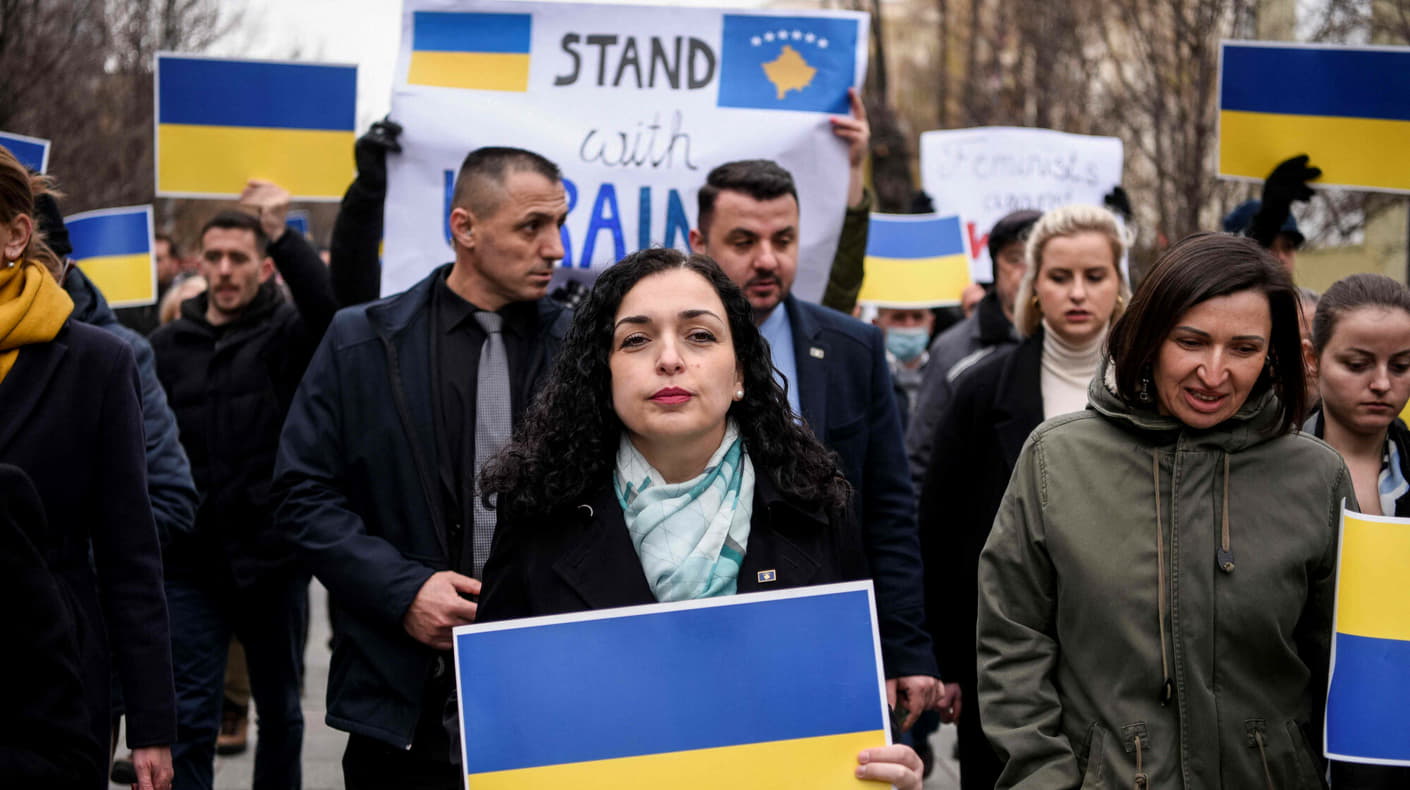
The massive "Free Ukraine" banner on the wall of the Grand Hotel in the centre of Prishtina was the most visible sign of the heartfelt, sincere and unconditional support and sympathy Kosovo’s Albanian majority hold for Ukraine as it undergoes an annihilating assault from Russia that for them parallels what they suffered in the late 1990s at the hands of a still unrepentant and revanche-minded Serbia.
The banner’s demonstrative removal by the ambitious opposition mayor of Prishtina in a populist, kneejerk and parochially-centred rebuke to President Zelenskyy’s remarks in Belgrade on non-recognition of Kosovo – at a moment when Kosovo’s national governance is consumed in failed coalition negotiations and the prospect of a fourth general election within two years – has done both Kosovo and Ukraine a disservice.
Disgust over embracing Vučić
Disgust among Kosovans at the optics of President Zelenskyy’s embrace of Serbia’s Vučić – a henchman to Milošević’s genocidal campaign in 1998-1999 – and his apparent rejection of Kosovo impedes their understanding of the pragmatic, sometimes ugly calibrations – and occasional miscalculations – of a nation fighting a war for its survival.
Kosovo actually has a strong case to make to Ukraine for ultimate recognition and some striking affinities, but has so far failed to overcome its own provincialism sufficiently to make this heard,
notably against the cacophony of President Putin’s frequent, insistent analogising of Kosovo with Crimea and Donbas.
Over the past four years Kosovo has attempted to translate its natural empathy for Ukrainians into such assistance as its modest means allowed: joining in all the sanctions, a government-funded project to harbour Ukrainian journalists, contributing to the UK-based "Operation InterFlex" training of thousands of Ukrainian soldiers, several small packages of military assistance sent via the UK, welcoming hundreds of Ukrainian personnel to the international mine clearance training centre near Peja in western Kosovo.
So, being confronted with the optics of President Zelenskyy – a perceived hero – siding with Serbia has come as a visceral shock.
It stings.
Scrolling through Facebook in Kosovo reveals the heartbreak.
The pros and cons of removing the banner
Arbana Xharra, a journalist with 90,000 followers wrote, "Kosovo stood with Ukraine. This Hurts….. It is painful to see that solidarity met with political calculations that disregard our own history and suffering."
Even a page devoted to tourism could not hold back: "Not to get too political on Explore Kosovo, but sometimes it just hurts your heart."
Prishtina’s mayor Përparim Rama, of Kosovo’s third-placed party, the LDK, is at odds with the acting government of Albin Kurti’s Self-Determination Movement Vetëvendosje! (LVV) even as the embattled LDK party leadership has attempted coalition talks with LVV.
Previously a London-based architect, Rama increasingly appears to have ambitions on the national political stage and the prominent 80-square metre banner his municipality originally erected in 2022 has offered him an opportunity to grandstand.
Its performative removal, announced by Rama on Facebook, became part of a recent pattern of peremptory and personalised actions in which he has denounced and withdrawn Prishtina’s public space from projects that fell into his disfavour.
"No just cause and no policy can be built upon belittlement of Kosovo’s statehood and the sacrifice of its people" argued Rama in his Facebook announcement. While his own verbal tone was measured, it appears to have licenced bitter recrimination in the bubble of his supporters. Among the 800 comments plenty argue for Ukraine’s "cancellation",
that Ukrainians are no better than Serbs,
with some recalling how Ukrainian helicopter pilots were employed to attack the Albanian side in North Macedonia’s brief 2001 civil war.
Kosovo’s acting government was caught flat-footed by Rama’s "When Kosovo is not respected, the Capital, Prishtina, responds!"
Acting foreign minister Glauk Konjufca, a scholar of Hegel, put out a long-winded statement on X, expressing "regret" for Zelenskyy’s Belgrade words, arguing that Kosovo has consistently supported Ukraine and that its statehood has been legitimately birthed in international law.
Yet his wall on X cannot compete for attention with that of the Grand Hotel, his reluctance to burn bridges is outbid for attention by Rama’s populist act of arson.
Plenty of citizen disquiet about Rama’s grand gesture of rejection is also emerging on Facebook.
Arianit Koci, a lawyer with a large following, called it out as "amateurism"; "dissatisfaction is one thing, foreign policy is another"; this should not be "a municipal matter, but a political message that requires coordination with the government"; Kosovo should "be working to persuade Ukraine to change its position towards us, rather than taking down its flag whenever its president says something we don’t like.
After all, if we follow this logic, why did we put up the Ukrainian flag there several years ago? Ukraine didn’t recognise us then either."
Journalist Besnik Krasniqi called for the banner to be reinstated: "Kosovo supported Ukraine because it knows what war means. It knows what it means to be attacked, expelled, killed, and to have someone attempt to eradicate you as a people."
None of Kosovo’s support was offered "so that Ukraine would recognise us. And that should not change because of the position Zelenskyy reiterated today in Belgrade."
Fellow journalist Enver Robelli called out Zelenskyy’s statement for its "scandalous lack of respect for Kosovo," but was scathing about the mayor’s action. "… today’s populist stunt of removing the Ukrainian flag from a building in Prishtina does absolutely nothing to help Kosovo.
It merely shows how local politicians who are unable, and do not know how, to remove even Prishtina’s rubbish try instead to climb into the realms of high politics, scoring points by flexing their flabby muscles in the small-town bazaar of grand gossip. Before flags or other symbols are displayed in such prominent places in the city, there should be a public debate about it.
Because hysterical solidarity subsequently leads to hysterical actions like today’s."
Benefits for the Kremlin
For Ukraine Serbia simply weighs heavier than Kosovo, both in terms of potential support and threat. In its multi-vectoral dance Serbia both supplies Ukraine with significant armaments – deniably, through intermediaries – and engages deeply with Russia, refusing to apply sanctions.
During 2023 President Vučić made several statements to the effect that Serbia was withholding recognition of Crimean, DNR and LNR independence (and of their subsequent absorption into Russia) as a quid pro quo for Ukrainian non-recognition of Kosovo; "if Ukraine recognises the independence of Kosovo, it will lose everything in one day."
President Zelenskyy made no reference to Kosovo in his prepared statement.
The words extracted from him, like a tariff, in the final question from a Serbian journalist at the joint press conference with President Vučić, were a careful restatement of an existing position, precisely with Serbia’s position on Ukraine’s occupied territories in mind, as was made pretty clear in President Vučić’s closing remarks, praising Zelenskyy’s "accuracy".
The out and out loser in this transaction was of course Kosovo; ungraciously thrown under the bus.
With resulting Serbian tabloid headlines like "Prishtina on life support", it appears to have lent Vučić the elan to propose a next assault – reversing the course of the River Ibar to dry up Kosovo’s water supply.
But to what extent was the visit successful in prising Serbia away from Russia?
American analyst Ed Joseph argued that the visit sends a valuable message to regional leaders otherwise inclined to favour Putin that Ukraine is the winning side.
Inside Serbia however, the regime’s geopolitical balancing continues, through its unofficial outlets. At a home football match on 8 August Red Star Belgrade’s famously pro-Russian supporters, the Delije, long associated with Vučić, displayed a banner: "While you host a Nazi in Belgrade, Serbs are bleeding in crucified Kosovo!", Russian flags were waved, to chants of "Serbs and Russians, brothers forever!"
The very mirroring of Ukraine and Serbia’s "respect" for each other’s "territorial integrity" is instilled and framed by Russia, almost as a Pavlovian adverse conditioning of Ukraine to Kosovo through constant referencing of it, associating it with Ukrainian nightmares.
By allowing itself to be coerced into denial of Kosovo’s statehood, despite that country’s many parallels with Ukraine’s own experience,
Ukraine is paradoxically falling into the role of a Russian proxy in the Western Balkans,
furthering Russia’s project of sowing division and obstructing consolidation and giving oxygen to Serbia’s allied long game of waiting upon a geopolitical opportunity to reverse its territorial loss in Kosovo, for which the Banjska attack in September 2023 was an early signal.
Kosovo echoes Ukraine
In reality Kosovo only resembles Crimea in what has been done to each of them by aggressors – forced takeovers of parliament and mass expulsions of the core population: the Crimean Tatars by Stalin in 1944, the Kosovo Albanians by Milošević in 1999. Did Crimea ever have the status in the Soviet Union to nominate and provide the head of state?
Kosovo did, twice, as one of the eight constituent federal units of Yugoslavia. Its closer analogue is Ukraine itself.
Russia and Serbia each root and justify their own identities respectively in medieval Ukraine and Kosovo and thus leave neither in peace.
Both modern Ukraine and Kosovo emerged from decaying, splintering multinational socialist federations, having been dragged into these respective federations in the first place by violent conquest in the 1910s, by each federation’s dominant republic, which a century later still refuse to accept respectively Ukraine’s and Kosovo’s legitimacy and territorial integrity.
During their decades in the two federations Ukraine and Kosovo both suffered cultural and linguistic oppression.
Just as in the USSR Khruschev’s cultural thaw of the 1960s was essentially for Russians and did not extend to Ukrainian writers and artists, who continued to be repressed, Kosovo got very scant taste of Yugoslavia’s liberalism: from the 1980s a generation of Kosovo Albanian men was decimated by political imprisonment.
While Ukraine suffered the Executed Renaissance at the hands of Russia, Serbia liquidated Kosovan intellectuals: Jusuf Gervalla, Fehmi Agani, Bajram Kelmendi.
Eventually, perhaps after the war, Ukraine and Kosovo will be able to invest in sufficiently powerful binoculars to at last "see" one another properly.
Alex Anderson,
an analyst and former director of the International Crisis Group for Kosovo,
for European Pravda