A record EU assessment despite stalled reforms: what's behind Brussels' optimism on Ukraine
Ukraine will overcome the parliamentary deadlock. Members of Parliament will come to their senses and realise that, through their actions and inaction, Ukraine is voluntarily allowing Moldova to overtake it on the path to EU membership. As a result, Ukraine will fulfil all IBAR indicators in the first quarter of the year, receive the right to close negotiating chapters, and begin doing so in the first half of the year.
This is a brief summary of the European Commission's forecasts and plans, published alongside its annual Enlargement Report.
This report is the main document of the year assessing the progress (or lack thereof) made by candidate countries. For the first time in its history, in addition to the report the European Commission has presented roadmaps for the next stages of the enlargement process for the four most advanced candidate countries, including Ukraine.
In Ukraine's case, the roadmap is clearly more optimistic than expected and certainly more ambitious than the pace of reforms demonstrated by Kyiv. Brussels, however, explains that it sees an acceleration in the process and expects this trend to continue.
For now, the European Commission has set an expected date for signing the accession treaty only for Montenegro: June 2027. No predictions have been made regarding the final accession dates for the other candidates.
The decision to leave the timeline open was largely driven by Ukraine.
A draft containing dates had been prepared, but the European Commission received signals from EU member states that room should be left for Ukraine to speed up its progress. After all, Ukraine is currently falling behind Moldova. The Commission agreed that it would be politically inappropriate to issue an assessment suggesting that Moldova could join the EU earlier.
Nevertheless, Moldova is clearly more advanced in terms of reforms, and the approved documents confirm this.
The Enlargement Report also sounds an optimistic note for Ukraine. This is another surprise and another important message for Kyiv. The report presents a paradox. The European Commission acknowledges that reforms in Ukraine have slowed significantly over the past year, yet its assessment of Ukraine's readiness for EU membership has improved, recording the largest increase in the country's history. This includes the critical Fundamentals chapters.
Brussels offers a logical explanation for this, however.
In particular, regarding anti-corruption efforts, the European Commission explained that the improved assessment was not the result of government action, but despite it. This is because the EU takes not only legislative changes into account, but also the work of Ukrainian civil society, the National Anti-Corruption Bureau (NABU) and the Specialised Anti-Corruption Prosecutor's Office (SAPO).
The report also sets out the tasks Ukraine must accomplish if it hopes to remain among the four frontrunners.
Brussels' ambitious plans for Ukraine
Just a few years ago, when Ukraine was only moving towards opening accession negotiations, the EU was engaged in a debate about whether it could cope with such a significant enlargement. The institutional challenge was considered to involve not only admitting Ukraine, the largest candidate country, but also integrating ten new states (which would mean ten additional leaders in the European Council, new official languages, and so on).
Recently the EU has begun distinguishing between serious and nominal candidate countries.
This distinction has now been formalised, helping the EU acknowledge that it is already ready for enlargement.
With the agreement of all member states, the European Commission has identified four promising candidates: Montenegro, Albania, Moldova and Ukraine. On 4 November, roadmaps and timelines were presented in Brussels, outlining how each country is expected to progress towards EU membership.
Ukraine has not yet completed the opening of all the negotiating clusters. The two remaining clusters – the most challenging ones – are awaiting Hungary's approval. Nevertheless, all of European Pravda's sources in Kyiv and Brussels are confident that this will happen by the end of 2026. Officials in Brussels say they have received positive signals from the Hungarian side. Although the European Commission cannot issue instructions to member states, its roadmap for Ukraine "insists on/calls for every effort to be made" so that the remaining clusters are opened by the end of 2026.
But the most ambitious target for Ukraine has been set for 2027.
The European Commission expects Ukraine to receive a positive assessment of its fulfilment of the IBAR benchmarks (the Fundamentals benchmarks) in the first half of that year. This will allow Kyiv to move on to closing accession negotiating chapters.
The roadmap aims for Ukraine to close seven negotiating chapters in 2027 (education and culture; intellectual property; social policy; enterprise and industrial policy; science and research; external relations; foreign, security and defence policy).
The Commission wants the first of these chapters to be closed in the first half of the year. This means Ukraine must complete the necessary IBAR reforms and submit its report to Brussels as early as April, or early May at the latest.
Kyiv is even more ambitious. Ihor Zhovkva, Deputy Head of the President’s Office, stated at the Accession Exchange Forum on 4 November that Ukraine plans to receive a positive IBAR assessment as early as March and to close several chapters, not just one, as expected by the European Commission, by mid-2027. The Ukrainian roadmap explicitly provides for this possibility if Ukraine progresses faster than anticipated.
But the current pace of reforms in Ukraine suggests that even the European Commission's plans are extremely ambitious.
A study by the Ukrainian Centre for European Policy indicates that since June, when the first cluster was opened, Kyiv has completed only 20% of the tasks required for the IBAR.
This means that Ukraine must complete the remaining 80% in the same amount of time. This will be very challenging politically. The IBAR includes all tasks related to the rule of law and the fight against corruption contained in the "Kachka-Kos list". [In December 2025, the Ukrainian government made written commitments to the EU regarding urgent key reforms in the areas of the rule of law and anti-corruption. The plan was signed on Ukraine’s behalf by Taras Kachka, Deputy Prime Minister for European Integration, and became unofficially known as the "10 Kachka-Kos points".]
The latest assessment, published in June, of Parliament's implementation of the Kachka-Kos list gave it just 15 points out of 100. European Pravda is aware of more recent assessments that were not made public due to the lack of progress. These indicate that the current score would be slightly above 20 points.
The four frontrunners
What gives the European Commission grounds for such optimistic expectations? To answer this question, it is worth first looking at the other leading candidate countries.
First and foremost Moldova.
The introductory and descriptive sections of the roadmaps for Ukraine and Moldova are practically identical. However, the specific details allow us to draw one conclusion:
The EU acknowledges that Moldova has overtaken Ukraine.
Overall, the European Commission has made no attempt to hide the fact that it has its own ranking within the group of four.
Montenegro is in the lead, as it is already almost ready to sign its accession treaty. Albania is in second place, with Brussels describing its negotiations as "advanced".
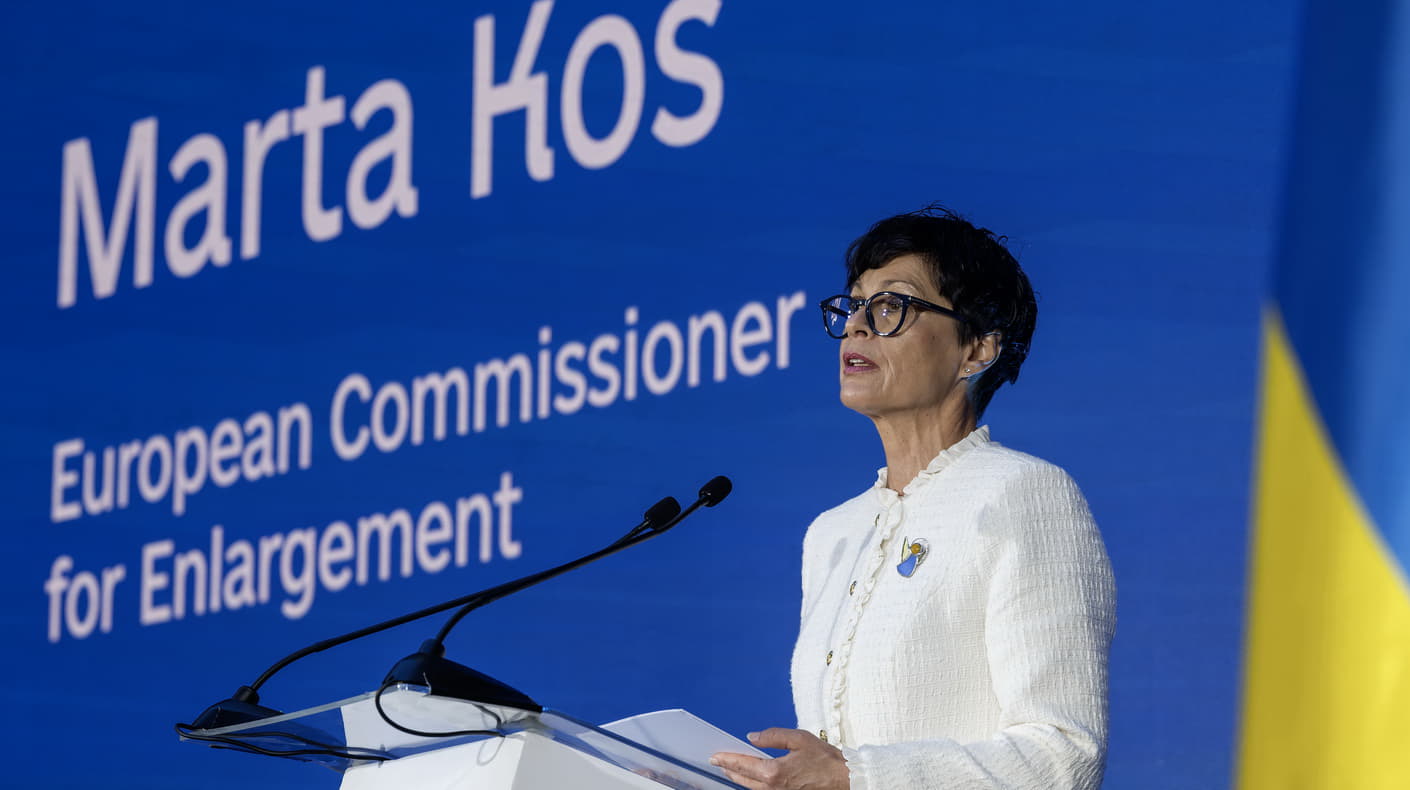
Moldova comes next, currently considered "well advanced" in meeting the interim benchmarks. Several sources have told European Pravda that the European Commission has prepared a positive IBAR assessment and is expected to send it to member states for approval soon. Marta Kos, the European Enlargement Commissioner, could announce this any day now.
The European Commission's plans for the next stages of the negotiations are particularly telling. For Ukraine, the roadmap envisages that negotiating chapters will begin to be closed towards the end of the first quarter (although given Kyiv's limited current progress in meeting the IBAR requirements, even this seems ambitious). But for Moldova, the plan is to close nine chapters in the first half of 2027 and another 16 by the end of the year – a total of 25 chapters in one year.
For Albania, the plan is to close all 31 remaining negotiating chapters, as well as Cluster 1, by the end of the year. In fact, this means Albania could spend 2028 preparing its accession treaty.
However, no specific target year for completing negotiations has been announced for either Moldova or Albania, although the European Commission had initially planned to do so.
According to European Pravda’s information, this decision was made in Ukraine's interests. It would be politically unwise to further emphasise that Moldova will be ready for EU membership before Ukraine. After all, the EU wishes to demonstrate in every possible way its desire to include Ukraine in this wave of enlargement, provided that reforms progress.
The Enlargement Report illustrates this further.
Ukraine: Record progress despite a lack of reforms
Ukraine has been included in the European enlargement report for the fourth consecutive year.
And if any of these four reports can be considered a success for Ukraine, it is this one.
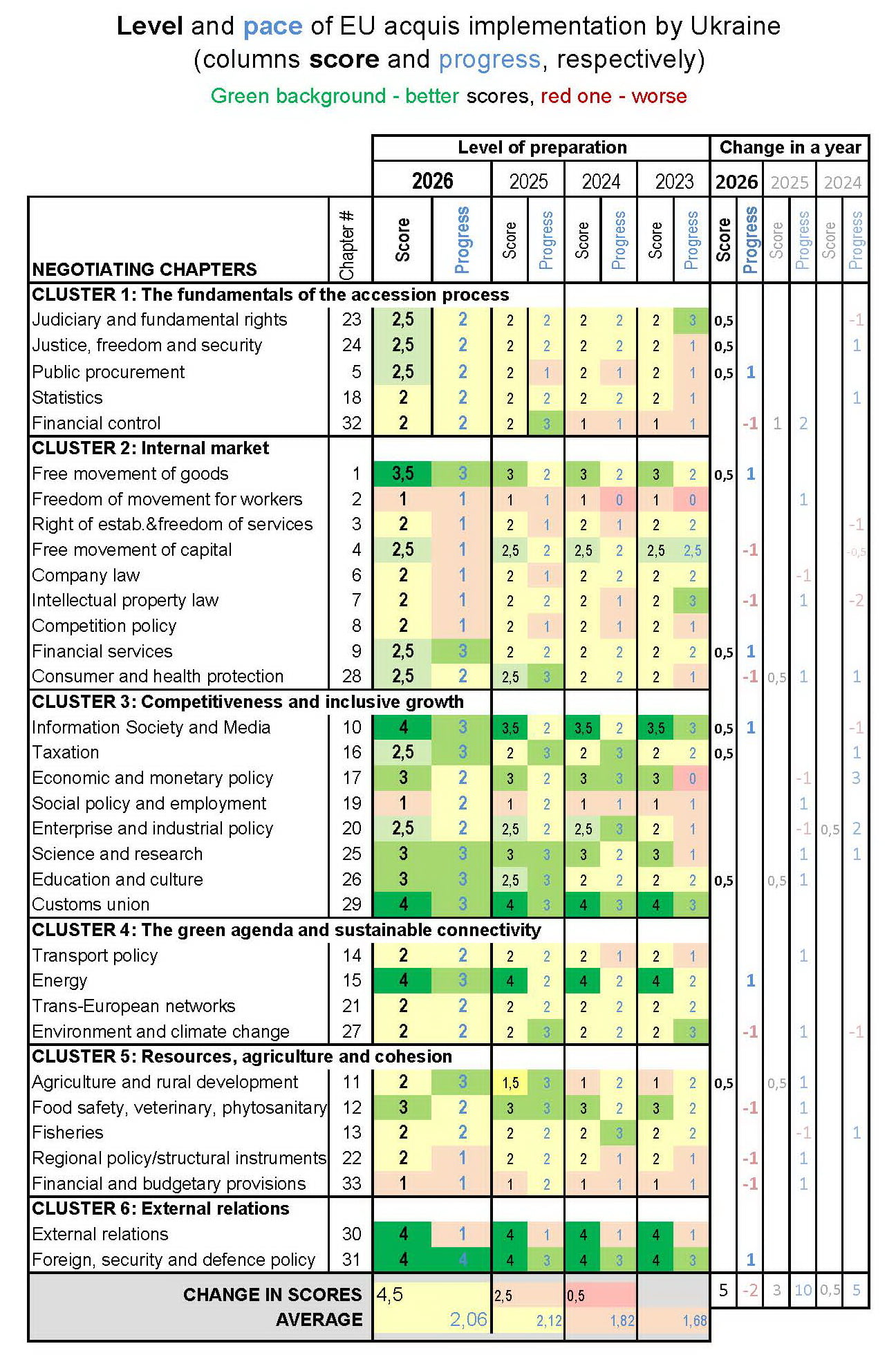
Every year, European Pravda prepares a graphic showing Ukraine's progress towards EU membership.
This year's graphic requires some additional explanation.
This amount of progress in the European Commission's assessment of Ukraine's readiness for membership has never been seen before. The progress made is still insufficient for a country hoping to join the EU within the next few years, but it is greater than ever before. The overall assessment across the 33 negotiating chapters has increased by 4.5 points, with half a point of progress in nine chapters.
The fact that the increase was limited to just nine of the 33 chapters does not mean that there is no room for further progress.
Nevertheless, the biggest increase Ukraine had previously achieved in a single year was 2.5 points, so the current result is certainly not bad.
Paradoxically, however, this record improvement for Ukraine has occurred against a backdrop of clearly poor progress. The European Commission states that the pace of reforms has slowed significantly in eight chapters, even compared with 2025, although concerns about the speed of reforms had already been raised last year.
How is it possible that the pace of reforms has deteriorated while the assessment of achievements has improved? The European Commission insists that its assessment is justified, although it did involve some "creative approaches" on the part of European officials.
To give Ukraine a better assessment in Chapters 23 and 24, the Commission had to take account of reforms implemented in the autumn, even though the report normally assesses results achieved between 1 September of the previous year and 1 September of the current year.
On Thursday, EU Ambassador to Ukraine Katarína Mathernová emphasised that the pace of reforms had picked up specifically during the autumn. Other officials, speaking anonymously, have said the same.
"Ukraine has in fact implemented a number of reforms, including in the judiciary. It is true that progress was somewhat mixed before the summer, but since then, significant progress has been made, including on reforms under the Ukraine Plan. This justifies the assessment we have included in the report," a senior EU official involved in drafting the report told European Pravda.
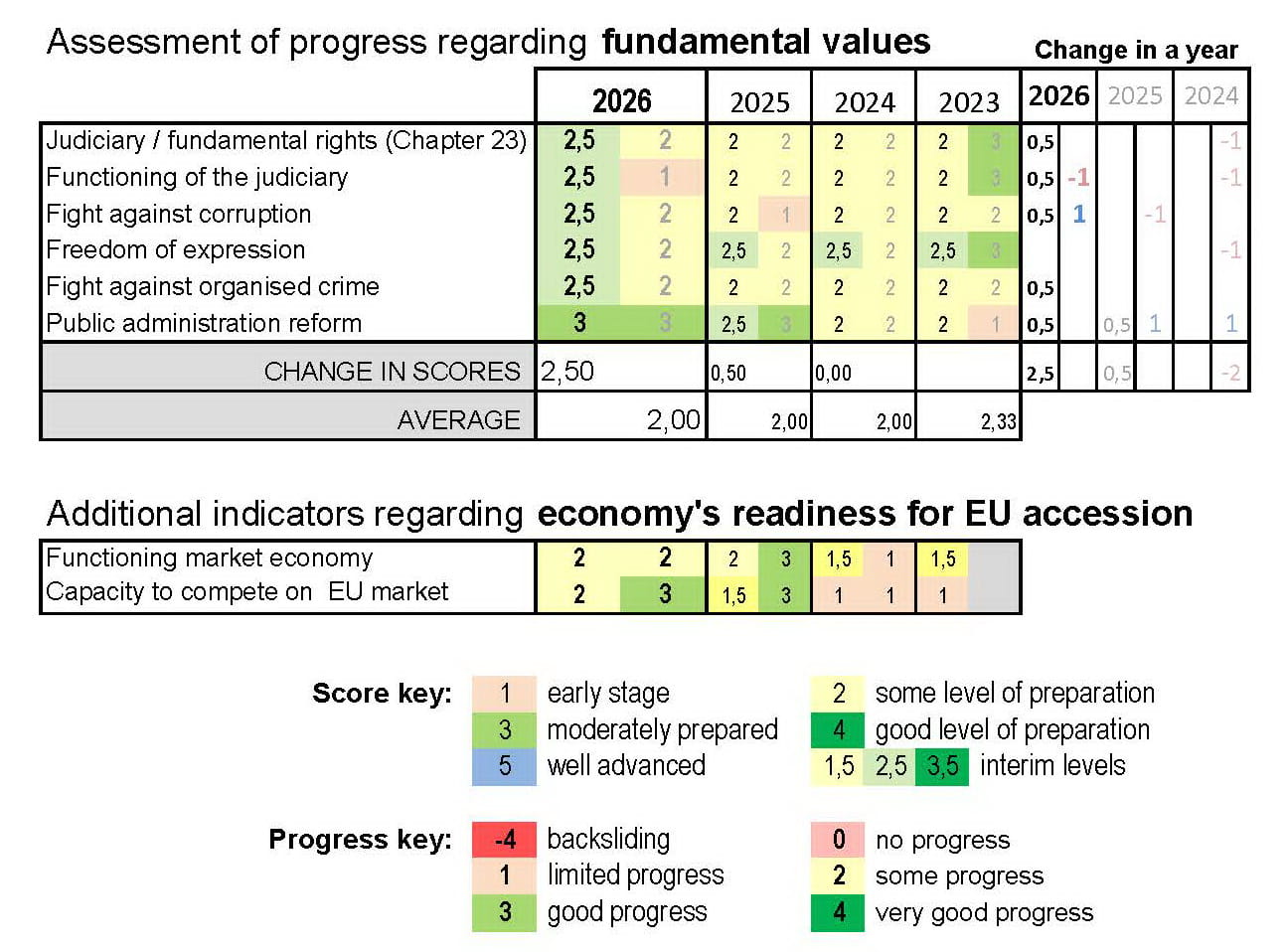
Assessments of the Fundamentals deserve particular attention.
Ukraine's scores have increased across all areas, including combating corruption. This is despite the fact that there were no reforms in this area during the autumn, while key documents such as the anti-corruption strategy remain unadopted.
So what explains the improvement in Ukraine's assessment?
This is another creative approach by Brussels, and one that is entirely justified. The European Commission is constantly emphasising that EU accession is not the responsibility of the president, the government or the Verkhovna Rada (Parliament) alone. It is a task for all of Ukraine and every level of society. And this is precisely what has provided the basis for the positive assessments.
The European Commission is saying almost explicitly that progress has sometimes been achieved not thanks to the government's actions, but despite them.
All the cards are on the table for Ukraine
The improvement in the European Commission's assessment despite the government's actions is particularly evident when it comes to Ukraine's anti-corruption efforts.
"Some progress was made, mostly because the specialised anti-corruption institutions – the National Anti-Corruption Bureau (NABU), the Special Anti-Corruption Prosecutor’s Office (SAPO), the High Anti-Corruption Court (HACC) – continued to deliver on their mandate and build a track record by stepping up investigations, prosecutions and final convictions in high-level corruption cases, including at the highest levels of government and the judiciary," the report states.
Several sources who were involved in drafting the report confirmed this interpretation of the paragraph to European Pravda.
Moreover, the remainder of the European Commission's report reinforces this conclusion.
Brussels makes no secret of the fact that the Ukrainian authorities need to fundamentally change their approach.
Officials in Brussels presumably understood that a positive assessment could be misinterpreted by the Ukrainian government. They therefore explicitly emphasised that the EU is fully aware of the seriousness of the problems.
European Pravda has reported that a shadow report commissioned by the European Commission points to serious problems, including the alleged persecution of anti-corruption detectives by the Security Service of Ukraine (SBU) and the authorities more broadly.
All the main elements have also been included in the official report.
"Despite these improvements, the limited advancement in adopting structural legislative and institutional reforms recommended by the Commission remains a major concern, requiring urgent action by the authorities to ensure the sustainability and effectiveness of the anti-corruption framework. Anti-corruption institutions continued to report pressure from state institutions, law enforcement and security agencies, and their situation remains fragile overall. Despite some improvements in regulatory and corporate governance, corruption remains an issue in certain economic sectors, particularly energy, defence and construction," the European Commission states.
In view of this, the European Commission needed to take a creative approach here as well.
EU Ambassador Mathernová had already announced it the day before when she stated that the EU report on Ukraine would take progress made in previous years into account.
Indeed, the European Commission's report states that it took account of "cumulative improvements in institutional capacity and the implementation of preventive measures over recent years", and this made it possible to improve Ukraine's assessment.
An important detail is that this approach encountered no opposition from EU member states. European Pravda has received confirmation of this from European capitals, where officials say the report appears objective. The European Commission also expects this approach to be accepted, as several sources have confirmed. Everyone understands why this is happening.
There are two main reasons why Brussels is looking for creative ways to present Ukraine in a more favourable light.
First, the EU recognises that Ukraine's accession process is taking place during a full-scale war and therefore requires special consideration. The EU cannot waive reform requirements for Ukraine – that would not have the support of member states and would contradict the very logic of EU membership. But the EU is prepared to be flexible.
Second, the EU has no desire to decouple Ukraine and Moldova, even though Chișinău currently appears better prepared than Kyiv to report on its progress. That is why Brussels is willing to look for alternative approaches and procedures and even to temporarily hold Moldova back. In particular, there are indications that although Moldova is ready to submit its IBAR report, it is unlikely to be approved quickly. This would give Ukraine time to catch up with its neighbour.
The main question is whether Ukraine, and above all its parliament, will be willing to take the necessary steps to achieve EU accession, or whether it will go back to stalling on reforms despite the consequences.
Sergiy Sydorenko, Kyiv
Tetiana Vysotska, Brussels
European Pravda