From paid voters to Romania-lovers: who's helping the Kremlin hack Moldova's elections?
Ukraine’s EU accession is following no fixed timeline. But even now, we can name two dates that will be decisive for Ukraine’s European integration. Both are tied to events in neighbouring states.
The second of these dates is 12 April 2026, when parliamentary elections are set to take place in Hungary. The situation here is clear: for the first time in 16 years, Viktor Orbán’s authoritarian and pro-Russian regime could face defeat. There is hope that this will make normal Ukrainian-Hungarian dialogue possible and allow the Hungarian veto on pro-Ukrainian decisions in the EU to be lifted.
There is an even closer date, though, that is highly significant for Ukraine’s path to EU membership: 28 September 2025 – election day in the Republic of Moldova.
The new government to be formed in Chișinău won’t just be decisive for Moldova’s future, but for Ukraine as well. And the issue is not only whether Moldova will officially announce that it is turning towards Russia. Much more realistic – and at the same time more dangerous – are the "hybrid" scenarios the Kremlin is currently working on.
Moreover, the Russian scenarios could include elements that are likely to gain broad support from Western actors. For example, is there any doubt that if the Transnistrian conflict were "resolved" US President Donald Trump would immediately declare it to be "another war he settled" – even if the terms of the settlement were dictated by Russia and posed real security threats for Ukraine?
Another danger is that Ukraine will be destabilised logistically. Moldova’s role as a link in Ukraine’s exports and imports – and even its importance for military transit – should not be underestimated.
Finally, a pro-Russian government in Moldova would be able to scupper not only Moldova’s European integration, but Ukraine’s as well, even if the Hungarian veto were lifted.
Fortunately, the dangerous scenarios are far from guaranteed. A more realistic outcome is that pro-European President Maia Sandu will at least keep her prime minister and key ministers in place – at least for a while. It is also possible that the election results will not allow a new government to be formed and Moldova will be forced to return to the polls. However, a Russian comeback is not out of the question either.
The Kremlin’s pieces on Moldova’s chessboard
With just days to go before Moldova’s parliamentary elections, there is even less clarity about their outcome than there was a few months ago.
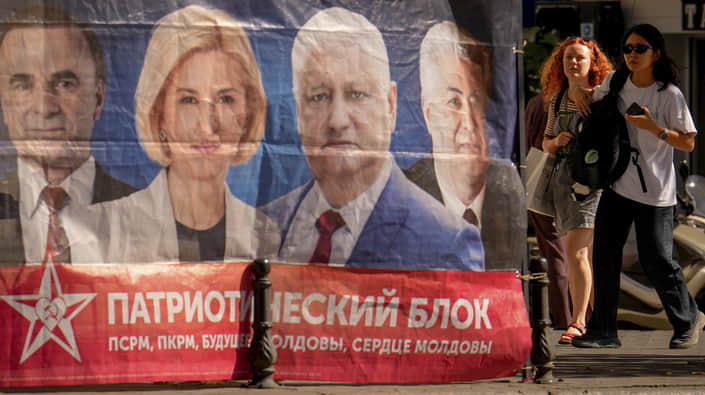
At the start of the summer, analysts agreed that three parties were virtually certain to enter parliament: the ruling pro-Western PAS (Party of Action and Solidarity), aligned with President Maia Sandu; the pro-Russian bloc led by former president Igor Dodon; and the Alternative bloc, headed by popular Chișinău mayor Ion Ceban, who aimed to attract centrist voters reluctant to back either left– or right-wing favourites. The populist Renato Usatîi also had a chance of winning a seat.
Now the picture has changed. These shifts could alter the balance between Russia and the EU.
The two frontrunners remain the same, though.
The most likely outcome is that the ruling PAS party will take first place, with Dodon’s Patriotic Bloc coming second. Yet even this is uncertain. Opinion polls in Moldova do not reflect reality. Around a third of respondents decline to say who their preferred candidate is or claim to be "undecided". Pollsters suspect that most of this group will vote against the ruling party but do not feel safe admitting this publicly.
European Pravda has access to data from a confidential survey by a reputable organisation that confirms this.
Moldovans were asked not only about these elections, but also a control question: how they voted last autumn in the referendum on Moldova’s European integration. Only 25.6% admitted voting against, while 59.6% insisted they voted for it. But this fundamentally contradicts the results of the referendum. Eleven months ago, about 54% of voters within Moldova itself (excluding the diaspora and Transnistria) voted against European integration, and only 46% for. Now, however, many won’t admit this.
It makes sense to assume that on other issues, too, the picture is looking artificially optimistic for the current authorities.
So Dodon’s bloc finishing in first place can’t be ruled out.
The second party considered a potential member of a pro-Russian coalition is the Alternative bloc. Yet while its entry into parliament was regarded as a done deal at the start of the campaign, this is no longer the case. It’s now highly likely that Ceban’s bloc will fail to cross the elevated threshold (7%) that Moldova has set for electoral blocs. That is why recent polls show his bloc falling short.
Why has this happened? Ceban was badly hurt when the Romanian authorities banned him from entering the EU and he suffered the stigma of being a pro-Russian politician. This ruined the positioning of Alternative, which had been trying to sell itself to pro-European voters who wanted Moldova to maintain its course towards closer ties with the West but were looking for an alternative to the current government (hence the name of the bloc).
But when it came to pro-Russian voters, Ceban never had a chance – he is "too pro-Western" for that audience. Pro-Russian voters already have Dodon’s bloc as "their own" and feel no need for an alternative. Yet the irony is that the failure of Alternative will hit the Kremlin’s allies in Moldova hardest. If Ceban’s bloc doesn’t make it into parliament, a pro-Russian coalition will become practically impossible.
Finally, there are two other pro-Russian parties that could unexpectedly enter parliament.
One of them is running on an openly anti-Ukrainian platform.
Nationalists of the world, unite!
The party in question is Moldova Mare (Greater Moldova), which has territorial claims against Ukraine in its manifesto. In other words, it is campaigning for parliament on a pledge to annex part of Odesa oblast. Its ideology is Moldovan nationalism. This is a virtual party – one that does not exist in real political life. It was founded and is led by Victoria Furtună, a protégé of fugitive Moldovan oligarch Ilan Șor, who now lives in Moscow and works for the Kremlin coordinating Russian activities in Moldova.
So why is there even a chance that Furtună could make it into parliament if her party has no real base?
The fact is that the Russians have managed to implement a unique project in Moldova – the so-called Șor network, through which voters in poor regions receive money transferred from a Russian bank (Promsvyazbank, which is tied to Russia’s Ministry of Defence). The authorities are trying to crack down on this network, but with limited success; meanwhile, members of the network have a strong motivation to see the current government replaced – both to escape the threat of arrest and to be able to convert their fees into cash.
Since it is illegal, the extent of the Șor network is unclear. The authorities have previously spoken of 300,000 people being involved (that would be 20% of the electorate!). This figure seems seriously inflated, but even 70,000-80,000 votes would be enough to confidently clear the electoral threshold.
It’s thought that participants in the Șor network will only receive their instructions on who to vote for in the last few days or even hours before the elections. The choice the Kremlin will make – whether to push Dodon into the lead, insert Furtună’s controlled party into parliament, or save Alternative from collapse – is unknown. Each option carries certain risks for Moscow, given that Sandu’s team is actively fighting the Șor network and is prepared to disqualify a contender if evidence of vote-buying is proven.
The Kremlin’s coalition could include Romanian as well as Moldovan nationalists.
Another party with a chance of entering Moldova’s parliament is Democraţia Acasă (Democracy at Home).
At first glance, this populist party seems to have nothing to do with the Kremlin. It is a unionist party, meaning it supports the unification of Moldova with Romania. Its main partner is the Romanian nationalist party AUR and its leader, George Simion – currently the most popular politician in Romania – who has been actively campaigning for them on TikTok, social media and beyond. In August, Democraţia Acasă was running at around 3.5% of decided voters in the polls, and that figure could easily have increased since then. If you add some of the votes cast by the Moldovan diaspora in Romania (which may be sympathetic to a unionist-populist party)… and if the Kremlin chips in a little via the Șor network… In short, clearing the 5% threshold is entirely achievable.
So why is Democraţia Acasă being discussed in a "pro-Russian" context?
It isn’t just because George Simion has a reputation, not without reason, for being a promoter of Kremlin ideas in Romania – something he proved during this year’s Romanian elections. An even more important factor is who is shaping the party’s list inside Moldova.
Democraţia Acasă is headed by Vasile Costiuc, a relatively unknown Moldovan politician (and, as is usually the case in Moldova, a Romanian citizen). Costiuc first came to the fore on the political scene this year when he emerged as George Simion’s key Moldovan partner ahead of Romania’s presidential elections (to recap: Simion made it to the second round, where he lost to Nicușor Dan; the Moldovan government had actively campaigned for Dan, urging Moldovans with Romanian passports to keep Romania on its pro-Western course).
It was after this that Costiuc caught the attention of Romanian investigative journalists, who uncovered plentiful evidence of his cooperation with the FSB.
But could far-right unionists really join forces with Dodon’s left-wing/ultra-left Patriotic Bloc? The answer is clear – yes they could. Their alliance would be motivated by what unites them – and that isn’t just Russian money, but also their shared and publicly stated commitment to bringing down Maia Sandu and her team. (After all, Moldova has experienced this before – in 2019, when Sandu herself put aside ideological differences and joined forces with Dodon’s camp to oust the then-ruler of Moldova, Vlad Plahotniuc.)
What’s more, this alliance would not even publicly declare that it is turning Moldova towards Russia.
For Russia but not against Europe
It is safe to say that if pro-Russian forces were to win – whether Costiuc’s unionist faction was involved or not – the new coalition would not announce that it was turning its back on European integration.
Despite its clear and well-founded image as a pro-Russian organisation, Dodon’s Party of Socialists consistently denies being pro-Russian. Last year the Socialist Party even amended its charter to include European integration as one of its goals. For Dodon, therefore, it would be no problem to claim that Moldova would continue moving closer to the EU, just that it would be doing so more effectively and professionally than its predecessors.
That said, there is absolute certainty among Moldovan experts that Dodon’s bloc is funded by Russia and that if it comes to power, it will effectively freeze the country’s European integration.
The fact that Dodon has been forced to put people reputed to be "Șor envoys" and with clear links to Russia in top positions on his list (such as former prime minister Vasile Tarlev) provides solid grounds to believe this is indeed the case.
Ceban’s Alternative bloc positions itself entirely as a pro-European and pro-Western force. His party has advertised its participation in pro-European rallies in Chișinău. Ceban himself has met regularly with the US ambassador in Chișinău, and he has travelled to the United States several times with his closest ally, Gaik Vartanean. In early 2025, Ceban proudly posed for a photo with Donald Trump Jr. in Romania.
But Moldovan experts remain unconvinced.
Ceban is accused of having a pro-Russian political past: he was once a member of the Communist Party, then of the Socialist Party, through which he was first elected mayor of Chișinău in 2019. Ceban himself insists that he has been independent of any party ever since. Yet there is also a more recent episode: on 24 February 2022, Ceban was in Moscow – and he has yet to come up with a convincing explanation for the trip.
Some believe that Ceban, lacking genuine convictions in favour of either the EU or Russia, was indeed ready to join the pro-European camp, but Sandu and her PAS party launched a political war against him, pushing the capital’s mayor into the pro-Russian sector. Publicly, however, he will continue to claim that he is ready to lead Moldova towards closer ties with the EU, combat corruption, and so on.
But European integration can be halted even while talking pro-European talk.
Threats to Ukraine
It is vitally important for Ukraine that the Moldovan government should continue to be PAS-led.
Credit must be given to the current government, which repeatedly emphasises that the Moldovan people should be grateful to Ukraine and its armed forces for preserving Moldova’s independence during Russia’s war.
Even now, Moldova is an extremely important logistical partner for both exports and imports, including critical supplies such as fuel.
Military equipment also crosses the border.
The road through Palanca, across Moldovan territory, is currently the only fast route connecting Odesa with the south of Odesa oblast. The fact that no one in Chișinău ever asks any awkward questions about this transit route deserves respect.
Does anyone still have any illusions that all this will remain unchanged if pro-Russian forces come to power?
Politically, however, the most crushing blow could be dealt to Ukraine’s European integration.
Much has been said about Ukraine and Moldova now being coupled together in their journey towards EU membership. Ideally this coupling is helpful to both countries, as it unites their friends.
If, however, the situation turns out to be the opposite, and Moldova finds itself blocked for internal reasons, this will undermine Ukraine’s path to accession as well. Fortunately, this scenario is not guaranteed.
Despite the problems faced by Sandu’s party, it still has a good chance of election victory. Moreover, there are strong grounds to believe that there is an understanding between the current government and Renato Usatîi’s populist Our Party, even though both deny this.
Will their alliance be strong? Will there be a coalition at all, or will a minority government suffice? Or could a miracle happen, with PAS once again securing a majority on its own?
We’ll find out on the night of 28-29 September.
Sergiy Sydorenko,
Editor, European Pravda, Chișinău-Kyiv