Ukraine has rejected "associate membership". What should the EU offer instead?
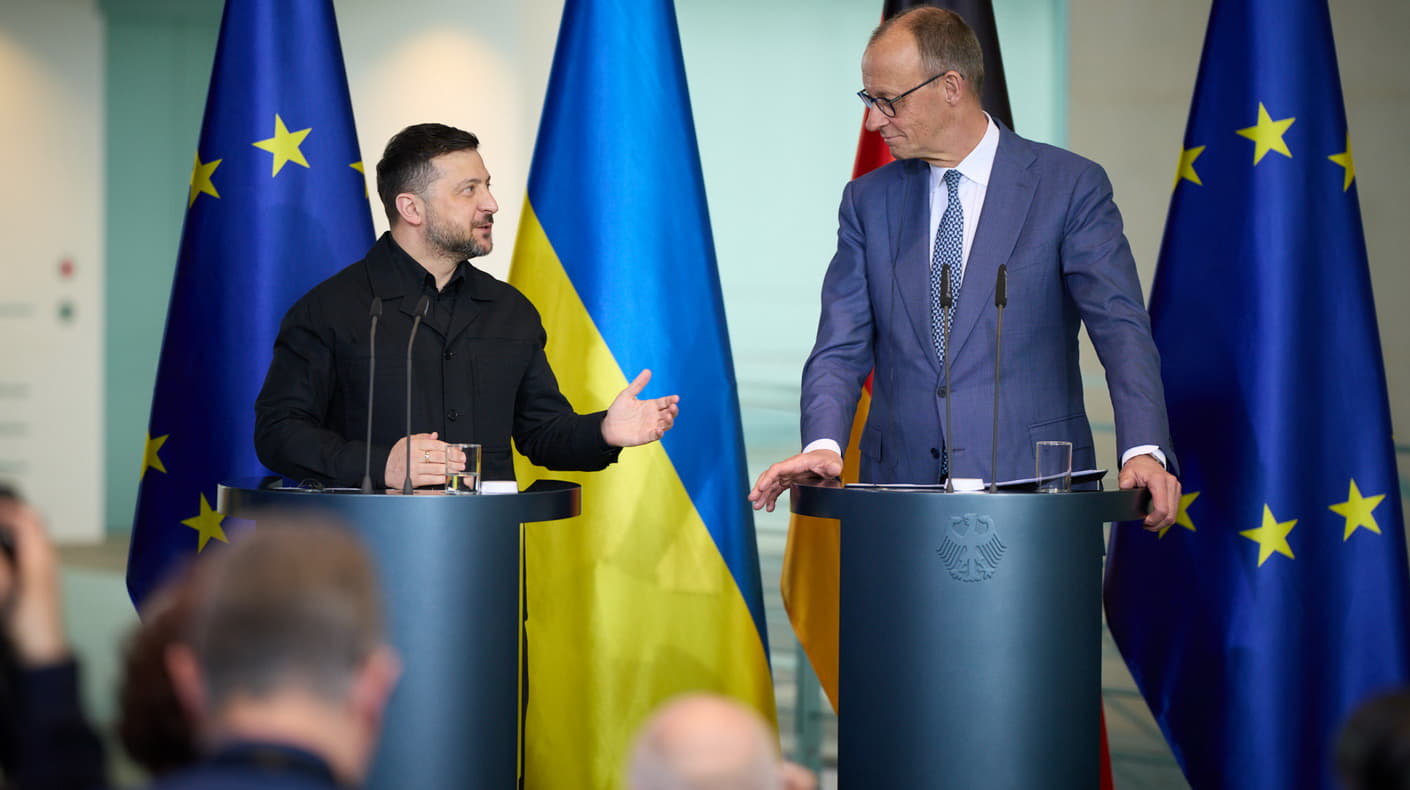
Last week, an idea put forward by Merz regarding a special format for Ukraine’s EU integration caused quite a stir. The proposal drew criticism, including from European Pravda, but also some positive reactions.
It may have seemed that President Zelenskyy had put an end to the discussion when, at the end of the week, he rejected Merz’s proposal in its current form in a detailed letter to EU leaders. His main message in the four-page letter can be summed up as: "There can be no complete European project without Ukraine, and Ukraine’s place in the European Union must be full and equal."
However, this does not mean that Merz’s initiative is dead.
The German chancellor has reignited discussions within the EU about what to do with Ukraine, and there are already several alternative proposals, including one from the Lithuanian government, which certainly cannot be accused of acting against Ukraine’s interests.
Moreover, despite the criticism from Kyiv, it is also in Ukraine’s interest that Merz’s idea should not disappear, but evolve instead.
The important thing is that it should develop into forms that are beneficial to both European and Ukrainian political actors, as well as to Ukrainian society.
And this is a completely realistic objective.
Indeed, Merz’s proposal contains both certain dangerous elements and some positive elements that could be useful for Ukraine.
The German chancellor did make several critical mistakes in his letter to the EU leadership, and these need to be analysed separately in order to draw red lines that would create risks for Ukraine if crossed. But if these errors are corrected, there are some entirely possible steps the EU could take that would not yet mean full membership, but would still be beneficial for Ukraine.
Not only that – Kyiv should fight for such formats and for Merz’s idea to be refined into acceptable forms. And this work must be done without delay, because the window of opportunity for creating a new framework will only be open for a few more weeks.
Membership, not a substitute
First, it must be emphasised as a fundamental point that Ukraine’s goal is full accession to the European Union.
And not just because this aspiration is enshrined in the Constitution. It is not just an aspiration supported by the country’s current leadership.
Joining the EU has unequivocal support from Ukrainian society, providing a significant level of confidence that this goal will be maintained under future governments as well due to voter demand. Even more important is the fact that Ukraine’s accession to the EU is a geopolitical necessity. Geography and the proximity of Russia, which is unlikely to stop wanting to destroy Ukraine, leave no alternative to European integration. And from a security perspective, it is also essential for the EU itself.
The main problem with Merz’s letter is that the integration scheme he has proposed, if implemented in its current form, would call Ukraine’s ultimate goal into question.
Under Merz’s proposal, Ukraine and Moldova would be decoupled. For Chișinău (and for the Balkan countries that are further advanced in integration), Merz suggests finding ways to accelerate accession, while for Ukraine he proposes introducing a new special status. As a result, the letter was perceived in Kyiv as an attempt to create a pretext that could lead to EU membership for Ukraine being replaced with an alternative (and an empty alternative devoid of substantive content at that).
European and German sources have assured European Pravda that this was not Merz’s intention.
He still sincerely aims to bring Ukraine into the EU, just as he stated in his letter.
But regardless of his intentions, for Kyiv, the decoupling of Ukraine’s and Moldova’s integration paths is seen as a red flag. If decoupling is carried out now, it could be used precisely to pull Ukraine away from the leading group of enlargement countries and relegate it to the laggards whose accession won’t be up for discussion until much later – even if the proponents of this idea do not actually intend that to happen.
Without this element, Merz’s idea would be received much more positively.
A path to accession, not a special status
The second idea that will definitely not find support from Kyiv or a unanimous positive reception from the Ukrainian expert community is the special status that Merz has proposed calling "associate membership".
European Pravda has already explained in a previous article why such a proposal sounds politically meaningless and like bad PR for Ukraine: for a country that has had an Association Agreement with the EU signed and ratified for nearly nine years, it sounds like an attempt to "sell" Ukraine something it already has. For that reason, any future "creative" ideas offering Ukraine "another association" are destined to be met with a negative reception.
In Berlin, however, they are insisting that for Merz, this term is not essential. Several sources have assured European Pravda that the chancellor’s team is already aware of Kyiv’s negative perception of the name, and that it would not be a problem to drop references to "associate membership" in all future reflections on Ukraine’s path to accession.
That’s a good thing. But the problem isn’t just the name.
Any ideas about how Ukraine could gain greater access to EU institutions and be more actively present in European discussions are worth considering. But attempts to formalise them as an official status raise a legitimate question in Kyiv: could this turn into a substitute for membership?
The framing of Merz’s proposal leans towards precisely that interpretation.
This is also how Zelenskyy appears to have read it, and that’s reflected in his emotional response to European leaders (European Pravda has seen the letter). The president describes the German chancellor’s ideas as "half-measures" and the proposed status for Ukraine as "semi-membership", insisting that Ukraine "deserves a fair approach and equal rights with Europe".
So what should the EU actually propose that Ukraine would agree to?
First, it is worth considering whether this should be a formal status at all. Interim initiatives that help Ukraine’s integration do not always need to be formalised as a special legal status. If they are, it creates grounds for debate about whether such a step could one day become an alternative to full integration.
The logic would be: you’ve got "intermediate membership" (or whatever it may be called), so there’s no need to rush towards formal accession.
Kyiv will inevitably take that risk into account, knowing that there are some actors within the EU (Merz is not one of them, by the way) who would welcome such an outcome.
But there is an alternative: a new formal EU status for Ukraine that would not give rise to such concerns from the outset. This is possible if the status is clearly defined as a staging post on the way to accession and has no alternative interpretation. Put simply, this would be the status of a country negotiating an accession treaty (as is currently the case with Montenegro), or a country that has signed an accession treaty but is awaiting ratification (normal and even desirable for Kyiv).
In search of a hybrid solution that takes these considerations into account, Lithuania, through dialogue with other EU countries, is proposing that Ukraine should formally be granted the status of an "acceding state", meaning a country in the process of joining the EU. As you can see, this is a fundamentally different concept from the "associate member" status suggested in Merz’s letter.
But it isn’t just the name that matters. It is also the substance.
Why the issue has become urgent
It is also worth briefly addressing something that was mentioned at the beginning of this article: the next few weeks are going to be decisive in shaping the future architecture of EU accession.
On 18-19 June, at the end of the Cypriot presidency, an EU summit is set to be held in Brussels. Formally, its agenda has not yet been set, but in practice the meeting is expected to focus largely on the emerging new balance of power within the European Union.
This is the first official EU summit since Viktor Orbán’s electoral defeat and the first time leaders will be meeting with the new Hungarian leadership under Péter Magyar. Orbán was a source of problems far beyond Ukraine. He openly worked to undermine European unity and publicly questioned shared values, and the weakening of EU unity on Ukraine was only one element of this broader pattern.
Although Magyar presents himself as "anti-Orbán", not all member states are fully convinced of that. He still has to prove it, and that hasn’t happened yet.
For now, the EU has significant leverage over Magyar’s government: blocked funds left over from the Orbán era, which are about to expire. Brussels must decide before the end of the summer whether to release billions of euros that are badly needed by the Hungarian government. It is during this period that Péter Magyar will have the strongest incentive to align with common EU policies.
The only EU summit in this period will take place in about three and a half weeks’ time, in June.
So Ukraine is interested in ensuring that ambitious and acceptable ideas regarding its European integration are put on the agenda of this summit.
However, it would be naïve to expect Ukraine to be offered EU membership at that summit. That is impossible even in theory. After all, the obstacles to faster progress are not limited to Hungary, and Hungary is not even the main one. There is also Ukraine’s own lack of readiness, as assessed by Brussels and key capitals; insufficient reform momentum, particularly in the Fundamentals cluster; and unresolved questions about the EU’s own functioning, including its Common Agricultural Policy and other institutional issues.
Nevertheless, we must make the most of this moment to shape a new European vision of Ukraine.
Even without "voting rights", you can still have a voice
Despite the criticism of several important elements of Friedrich Merz’s initiative, Ukraine should in fact be grateful for his letter, because it has triggered a discussion within the EU regarding what to do about Ukrainian accession.
The standard path to EU membership is clearly not suitable for Ukraine, and the German chancellor emphasises this as well. It’s too long, because this path was designed for completely different realities in Europe. And it’s too dangerous, because even European leaders now understand that for Russia, Ukraine’s success and its accession to the EU are unacceptable outcomes.
That is why Europe is trying to find ways that do not threaten the destruction of the European Union, but would allow Ukraine to become a member more quickly.
As a result, creative ideas are emerging about how to help Kyiv, including in the area of reforms (which ultimately have to be carried out).
Not all of these ideas have received support from Ukraine. In particular, in his letter to the EU, President Volodymyr Zelenskyy was very critical of Merz’s proposal that as an "associate member", Ukraine would receive the right to send representatives to all EU institutions (from the Council of the EU to the Court of Justice of the EU), but without voting rights.
His arguments are understandable, but not all of them are convincing.
In fact, participation in the Council of the EU would be very useful for Ukraine.
And this is not about politics.
Meetings of the Council of the EU take place almost daily in different sectoral configurations, with ministers from various countries travelling to Brussels every day. In this context, it is arguably not essential for Ukrainian ministers to be constantly travelling to the EU capital, especially given that it takes them two whole days to get there – significantly longer under wartime conditions from Kyiv than from most other European capitals.
Moreover, these ministerial meetings are often more of a formality – countries arrive with their positions already agreed.
So it would be much more interesting to participate in the Council’s working bodies where those positions are actually shaped, so that Ukrainian representatives would be present at all internal EU discussions without exception, receive information, and be able to report back to the capital if anything went wrong.
And ultimately be able to express Kyiv’s position.
Because even without voting rights, Ukraine does not have to remain silent. Even in an observer role, Ukrainian representatives would have the right to present and explain the Ukrainian government’s position, warn against decisions that could undermine EU-Ukraine relations, and point out consequences that may not be obvious in Brussels, among other things.
There is a lot less sense, however, in Ukraine being represented in the European Parliament without voting rights. That is a political body, where influence matters greatly. And if it came to holding elections for "not-quite-MEPs", what Ukrainian politician would want to compete for such a position with only symbolic weight?
The same applies to the EU Court of Justice (appointing a judge from Ukraine who would have no vote but simply sit in Luxembourg – an idea that may be interesting, but not groundbreaking), and so on.
And finally, the timing of this development is crucial.
Let us recall a basic principle: Ukraine’s goal is full membership. And it would be entirely normal, even desirable, for there to be an intermediate status that serves as a transitional stage on the way to accession. For example, the "status of a state in the accession process", as proposed by the Lithuanians.
Therefore, if the European Union offers a substantive, concrete status that truly functions as such a transitional stage, this could help Ukrainian reforms. It would also demonstrate to EU member states, their politicians, Ukrainians, and ultimately also the Kremlin, that Ukraine’s accession to the EU is a truly inevitable and irreversible European decision, and that full membership is only a matter of time.
Ideally, the EU could decide to grant this status in exchange for Ukraine meeting the requirements of the first Fundamentals cluster, which covers the rule of law, anti-corruption measures, human rights and more.
Within the EU, the benchmarks (criteria used to assess Ukraine’s compliance) have been agreed, and there is also a mechanism for assessing candidate countries known as the Interim Benchmark Assessment Report (IBAR).
From there, the question becomes one of creativity.
When to sign the accession treaty and when to ratify it; how to define possible timelines for Ukraine to enjoy the benefits of membership; how to make the process legally irreversible – these are all issues that can and must be considered.
And if Merz’s letter, despite its initial shortcomings, leads to such an agreement, it will become a historic milestone on Ukraine’s path to EU accession.
After all, diplomacy is always the art of the impossible. And Ukraine has more than once displayed its mastery of that art.
Sergiy Sydorenko,
Editor, European Pravda