Six ways Merz’s "EU associate membership" idea could benefit Ukraine: a view from Brussels
The idea of "associate membership" for Ukraine, proposed by German Chancellor Friedrich Merz in his letter to EU leaders, has become the subject of heated debate both in Ukraine and within the EU.
European Pravda has published its own view of how the proposal should be modified in order to address the concerns being voiced in Ukraine.
Now we are giving the floor to a European expert – a retired but still influential official who is defending Merz’s initiative while acknowledging that some of its elements will probably need to be revised.
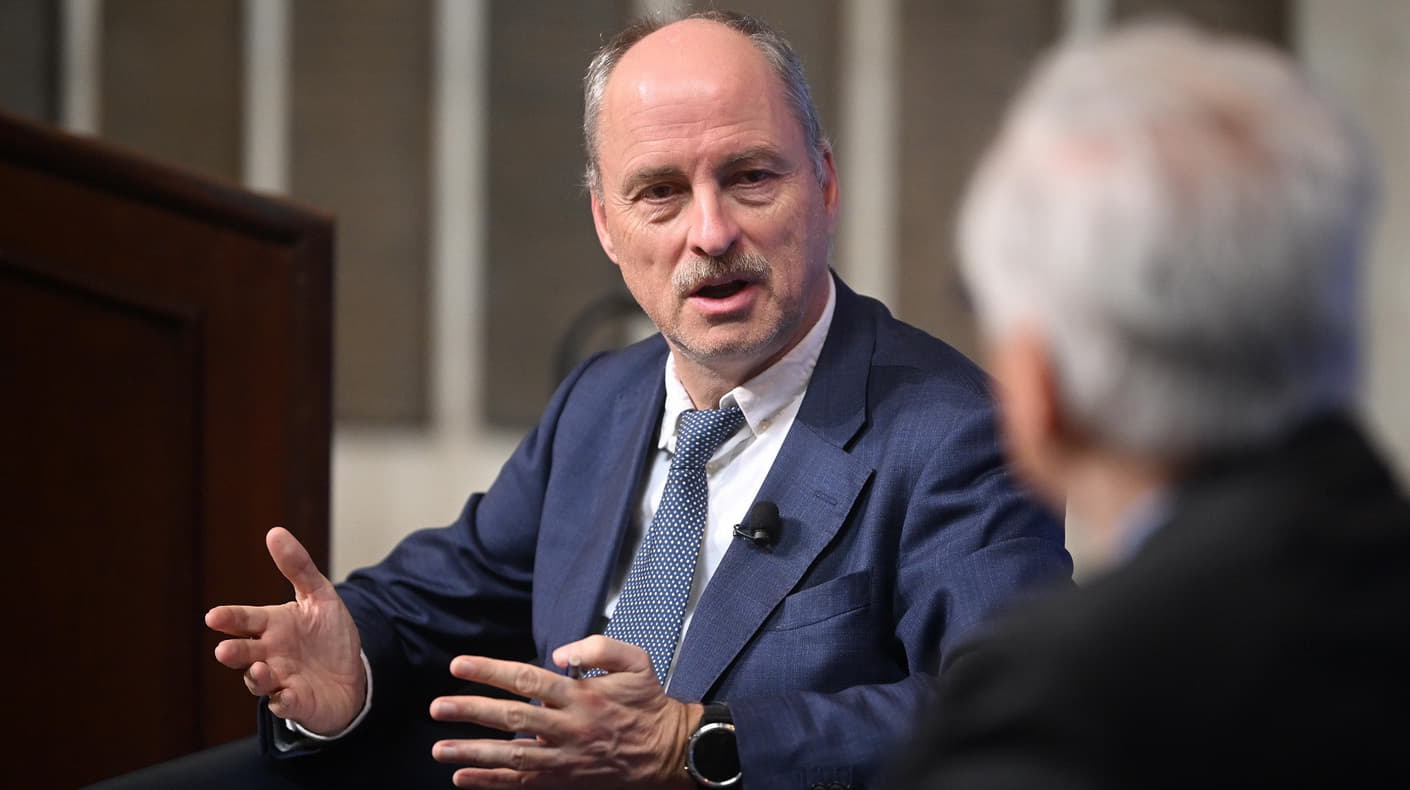
Klaus Welle is the former Secretary General of the European Parliament. He occupied this post for nearly 14 years – longer than any of his predecessors for nearly 14 years – before stepping down at the end of 2022. He currently chairs the academic council of the Wilfried Martens Centre for European Studies and advises several current top officials. It is also important that Welle is German and comes from the Christian Democratic Union of Germany (CDU) – Merz’s and Germany’s ruling party. He is actively engaged in Ukrainian issues and has travelled to Kyiv many times during the full-scale war. We met at the European Pravda office during his latest visit.
Klaus Welle avoids using the term "associate membership", which has provoked resistance in Ukraine. However, he considers many elements of Merz's proposal beneficial for Ukraine.
Below are quotes from Welle's interview with European Pravda's Editor in Chief, Sergey Sydorenko:
On the main elements of Merz’s proposal
Friedrich Merz, as the Federal Chancellor of Germany, has a strong interest in ensuring that Ukraine comes as close to the European Union as possible at any given moment.
I've been active in the Brussels bubble for more than 30 years. I've seen very, very closely the enlargement round with Poland and all other countries that joined the EU in this period.
I can say that when we look in detail at what he proposed – not the headlines, but the real points – these are improvements compared to past enlargements. What was proposed to Ukraine is a much better offer at the early stage.
Firstly, Merz proposes to immediately open all negotiation chapters–and that's exactly what Ukraine wants.
Secondly, Ukrainians would be present in the meeting rooms of the European Council, the Council of Ministers, the Commission, and in the European Parliament. I believe that would help your [Ukraine's] case.
Thirdly, Merz proposes to apply step-by-step the acquis communautaire [EU legislation] according to the progress in accession negotiations, meaning you grow into the European Union.
Fourthly, some budget programmes under the direct management of the Commission would already be accessible to Ukraine. Ukraine could criticise it and say that it doesn’t touch agriculture or cohesion funds, but programmes under direct management are about 20% of the EU budget and that’s a lot.
The fifth point is the full alignment of Ukraine’s foreign and security policy with the European Union, and while this is something for Ukraine to do, in exchange Ukraine would get access to Article 42.7 – a solidarity article, a kind of European analogue to NATO’s Article 5. Under Article 42.7, you can activate many European Union programmes, for example military mobility, which provides a way to supply military equipment quickly. We are now discussing in the European Union how to make Article 42.7 operational, so it will evolve.
The sixth point is a snap-back mechanism against backsliding, which would allow the EU to reverse certain steps in the event of a rollback of reforms in Ukraine.
On no voting rights
It has already happened that we were giving observer status to those countries which were about to join the EU – at the phase between the signature of the accession treaty and ratification. At this stage, they also did not have voting rights.
For Ukraine, it is proposed to reach this stage much earlier. And I would argue that most applicant countries in the past would have loved to have the proposal made to Ukraine.
No voting rights and no influence do not go together.
But being present at EU meetings means that every day you put the interests of your country on the agenda. You are in the debates, you go to the committees, and you say, "Look, you are discussing something, but here is an important point from my country’s point of view".
In the European Parliament, those who have influence are those who have strong arguments and who can make their points. Voting has an importance, but instances where one vote makes a big difference are relatively rare.
But one strong voice can make a huge difference in debate, if you send your leading politicians to the European Parliament.
I would stress that in the European Parliament this observer status would mean that representatives from both the government and the opposition would be heard, so that the plurality of voices from the country can be heard. Hopefully this would be in Ukraine's interest as well.
A Ukrainian representative to the European Commission would not be a full Commissioner, but we expect an observer country to send somebody strong, with governing experience, because you want that person to be taken seriously in the College. Even if they are not yet a full Commissioner. And these representatives would have staff, a cabinet, taking part in various meetings.
Having Ukraine in the institutions with voting rights is not possible legally, unless you become a full EU member.
While the institutions – the European Parliament, the Commission, the Council can organise the way they run, but the composition of the institutions and the voting rights are set out in the Treaties and cannot be changed that easily.
Failure to implement reforms would mean no full membership
The "snap-back" mechanism against reform rollback is an important element. If Kyiv fails to implement the necessary prerequisites – for example, in the area of anti-corruption – then preferences provided to Ukraine could be reduced.
And here comes a question: do you want EU membership absolutely, or do you want EU membership relatively?
Let me explain what I mean.
If you want it absolutely, you have to tackle very painful issues with very painful action, even if these actions could cause you problems as the government. Reforms may go against party interests as well. There would be really tough and painful things to be done, but absolutely needed for your membership.
I worked for EP President Jerzy Buzek, who used to be Prime Minister of Poland in 1997-2001. The most important reforms in Poland on the accession path were conducted under Prime Minister Buzek and his deputy Leszek Balcerowicz [former Deputy Prime Minister of Poland], and there were very painful reforms (for example, on social security).
The party union that delegated him to the government [Akcja Wyborcza Solidarność, AWS] got an absolute majority in the 1997 election. But by the next elections in 2001 it became so unpopular in Poland that it did not make it back into parliament. The reforms they did were so tough that people didn’t want to see them in politics anymore, and [in 2001, after that defeat, AWS was dissolved].
Nowadays, everybody understands this was the decisive time that is why Poland is now doing great. And Prime Minister Buzek is very respected for what he did. But this understanding came later.
And that is what I call "if you want to be in the EU absolutely".
The road to membership is neither easy nor smooth. You have to go against a lot of vested interests. And if you have the absolute willingness, you get the prize.
That is what we see now in Montenegro: they have the absolute willingness, they're always ahead of schedule with reforms, and that’s why they are where they are now. [Montenegro is the only candidate country that has begun preparing the text of its accession treaty].
With Ukraine, I definitely see that the Ukrainian people absolutely want to be in the EU. But if your government is not willing to make that sacrifice – to take actions which are needed but may result in the loss of popular support – then it will be difficult to reach what their people want so much.
The Merz proposal is not final – Ukraine has a say
This letter is not a decision or a legislative proposal; it is a call for discussion. It is a contribution from the largest member state in the EU, a state that feels very close to Ukraine. Berlin is looking for a constructive answer to Ukraine’s concern about the overly long accession process.
Now the European Council in June will discuss this [at the summit].
And I am sure they will very carefully listen to what Ukraine has to say, and of course that will be respected. It would be absolutely fair to say that Ukraine and Moldova should not be decoupled. And I do not think this would present a major hurdle.
On the contrary, the current proposal is more of a challenge for Chișinău, because they would need the same benefits offered to Ukraine to also be made available to Moldova.
Whether everybody in the European Council supports this, I do not know. But it is important that Merz is the proponent of this, and I think he deserves some credit, not just criticism, because he is making the case for some special rights for Ukraine.
Friedrich Merz is motivated to push this because he sees himself as a close friend of Ukraine.
Of course, if Ukraine says "we do not want this", the others will not impose this on Ukraine. It is an offer.
And if this initiative is taken to the European Council in June, there will surely be some in the room who are more sceptical, who will question it, like: "Why should we do that? Let’s go for the normal process."
Even those ideas [like the opening of all clusters for Ukraine] that were already supported by 26 in the past, meaning everyone except Hungary, are not guaranteed now. It could happen that for some countries it was easy to vote for Ukraine knowing that Hungary would block it anyway.
Now you could face the reality that other countries may be willing to delay pro-Ukrainian initiatives a bit.
And that is why I say that the German Chancellor deserves some credit for the initiative he took, knowing that it may not be popular with all EU member states. And I believe Merz should not be shot down both by member states and by Ukraine.
Still, Ukraine has a say in the shape of that initiative. There are elements that Ukraine may have reason to dispute, and that debate is exactly what Mertz's proposal sets out to initiate.
And let me share with you a story from my early years of work in European politics.
It was 30 years ago when the EU prepared to change its fundamentals and held negotiations on what is now called the Amsterdam Treaty. At that time I worked for Chancellor Helmut Kohl. There were tough debates among member state representatives [the EU consisted of 15 states back then], but we worked hard and managed to find a consensus by the summit, presenting our leaders with a draft treaty that every member was ready to sign.
But Helmut Kohl was very angry that we did it.
Because he wanted to have a debate at leaders’ level; he wanted to hear what every other leader had to say, to feel where the differences between the capitals lay. That is politics. And that is why leaders sometimes go forward with proposals that are not final–to feel the temperature and to find the idea that will fly.
Sergiy Sydorenko,
Editor, European Pravda