Why Orbán lost: what vulnerability of autocracies the elections in Hungary revealed
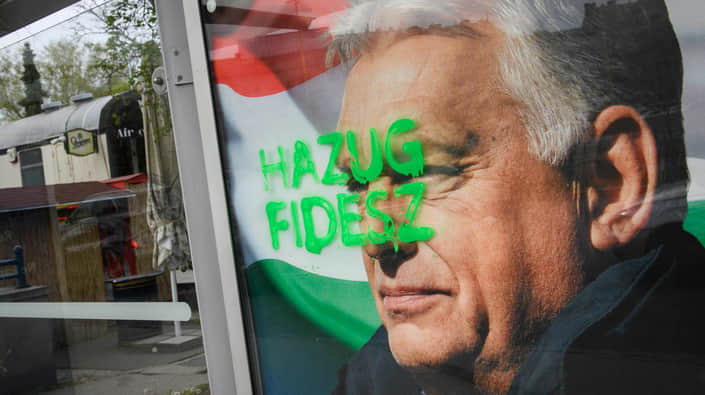
For 16 years, Viktor Orbán’s Hungary embodied a troubling idea: that "illiberal democracy" could be made stable and entrench itself in power.
Combining electoral dominance with the systematic weakening of institutional checks and balances, Orbán appeared to solve a central dilemma of modern authoritarianism: how to win repeatedly at the ballot box while hollowing out liberal democracy.
And because his model inspired admirers throughout the West (and beyond), helping to sustain a broader narrative of democratic decline, his humiliating election defeat carries implications far beyond Hungary.
The victory of Péter Magyar’s Tisza party, like the triumph of Poland’s Civic Coalition over the illiberal Law and Justice (PiS) party in 2023, represents not only a reversal of a seemingly consolidated system, but also signals that such regimes may be more fragile than they appear.
The lesson is not simply that illiberal regimes can lose.
It is that the very logic that sustains them can lead to their undoing.
Illiberal leaders have long justified their concentration of power by invoking the success of East Asia’s developmental states.
By weakening institutional constraints, they argued, governments could act decisively, coordinate investment, and deliver economic growth.
But this analogy was always misleading. The regimes of South Korea’s Park Chung-hee or Singapore’s Lee Kuan Yew were effective not because they faced fewer constraints, but because they faced more pressure.
Geopolitical insecurity and the constant risk of domestic unrest forced them to deliver broad-based gains or risk collapse.
Reduced accountability did not produce complacency; it produced discipline.
More generally, effective state capacity depends on constraints that discipline those in power.
These can take different forms. In liberal democracies, constitutional checks and balances impose such discipline. In developmental autocracies, external and internal vulnerability provided it.
Contemporary illiberal regimes operate under very different conditions.
In the absence of pressures comparable to those faced by Park and Lee, the weakening of accountability does not generate developmental capacity. Instead, it creates opportunities for rent-seeking.
Power becomes a resource for maintaining political coalitions rather than for delivering public goods.
A supposed strategy for strengthening state capacity turns into a system of selective distribution.
Over time, this logic erodes the economic foundations of illiberal rule.
When political loyalty becomes the primary criterion for allocating resources, efficiency and innovation suffer. Public procurement rewards insiders, rather than the most productive firms.
Domestic entrepreneurs face corruption, uncertainty, and limited opportunities for expansion. At the same time, growth strategies based on foreign direct investment generate employment but often fail to produce upgrading or sustained productivity gains.
That is what happened to Hungary under Orbán. As economic performance weakened, so did the regime’s capacity to sustain its supporting coalition.
Slower growth narrowed the tax base and reduced the resources available for redistribution. Investment in education, health care, and social mobility stagnated. Hungarians increasingly experienced what had been presented as a system of stability as a system of closure.
Large segments of the workforce faced declining prospects, stagnating wages, and limited opportunities for advancement.
At the start of Orbán’s long reign, these internal dynamics were partly masked by financial transfers from the European Union.
But access to these resources became increasingly conditional on government transparency and judicial independence—precisely the forms of accountability Orbán resisted. The result was a self-imposed constraint:
by rejecting external oversight, the regime limited its own access to funding.
As such constraints tightened, it is no surprise that Orbán turned to even more illiberal partners, including Russia and China, trading regulatory autonomy for new forms of geopolitical dependence.
A project that began in the name of sovereignty risked ending in vulnerability.
More broadly, Orbán has shown that even highly captured systems can become politically exposed. The very mechanisms that sustained illiberal rule could, over time, turn into sources of fragility.
Hungary’s model relied on a tenuous coalition of multinational firms, politically connected domestic elites, and voters promised stability and economic improvement. But as growth slowed, tensions within this coalition intensified. Domestic businesses found fewer opportunities, while voters faced declining living standards and blocked futures.
Defeating Orbán became possible when discontent met organization — when a credible challenger united fragmented voters and turned frustration into participation.
Where traditional opposition forces were weak or discredited, this required leadership capable of transforming social grievances into a broad-based political movement that mobilized across class and institutional divides.
That is what Magyar and his Tisza party accomplished. For years, Hungary served as proof that democratic backsliding could be institutionalized and sustained within the framework of formal electoral competition.
Magyar’s decisive victory demonstrates something equally important: that such systems are not irreversible.
But Orbán’s defeat, like the defeat of Poland’s PiS three years ago, does not mark the end of illiberalism.
The structural conditions that fueled its rise — economic insecurity, social fragmentation, and political distrust — persist across many democracies. But Orbán’s fall does challenge the sense of inevitability that had surrounded the global drift away from liberal democracy.
Now, the more difficult task begins: dismantling entrenched patronage networks, restoring institutional autonomy, and rebuilding state capacity without reproducing the failures that enabled illiberalism in the first place.
Magyar will also need to redefine how national interests are pursued within the European Union — strengthening domestic constituencies while building transnational alliances capable of advancing deeper and more resilient forms of integration.
Defeating illiberalism at the ballot box was hard. Building a resilient form of liberal democracy in its aftermath — one capable of delivering both accountability and inclusion—might be even harder.
But one thing is certain: democracies, friends and foes alike, will be watching closely.
This article originally appeared on Project Syndicate and is republished with permission from the copyright holder.