Full EU membership plus an add-on for Ukraine: Germany’s ambassador in Kyiv defends Merz proposal
When German Federal Chancellor Friedrich Merz wrote to the EU leadership to propose a special path for Ukraine towards EU accession (and a new status for Ukraine which Merz dubbed "associate membership"), the letter triggered a reaction in Kyiv that Berlin probably hadn’t been expecting.
European Pravda has already published both an article criticising the German approach and explaining how it should be changed, and arguments from Brussels in favour of the idea, highlighting the advantages for Ukraine of participating in EU institutions even without voting rights.
However, it was important to hear an explanation from Germany.
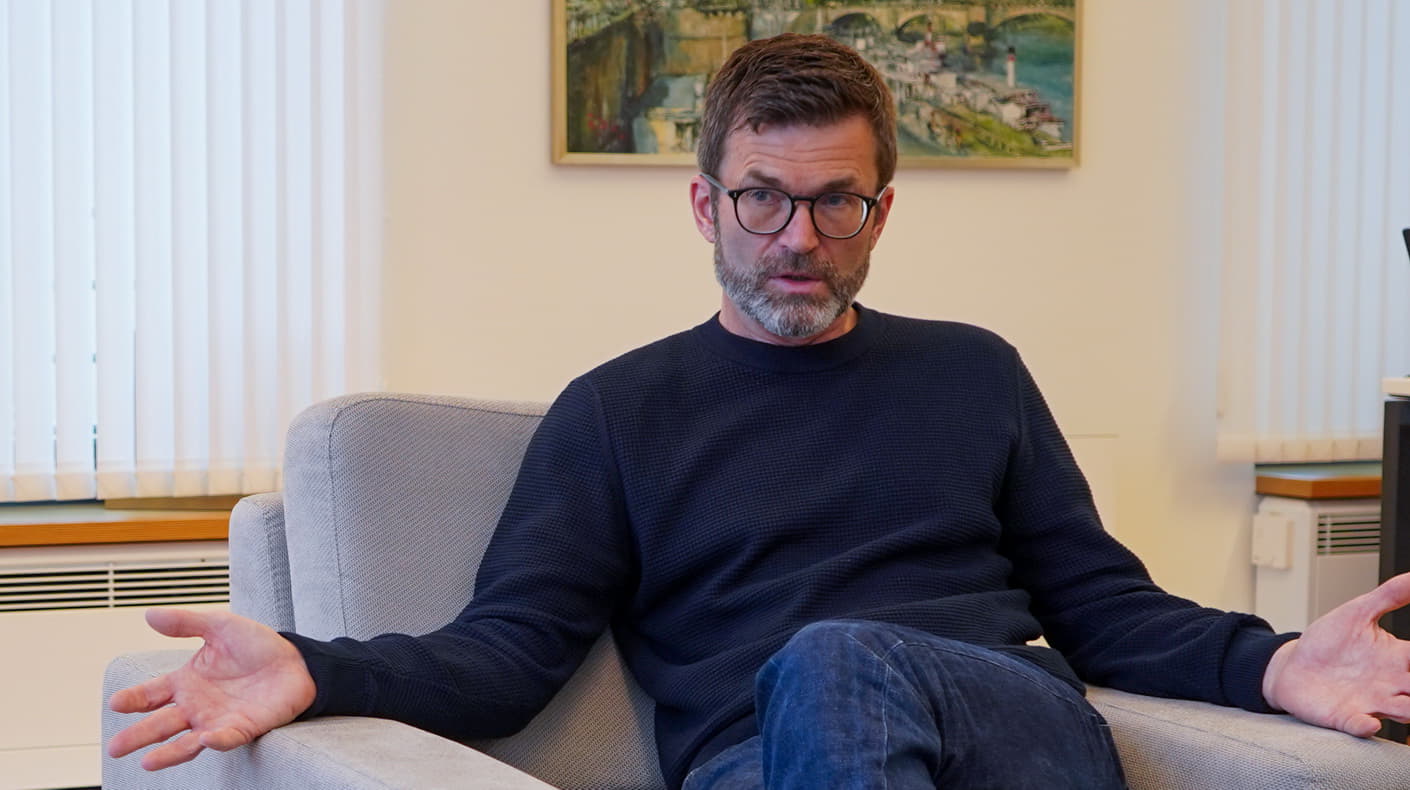
So we were happy to accept an invitation to discuss the issue with the German Ambassador to Kyiv, Heiko Thoms.
In this interview – which definitely deserves attention – the ambassador explains Merz’s motives and acknowledges that some elements (such as the name of the format) need to be adjusted, while others have been misunderstood in Kyiv. Berlin continues to believe that the idea is worth considering and has assured us that this is "the best proposal that will be discussed anytime soon for Ukraine".
It’s also worth noting that Berlin sees something positive even in Volodymyr Zelenskyy’s rather critical comments about the German idea.
"I understand the desire to become a member of the EU very soon"
I believe you have heard that Merz’s proposal did not receive an unequivocally positive response in Ukraine, haven't you?
Yes, there were a number of reactions which do not necessarily reflect the intention of the letter sent by Chancellor Merz. It’s a proposal specially designed and tailored for Ukraine, a country which is at war, which needs our support, which is receiving our support, and which will continue to receive our support. And one of the ways of expressing our support is to pave the way for Ukraine into the European Union.
For the German government, the goal is to get Ukraine into the European Union, and we want Ukraine to be in the EU as fast as possible.
And the proposal by the Chancellor, by the German government, is meant to speed the process up and give Ukraine additional ways of being represented in Brussels on your way to the EU. It’s something that we are not going to offer to other candidate countries because we want to reflect Ukraine's unique position as a country at war, which is still making great progress. You're one of the frontrunners among the candidate countries.
That doesn't mean that you cannot do better, but you're doing quite well.
The president of Ukraine, Volodymyr Zelenskyy, responded to Merz’s letter with scepticism. He said that Ukraine deserves 100% membership, and he reads the letter as an offer of "semi-membership".
It's very important to look at the facts objectively. Merz’s letter very clearly says that our goal is Ukraine's full membership in the European Union.
At the same time, I’d subscribe to every word President Zelenskyy says in his letter. There is nothing that I would not agree with.
The only thing that I believe is very important for everyone to understand is that there cannot be a discount on EU membership. And I believe that this accession process, with all the steps that need to be taken, is first and foremost in the interest of Ukraine and the Ukrainian people.
But I don't see the letter by President Zelenskyy as going against the proposal. On the contrary, I find that he, in his own way, expresses support for many elements of Merz’s proposal.
Our goal is shared.
We want Ukraine to become a full member of the European Union, full stop.
You want the same.
That sounds quite surprising. In Ukraine it was perceived differently, and I didn’t see that support in the letter either.
I can see it.
And I understand the desire to become a member of the European Union very soon. I see the negotiating position of Ukraine – that you want to define a date.
That's the only element where I believe we will still need to discuss more with Ukraine. I think it's important to understand that just mentioning a date will never be enough to join the EU. What needs to be done is to take the necessary reform steps. That’s why it's in Ukraine's own hands when the accession will happen. When Ukraine does its homework, Ukraine will be in the EU.
Has anyone else in Ukraine, apart from the president, shared their impressions of Merz’s letter with you?
Of course – we are in touch with many interlocutors here, including those who are steering the process. They understand the nature of the proposal very well.
"If Moldova stopped reforming, this would not harm Ukraine"
I believe that some elements of the Merz proposal should be amended. One example is the name "associated membership". You may have noticed that it met with widespread criticism here in Ukraine.
Yes, but I believe it's partially due to misunderstandings of the nature of the proposal. Because it is not a second-rate membership. It is not an intermediate status that then will become permanent.
I believe this name was also a mistake in communication terms. Ukraine has had an Association Agreement for over ten years, and "associated membership" is perceived as something we already have.
Yes, I can see that too.
But we are not married to that name. If someone comes up with a better name, we are for it.
There are still concerns that we could get stuck in that semi-membership position.
Look, there are only two possible pathways.
The first path, a standard one: Ukraine does the necessary reforms and joins the European Union and all the EU structures after all the benchmarks are fulfilled.
And a second path: Ukraine does the necessary reforms and at some point also becomes a full member of the European Union, but in the meantime you also get some additional elements of membership right now. That’s an option no other candidate country will get.
With this second path, you will be represented in the College of Commissioners, you will have members in the European Parliament, participation rights in the European Council, even observer judges in the European courts, and you will also benefit from the application of the acquis communautaire.
That means that we’re offering full membership, which is the desired outcome for President Zelenskyy, plus some additional elements.
The Merz proposal also reflects that it is not only your interest but also our interest to have Ukraine inside the EU. For that, we are bringing you as close to us as possible already today.
You mentioned that this is a unique scheme that would only be offered to Ukraine and no other candidates. It would mean that our "accession coupling" with Moldova would be broken. In Ukraine, decoupling is seen as a threat because we had a bad experience with the Hungarian veto, when decoupling was pushed for. Who knows whether it won’t happen again?
Well, indeed there were good reasons why there was this coupling, and everybody knows what the background is.
But in the end, for Moldova and for Ukraine, everything will depend on reforms. Now, if Moldova suddenly stopped reforming, this would not hold Ukraine back.
It’s the same in the other direction.
President Zelenskyy clearly says in his letter that Ukraine should stay within the same type of accession process as Moldova. Does Germany insist on the contrary?
I think this debate is rather a distraction because in the end, your membership will not depend on what another country is doing or not doing. It will depend on what your country will be doing in terms of implementing reforms.
If Moldova stopped reforming, this would not harm you. And the other direction as well.
"It's probably the best proposal that will be discussed anytime soon for Ukraine"
Chancellor Merz’s letter mentions that negotiating clusters should be opened immediately.
That's our clear intention. That's our political direction: we want clusters to be opened as soon as possible, and we want all clusters to be opened.
But every member state sees that "as soon as possible" differently.
Yes, absolutely.
But the opening of at least one first cluster might be a matter of weeks, if not days – that’s what we’re pushing for. You know there will be a European Council [meeting] in June, and it’s usually a moment when important decisions are being taken.
Only the first cluster?
That would be my realistic expectation now.
And for all the rest of the clusters, I believe we will also be making progress soon. But again, in the end, what is really important is not formal steps. What is important is changes in substance. And there Ukraine has homework to do.
We on our side also have work to do inside the EU.
As you rightly referred to, there were blockages of Ukraine in the past, which was also frustrating for us. And I believe that we are making good progress here. We are having very substantial talks now with some member states of the EU which will enable us to show progress with Ukraine in the near future.
When do you expect this scheme which Chancellor Merz is proposing to start working? When will Ukraine get that observer status?
As soon as it has been agreed by all member states.
I don't think there's any connection. I believe once a decision at the European Council or in some other format is taken and supported by 27 states, then it can be implemented immediately.
And there’s something I want to make very clear: the proposal by us, by Germany, to Ukraine is, I believe, the most concrete proposal that has been on the table yet. And it's probably the best proposal that will be discussed anytime soon for Ukraine.
The best one? What about the Lithuanian idea of granting Ukraine the status of an "acceding state"?
I was talking about realistic proposals among those on the table now.
And it's not a given, it's not self-understood that everyone in the European Union will automatically agree to this German proposal. This is something that we jointly need to work for.
Germany feels obliged to work on it. It’s our proposal, and we will do what we can to fight for it inside the European institutions, but of course,
we also need Ukrainian backing for this.
And of course it would be hard to convince other EU members that this is the direction we should take if Ukraine is not on board.
Let’s talk about reforms. There are definitely some reforms that are the most important. And possibly there are solutions that could unlock membership even before the full list is implemented, but when Ukraine is almost ready.
I agree. I think it will very much depend on the momentum that will be observed. And that has been the case also for other countries.
But still, there will be no discounts in the sense that we, in the end, will require less from Ukraine. That needs to be understood.
And that’s why it's so important that reform momentum is not lost. Ukraine has been a model candidate for many years, and now it's extremely important that we do not stop here or slow down.
Ukraine needs to reform further, and this is very much in the interest of the country and the Ukrainian people, who are demanding more transparency, demanding additional efforts in the fight against corruption, demanding more steps for fostering the rule of law in your country.
There are still things that Ukraine can do and that Ukraine must do.
"German IRIS-T systems are probably as important as Patriots, but less well known"
Russia is threatening Ukraine with new attacks. I'm happy to see that we are meeting here at the embassy and your staff are around.
We can also meet next week, and we will be here too.
We have absolutely no reason to change our presence here in Kyiv.
Ukraine needs additional support to protect its skies. And Germany is definitely number one among our allies in terms of providing air defence capabilities. How many Patriot systems have you already provided?
We intentionally do not disclose concrete numbers, but you're right that when it comes to air defence – but also, I believe, in almost every other respect – Germany is the number one supporter of Ukraine. That includes other forms of military support, support for the civilian sector, for the energy sector, fostering regional structures, administrative reforms, and also assisting you and standing by your side in the EU accession process.
Whatever area you name, even support for schools and frontline areas. And I don't want to mention the support we give to Ukrainian refugees in Germany.
Indeed, we can now fairly say that we are overall the number one supporter of Ukraine.
Speaking about air defence, indeed we have provided several Patriot systems.
Also, we help through the PURL mechanism [the Prioritised Ukraine Requirements List, through which US military equipment, including Patriot interceptor missiles, is purchased for Ukraine – EP], where we are again the largest supporter. Here we have been providing PAC-3 missiles, which are the most effective defence against Russian ballistic missiles. And we have now signed a deal about providing additional PAC-2 missiles, which goes into the hundreds.
Then I would like to mention the German IRIS-T systems, which are probably as important as Patriot, but less well-known. This is the most effective air defence means that Ukraine has against cruise missiles.
As you remember, last winter there was a minimum of energy infrastructure in Ukraine that could be preserved, and your air defence managed to do it in large part due to the IRIS-T systems that we delivered.
We all know that the situation in the winter was extremely difficult; our embassy also suffered from it, and we all stayed here. And I can say that if Ukraine hadn’t had that IRIS-T supply, the situation would have been worse. They proved to be very efficient, very often showing a hit rate of 100% against cruise missiles from Russia.
But again, we don’t share the numbers of systems we supply, and we do that intentionally. I can only say that we supplied several hundred IRIS-T interceptor missiles, and that’s going up.
Readers sometimes ask: why does Germany need to support Ukraine that much?
Frankly, that's a surprising question to me. I'm always being asked the question the other way around. But of course, I have the answer.
It's obvious that no country which is under attack by a criminal regime like the one in Moscow can withstand those attacks alone.
If you are under threat of attack from an actor which blatantly violates international law, which has such military means at its disposal, you need help from your friends. And we consider Ukraine not only a partner but also a friend, and we will continue to stand by your side.
As the Chancellor said once, Germany is acutely aware that Germany is not at war at this point in time, but we are also not living in peacetime.
Sergiy Sydorenko
Editor, European Pravda